Back in 2012 the FDA did approve another drug from Genzyme, who is owned by Sanofi for the treatment of multiple-sclerosis and the current drug they are seeing approval for has been approved in Europe, Canada and Australia. The Genzyme division of Sanofi produced the drug, Aubagio, which is a pill.
Lemtrada is an injectable drip drug and the company argues it would take 3 years to produce the trials that the FDA is requesting. It would seem to me that the pill would be a preferable treatment but again I’m no expert on MS drugs by any means. BD
Pharmaceutical company Sanofi, which owns Genzyme, will appeal a U.S. Federal Drug Administration (FDA) decision not to approve its multiple-sclerosis treatment Lemtrada at this time, according to a press release today, Dec. 30.
The FDA in a letter to Genzyme said its drug Lemtrada application can't immediately be approved because Genzyme hasn't submitted evidence showing its benefits outweigh its side effects.
Lemtrada already has European Union, Canadian and Australian approval and is under review in other countries.
U.S. Food and Drug Administration staff said Lemtrada increased the risk of autoimmune and thyroid diseases, including diabetes and cancer.
Sanofi is the parent company of Genzyme, which has offices in Cambridge and Framingham. French drug maker Sanofi purchased Genzyme for $20.1 billion in 2011 based largely on anticipated sales of Lemtrada.
The DNA tests the author had done were segments of DNA called SNPs and none were a complete sequence and you can read through her comments and the entire article at the link at the end of this post. Pretty amazing stuff when you look at how the interpretations read out. This is the same thing as with medical records with the more information you have and can relate, the better interpretation you will get. 23AndMe, who was told by the FDA to stop is one of her sources uses to read her DNA.
The companies choose which SNPs to read as well and some relied on different strands than others. This a case of segmentation and not having the big picture with all not being equal in the markers examined as some were a lesser number and some were more. A full sequence is probably around $3000 according to the article and there may be places that do it for less or more. George Church when he sequenced the famous first 10 individuals did a “full sequence”. Also mentioned here is Craig Venter with his synthetic genomics and he says the same thing, you need a full sequence to attain accuracy.
This holds true with a lot of what we see with data today, even outside of DNA tests as we have analytics that zero in on certain areas and don’t’ include other areas that touch and affect the data we are looking at. Any mathematician, quant or computer scientist will tell you right up front about the rate of errors with any such calculations. I always kind wondered why the company was called 23 And Me and it appears that there are 23 diseases that start in adulthood that can be treated where there are tests for them, and the rest we rely on DNA testing for insight. LabCorp does the lab work for 23AndMe who also has their own genetics institute and of course has their branches of retail labs across the US.
All in all the opinions here were to take such tests with a grain of salt and consider it entertainment. My deceased mother was an astrologer and being around it all my life, I took it as entertainment as well, so I guess the same idea here except no DNA for what she told me (grin). BD
My experiment ran into hurdles from the start. After I ordered 23andMe’s saliva test kit, which for $99 promised a report on more than 240 health conditions and traits, it turned out that I could not legally send it in; the New York State Health Department forbids any labs that lack a state permit to accept specimens from a health-related test. Luckily, my in-laws mailed it from their home in New Jersey.
Then I learned that the other two companies I planned to approach were no longer offering genetic testing. Additional research led me to two more: Genetic Testing Laboratories and Pathway Genomics. G.T.L. charged $285 for a report on 25 disease risks, and required a professional sample collector to draw blood; Pathway charged $399 for a report on 24 disease risks. (In 2010, Pathway planned to sell its saliva test kit at Walgreens, but abandoned the idea after the F.D.A. challenged the sales. Now Pathway requires a doctor to order a kit on a patient’s behalf.)
23andMe said my most elevated risks — about double the average for women of European ethnicity — were for psoriasis and rheumatoid arthritis, with my lifetime odds of getting the diseases at 20.2 percent and 8.2 percent. But according to Genetic Testing Laboratories, my lowest risks were for — you guessed it — psoriasis (2 percent) and rheumatoid arthritis (2.6 percent).
For coronary heart disease, 23andMe and G.T.L. agreed that I had a close-to-average risk, at 26 to 29 percent, but Pathway listed my odds as “above average.”
In the case of Type 2 diabetes, inconsistencies on a semantic level masked similarities in the numbers. G.T.L. said my risk was “medium” at 10.3 percent, but 23andMe said my risk was “decreased” at 15.7 percent. In fact, both companies had calculated my odds to be roughly three-quarters of the average, but they used slightly different averages — and very different words — to interpret the numbers. In isolation, the first would have left me worried; the second, relieved.
Scientists have identified about 10 million SNPs within our three billion nucleotides. But an entire genome sequencing — looking at all three billion nucleotides — would cost around $3,000; the tests I took examined fewer than a million SNPs.
We have one more announcing retirement and 41 years spent at CMS is a long time. What we are finding out now though is that folks who kind of grew up with jobs as such are ending up behind the “complex 8 ball” with the fact that there’s no “data mechanics logic” to draw upon for decision making. This does not mean they are bad people at all and it’s just the fact that technology has risen like the Phoenix bird and the demands are way beyond what traditional perceptions and thinking can handle, i.e. the “Sebelius Syndrome” as she’s right in there too at the top of all of it.
Back in 2009 I said Health IT would eat her up and to please consider someone with “some” data mechanics in their background to run the agency…and well…we got what we got. As you can read at the link below the CIO left a short while back so perhaps we might see more without the data mechanics logic consider the same as the pressure has to be phenomenal in not knowing what kind of logic to use for decision making and the release of Healthcare.Gov without calling it a beta to me made no sense. People would have a lot more sympathy for honesty and a bigger focus on the manual side of signing up with realizing the site was in fact a “beta” which means improvements are coming all the time. We did not see that.
When you read the article, Sebelius states she’s responsible and she is, no data mechanic logic there and she need no help from Issa as she does herself in, been in the press many times with everything from publicly taking on Dr. Hamburg at the FDA to getting DOJ Holder to write a letter telling doctor and hospital associations that they were all basically liars with medical billing. She has no “logic” and it shows as well as an underlying current of not liking technology much with wanting to “hurry up Health IT”…what’s up with that? I can’t for the life of me figure out what her own self perception is with all of this, again the logic is missing. Where’s the OIG going to get the expert Linux, Red Hat and other tech folks to audit all of this?
“The short order computer code kitchen burned down a few years ago and there was no fire sale”…the Medical Quack.
She’s not alone as we have Congress with same issues and so very frustrating, when in fact we live in the most complex times ever and they won’t educate themselves or seem to make any public effort to do so. So as I wrote a while back both government and consumers are getting a real cold hard lesson about the complexities, flaws, and the horrific data selling epidemic that exists out there today as well. BD
WASHINGTON — The No. 2 official at the Centers for Medicare and Medicaid Services, who supervised the troubled rollout of President Obama’s health care law, is retiring, administration officials said Monday.
The official, Michelle Snyder, is the agency’s chief operating officer, in charge of day-to-day activities and the allocation of resources, including budget and personnel.
Technology experts who built the website for the federal insurance exchange, HealthCare.gov, reported to her.
Ms. Snyder is the second administration official to depart since problems with the website frustrated millions of people trying to buy insurance and caused acute political embarrassment to Mr. Obama.
A former agency official who had predicted Ms. Snyder’s departure said Monday: “She had to go. She was responsible for the implementation of Obamacare. She controlled all the resources to get it done. She was in charge of information technology. She controlled personnel and budget.”
At a congressional hearing on Oct. 30, Kathleen Sebelius, the secretary of health and human services, was asked who was responsible for developing the federal website, and she named Ms. Snyder.
This is a small number but it’s better than nothing as it looks like the association did their homework with some obvious extreme cases as mentioned below with cutting two gastroenterology practices, the only ones in the region from their network. Since that was the case it appears perhaps the United decisions and algorithmic formulas used to make the cuts of doctors seeing Medicare Advantage patients came up short in the “big data” department as that’s part of the big complaint here, to not rule out all potential specialists and family practice doctors in regions, so patients don’t end up with big road trips to see a doctor when needed.
If you have been following this then you know there are more states than just Ohio affected here with Connecticut and New York included in the mass firings. As I said in a prior post “algorithm says”…
Meanwhile back at the ranch, United has invested around $9 million in low income property rentals in Ohio with HUD kicking in a little bit too, and in addition they invested another $50 million in a housing project in Minnesota.
The news article said below there could be more changes coming and the 10 practices represent about 75 doctors who are getting reinstated. Here’s what’s happening in New York with a new lawsuit filed there regarding the same issue. BD
About 10 practices representing roughly 75 Ohio doctors have been reinstated to UnitedHealthcare’s Medicare Advantage network in Ohio, in the wake of appeals by a physician-advocacy group.
But potentially hundreds of other doctors in the state, including a large ophthalmology practice that serves central and southern Ohio, have not had their terminations overturned, said Reginald Fields, spokesman for the Ohio State Medical Association.
Most of UnitedHealthcare’s reinstatements cover doctors in southwestern Ohio, including a 22-doctor gastroenterology practice in Dayton, where the only two large gastroenterology practices had both received termination notices. The other practice’s Medicare Advantage status with UnitedHealthcare remains under review, Fields said.
The association has been challenging UnitedHealthcare’s paring of hundreds of physicians from its Medicare Advantage network, saying such cuts would leave the large health insurer with an inadequate provider network for enrollees.
UnitedHealthcare has about 102,000 Ohioans enrolled in six Medicare Advantage plans. About 36 percent of Ohio’s 2 million Medicare enrollees are in Advantage plans.
For about the last 4 years I have written many, many posts about the subsidiaries of health insurance companies and where they fit in. As this article states the operations are said to operate separately but one thing they all have in common is that each subsidiary is responsible for putting profit dollars to the corporate conglomerate bottom line. Some subsidiaries are related in business functions. Some subsidiaries are in fact investors that put money into low income housing projects and partner with banks. If the name QSSI sounds familiar it should as they were one of the contractors, who later became the lead contractor with Healthcare.Gov. QSSI is a government contracting company that was purchased by United Healthcare about 2 weeks or so after they were awarded the contract to work on portions of the Healthcare.Gov project.
As you can see in the article below, the main contractor for the state of Maryland is also owned by an insurance company. Come to think of it, most Medicare contractors are owned by insurance companies, subsidiaries, so you will find subsidiaries in places you have never thought of before. Most insurance companies today also own their own VC companies as well where they invest money in start ups and other projects. As a matter of fact if you visit the SEC listings for United Healthcare, you will about 15 pages listing all their subsidiaries with everything from Chinese Hearing Aids, low income housing investments, software consulting, medical records software companies and so on. About 1/3 of the revenue for United comes in from subsidiaries that are not directly in the insurance business, mostly software and software consultants.
A few years ago the company integrated their revenue cycling with Cerner medical records as part of the system so there’s some licensing revenue that comes in to a subsidiary of United when a Cerner system is sold, as of course United is not giving away the software for free and that integration was announced before the name change from Ingenix to Optum. Also of interest the CEO of Optum Insights (United sub)spent a number of years at Cerner before going to work there. The Optum LYNX ED Charging application from Picis (another subsidiary) algorithm does the ER visit calculations with CernerFirstNet, their ER tracking and triage. In addition we have this new company that United formed, speaking of revenue cycling to work with Dignity Healthcare (link below) and they are busy hiring more folks to work on premise at the hospitals in this area. You will find Picis at many VA hospitals as they were already there before United bought them.
Optum and/or Optum Insights subsidiaries of United Health also make a lot of money selling data and they have for years as being one of the original companies selling prescription data, which does not full under HIPAA and has been used for underwriting assessments among other things. I watch what happens in the OC and in addition to being a subsidiary or a subsidiary of a subsidiary (aka tiered subsidiaries) they also own 51% or controlling interest of other physician’s groups and formed a new company with their Memorial Foundation to tier some additional interest, such as “Wave Imaging” and “SimonMed”.
Here’s a past post with a ton of links relative to United from my archives over the last four or so years…even some on here beyond what you see at the SEC, as again some of these are 51% controlling interest ownerships, kind of how they under the radar. LHI is another United owned government contractor that does disability work for the VA and is always looking to hire doctors to see military patients and use “their” software to add such medical records created to the VA VistA record system, big operation that also does healthcare deployment for the DOD as well such as group inoculations and physicals too. United by the way does have a “military” subsidiary that handles that end of their business and the Tri-Care agreement figures in there too and you may or may not remember that United sued DOD to get the Tri-Care West contract and there’s been almost nothing in public records to tell us what exactly was the case here and in getting the contract through a lawsuit as such, they put a Blue Cross subsidiary that had the contract out of business.
There’s also the Optum Practice Management medical records system sold under subsidiaries and yet one more subsidiary CanReg consults with companies trying to get their medical devices or drug introduced and approved by the FDA. In addition United/Optum also announced that it was ready to be the integrator for hospital systems purchasing Epic, Allscripts and GE Centricity, and since we have had issues with insurance exchanges I know more of you are now much more familiar with the job the integrator does with aligning all the proper technologies to work together and integrator or not the big complex systems today have issues so you can’ always say failures are due to the lack of having an integrator as look at Deloitte, CGI, and a few others that are having issues outside of the Federal government with state and other government entities with contract and performance failures. The company also created yet another subsidiary, a Medical Claims Clearinghouse to integrate with Epic.
So I would say that if the government is looking for potential conflicts of interest, the best place to start looking as at the 15 page SEC listing for one or they can search my archives here as I have a ton of posts about insurance company subsidiaries and it’s not just United but being they are the biggest there’s more of them.
New York though who has had some of the best success with their exchange went a completely different route with their selection of a contract, SCC or Computer Science Corporation who was not there to sit around and write open source code from the bottom up like many tried to do, but rather they are Gold partners for Oracle, Microsoft and many more and have the expertise to meet deadlines and know which technologies can work together. California chose an Oracle Gold partner for their design. I still feel bad for Oregon as that whole situation was not fair and as much as everyone is dogging on them, few seem to mention that when other contractors saw the scope of the work to do with at the same time as creating an insurance exchange…they walked (to include an IBM subsidiary company) and said “it’s yours Oracle”..again the legislature created that mess with wanting a rewrite of most of their social service in addition to the exchange with checking 1700 sources for eligibility where most exchanges were at 250 to 400, so an additional 9 months of custom code there.
Anyway, here’s a couple SEC listing links for UnitedHealthGroup aka United Healthcare and Optum.
We have no clue on what big conglomerates may or may not do with “data” though and if subsidiaries exchange and pool data, only the Query Masters know for sure but it’s a good question to ask today with everyone and talking about their big data as the big corporate conglomerate over all of them has the control to take care of business as they desire. So when it comes to involvement with exchanges, the data and the algorithms are the big items to question of course.
So it will be interesting to see what route Congress takes to investigate all of this with QSSI and the other truckloads of subsidiaries United owns or owns 51% controlling interest in. BD
When state leaders brought in a new company to help repair their troubled health care exchange, they went to one whose owner has a lot to gain from the sales of insurance plans under the Affordable Care Act.
The Columbia-based health care technology company Optum/QSSI is a subsidiary of UnitedHealth Group, which also owns one of the four insurers selling policies on Marylandhealthconnection.gov.
QSSI will help the state's main contractor on the exchange, Noridian Healthcare Solutions, which also is owned by an insurance interest — BlueCross BlueShield of North Dakota, which is independent of CareFirst BlueCross BlueShield, another of the companies selling policies on Maryland's exchange.
This is a bit of an updated as there has already been one lawsuit filed with other states joining in, more information at the link below. The Supreme Court made a ruling earlier this year that doctors could group together to litigate and that’s what appears to be happing there.
In the meantime, New York has decided to file their own lawsuit and again this is the same situation with doctors who take care of Medicare advantage patients being dropped. Patients will either need to find another plan where their doctor is in network or look for another doctor. In addition, travel for seniors is also a factor as in many instances a new doctor could be miles away from where they live.
Anymore the big conglomerates just look at their numbers and the decisions seem to be a matter of “algorithm says” and from what I have read on the web it’s even a bit more irritating as United seems to not be communicating with the doctors they are eliminating from Medicare plans. A couple years ago United did a mass firing of around 200 employees to where they received a text message to report to the lobby, and then all were loaded on to buses and taken to a hotel and given their walking papers, so again their methodologies with the “human” element at times are certainly questionable.
The company also does hospice and palliative care for profit via a subsidiary Evercare, they own so they want want the money from Medicare for taking care of many terminally ill seniors but it seems as until you get to that point if you are an “Advantage” subscriber, there’s not enough money in your body to put down to their bottom lines. BD
The Medical Society of the State of New York has filed a federal lawsuit asking the Eastern District court to intervene to prevent United Healthcare from dropping nearly 2,000 of the society’s doctors from its Medicare plans on Jan. 1, court documents show.
In a complaint filed Dec. 23, the Medical Society alleges the insurer terminated doctors’ contracts as Medicare providers in order to offset “reduced federal payments under the Affordable Care Act.”
We don’t know much about Centrexion Corporation other than to know it has raised several million. Dr. Campbell is a professor of Neurological surgery at Johns Hopkins. Stay tuned and from reading this article their efforts might be in the area of pain therapies, but don’t know for sure. Since his retirement from Pfizer, Kindler has also joined a VC firm, Lux Capital. BD
A group of heavyweight biotech industry executives, including the former CEO of pharmaceutical giant Pfizer Inc., have formed a new Baltimore biotech company.
Centrexion Corp. has raised a total of $23.4 million since its incorporation in February, according to recent Form D filings with the Securities and Exchange Commission.
Since retiring from Pfizer in 2010, Kindler has been an adviser to several venture capital firms. Campbell is the founder and CEO of Arcion Therapeutics, a Canton biotech company. Brady, Centrexion’s chief business officer, was chief operating officer at Arcion.
The CEO contributes to the hospital’s foundation and is one of the highest paid public officials and gets more than a million a year in reimbursement. I’d say this lacks a little transparency here. When you make that kind of money you can’t just “give”…but the pressure is on and it appears the CEO will be giving some of that reimbursement money back.
Washington Hospital is located in Fremont, in northern California. The CEO’s contract though states she is entitled to the reimbursement dollars. It is supposed to be a good showing of philanthropy to encourage others to also give but when one get’s reimbursed, it’s not really giving is it? The hospital is not getting any money out of it. This appear to be changing though and this practice seems to be going away soon and the article also stated the CEO does have some donations to where she was not reimbursed as well. BD
When charity calls, Washington Hospital CEO Nancy Farber has opened her checkbook, contributing to the hospital's own health care foundation, donating to service clubs and college funds, and helping to fund services for chemotherapy patients and a new brain and spine imaging system.
Then Farber, one of the highest paid public officials in the state with more than $1 million in annual compensation, submitted many of her charitable expenses to her public hospital district for reimbursement, to the tune of more than $20,000 over the last three years.
While an executive's business expenses are commonly reimbursed by public and private agencies alike, reimbursing charitable donations is outside the norm, government ethics experts say.
"Things like this cause the public to become cynical," said Judy Nadler, senior fellow in government ethics at Santa Clara University's Markkula Center for Applied Ethics. Noting that the hospital was in essence funneling money through Farber to its own foundation, she said, "That is not a very forthright way to get donations for the organization."
"It is all a publicity stunt, because essentially the hospital gets zero if they reimburse her," Jim Weil said. "Given her salary, she is in a position to make such donations without reimbursement."
Reimbursements received for all Fund a Need gifts will now be refunded by Farber, and her 2013 gift for the mammograms will not be submitted for reimbursement, officials said Tuesday.
Farber has been listed as a sponsor of many fundraisers and galas in websites and promotions, even though the hospital is actually footing the bill.
Ok this is the only time of the year I get to do this. Hope all had a great holiday and this is Otto, my new sentry hard drive guard:)
He’s a Weiner dog with a “Collie Coat”…a breed known as a “piebald”…the white comes from a recessive gene and breeders have been breeding them over a number of years and thus we have now have dachshunds with “collie coats”. Most of them end up with spots more like a beagle but his coat was on a mission. By the way he was a rescue dog as well that I gave a home to earlier this year…Weiner dogs I found out have their own rescue groups too. I was so lucky…..and will start the new year with my bud as well!
This is the Christmas message delivered to the citizens of the UK on Channel 4. If you have been reading the news, Snowden says his work has been done, with brining the awareness to the forefront. He still has more documents he could release but I don’t see any more of consequence to be released unless someone turns the heat on him.
If you here often enough then you the Medical Quack is privacy advocate and how frustrated I get with businesses and banks and their efforts that thwart our privacy as actually they reach out and touch you every day, where as with the government they decided when they might, but still both issues are important and we need privacy. Snowden makes mention that a child born today won’t even know a world without privacy, which is true with how technology has evolved. If you go back to the case with the former Goldman Sachs programmer and how bungled all of this has been, you can see the point Snowden is making here and he had to act because Congress could not he was quoted saying. The link below shows the digital illiteracy of the FBI, admitted by the agent and it’s not much better at the DOJ or with Congress.
I very much agree that Congress forced his hand as I have blogged for about 2 years about a couple items Congress could do to help themselves and it comes back to education and knowledge. For the life of my with the complex times we live in today I don't know why they in Congress seem to feel they know it all, as I'm in tech and I certainly don't so it boggles my mind why they stick with old perceptions out of the 70s or 80s and keep functioning that way while so many in the country, once you get past the OMG news that helps journalists keep their ratings, see it loud and clear. I have done many intellectual posts on this topic with ideas and not just a rant.
They could restore a great tool called the Office of technology Assessment (why the digital illiteracy of Ted Cruz rang so strong as he's the current poster child) and said when IBM Watson came out to explore the huge research and modeling tools it has to predict unintentional consequences when creating laws. Read the two links below on how Congress could be helping themselves. http://ducknetweb.blogspot.com/2013/09/jon-stewart-discusses-little-paper.html
You will never get them all but between having Watson or a comparable tool that can use speech recognition, even the lowest tech common denominator we elect can participate. Here's what they are...and again when help is there, you do wonder why they stick with old nonsense perceptions that simply are not true today. Read the link below and see how you get duped today. I included this link as duping is part of privacy violations. BD
This occurred in the pediatrics area of Summerlin Hospital and they didn’t realize the woman being treated had TB and died later, and an autopsy discovered the TB bacteria. She gave birth to twins and one of the babies died. Now letters have gone out for all who could have been exposed to come in for testing. One hospital worker has the active form of the disease along with one other patient. About 140 had contact with the hospital worker.
Class action lawsuits have been filed against the hospital. The video states the mother drank non pasteurized milk and that could have been at the root. 59 in all have tested positive but only the two were active to where they could pass the disease along and be contagious. Two antibiotics most commonly used are isoniazid and rifampicin. BD
Fifty-nine people have tested positive for tuberculosis after being exposed at a Nevada hospital neonatal intensive care unit, according to a report issued by the Southern Nevada Health District.
Dr. Christopher Ohl, an infectious disease expert at Wake Forest Baptist Medical Center, said an outbreak this large tied to a hospital is "extremely unusual."
"Unfortunately, this situation is a hospital epidemiologist's worst nightmare as neonates are highly susceptible to contracting TB and their infections can progress quite rapidly," he said.
A mother and her newborn twins died of tuberculosis at Summerlin Hospital over the summer, prompting an investigation by the Southern Nevada Health District.
Hospital staff didn't realize the infected woman had tuberculosis until after she and one of the twins died and they performed an autopsy, according to KTNV, ABC's Las Vegas affiliate. The other twin was in the NICU being treated without being under quarantine.
This is so well done and it’s the truth…I don’t know who did the words to Rudolph for this but they did a real good and factual job.
You have to absolutely enjoy this one…”but I had forget what my friends could have or have not”…”Charlie could not have cheddar cuz it clashes with his meds”…
“Everyone’s getting older and skipped the dinner all together and talked about their surgeries…BD
We all know what that old saying means when someone is trying to get “in to your pants” and now it’s not just people, it’s technology wanting to get into your pants every time you turn around. So let’s talk about what happens you leave you fly open as the old story goes you don’t know it’s open until someone tells you. I’m not talking about the use of big data for retailers to define their markets as that is helpful to see where interest lies and that was the basis of mining data to begin with and there is a plus side if done right that the consumer gets targeted information and not junk they don’t want, but in my inbox of late, it’s not happening very well today as some of the matching and analytics being done when it goes beyond targeting general demographics is getting flawed out there. If I write about something I don’t like, the key word is searched and I get email soliciting me for exactly what I don’t want.
I’ll give you an example here with how this has worked in a somewhat ridiculous way for me. My last name is “Duck” and you can’t go through life and be thin skinned and I’m not of course and I like to have fun with it when I can and to break the monotony I do some “off the wall duck posts” just because it’s about ducks and to add little entertainment here. Well there was one that ended up on Reddit about a study about the duck phallus. I thought it was a bit entertaining and thus blogged it as it said if you don’t use it, the duck loses it, real scientific study but at the same time a bit entertaining. Here’s the post from a couple years ago if you want to read it. All these marketers keep trying to get in my pants and I don’t possess one of those organs so the simple “male-female” data column to segment is not being used properly for one example to target.
Well guess what, due to that blog post I get bombed with erectile dysfunction emails about products, studies, and you name it because sex always sells, or is supposed to anyway <grin>. Ok so here’s the query masters looking at keywords like “phallus” in the content and guess how they all found me. This is where the problems lie today with some of this…they tell you that data mining will help you reach your audience, well I’m not a good audience for this topic with every frigging product someone develops and wants to market and again just added it for some different content on my blog. For those of you that are fans you might want to read the rabbit story I covered a while back as well where they have grown them for rabbits and perhaps this blog post added to the phallus marketing data mining as well.
Google got me too with not having a “machine compliant” name and their algorithms said I was a real “duck” and out of the blue suspended my account which I had to appeal, so all I did there was “use my real name” as their policy called for and their algorithms were flawed as they had not learned enough about the word duck being a surname in their dictionary, so because of that I was suspended for doing what they asked and they thought I was avoiding their “data collection” machine, so be aware of that if you are having babies and if you want them to grow up and use Google as they will need “machine compliant” names <grin>.
So moving on here I’m very aware of how SQL queries work and wrote tons of them myself and also spend over 25 years in sales and marketing so I try to see both sides of this. That’s why you might say the content here on this blog is different, more than one point of view and yes it makes my brain hurt at times too. So when I see these big data efforts out there I put two points of view together and this is what is written here. So in the case of MasterCard here we have this big news about how they are going to use big data and sure with creating indexing on their 30 years worth of data will help in many ways but it will also help them sell more data about us, not born under the cabbage leaf yesterday if you will. Here’s the new lab you may have read about in the news.
So I was now reading the article below again about MasterCard and their use of big data and what they are doing. Again they not alone as you will find these types of efforts all over the electronic financial world. So I’m reading along here and I learned something, that MasterCard has invested in a start up company MuSigma and there’s no dollar amount listed, so let’s swing over there and see what they do. Well they sell software platforms and don’t identify who their “big” customers are outside of telling you that Microsoft is one of their partners. Now you can’t really tell from this if in fact Microsoft is using their decision making analytics or if they are a provider of some of the solutions the company sells. All the other “Fortune 500” clients are “no names” to include a “large publicly head US insurance company” a “Top 10 commercial banking institution”, and the “world’s largest pharmaceutical company” and I put that into Google and came up with the name “Pfizer”…which may or may not be their client depending on who’s ranking who out there. Anyway you can look at the page from their site and create your own perceptions of who they are.
Notice the site says “do the math”…and talk about the “math” as well here quite a bit in many posts and even to the point to where this PLOS One study seems to have a lot of merit anymore with showing a study on how the financial world always wins as “the fear of math” seems to be giving most of us some real physical pain. Again the study has real MRI images and so forth that took a look at the stated phenomena.
Ok so MuSigma is in the analytics and data science business. There’s a lot of good that data scientists can create and this field is still so very new and again there’s the data mining side that wants to be in your pants as well as selling data makes money. A while back I had to agree with some banks from down under with what they had to say as they study what type of analytics to purchase in depth and based on what they were seeing and evaluating out there, the conclusion was reached that about half of what banks and companies were going to be investing in would be a waste of money perhaps they had already wasted some of their money as nothing like hands on experience can speak any louder. This was from February, link below, of this year. So again while all of this is taking place, can these folks please make it a point to stay out of my Internet pants <grin>. My body hurts from being shoves in and out of data cells, ok and being forced to join up with other data right now:)
Ok so I’m going to leave the MuSigma page and follow a link over to the MasterCard site to read up and get a little more educated on what’s going on here. So let’s see what they have to say over at the MasterCard blog, I like to read and be informed by all means, so I end up over here at the “Engagement Bureau”…how do you like that marketing terminology. Most of the time I’m writing about mHealth and all the folks over there that can’t figure out how to get patients to engage, which ties in with this as well as we don’t trust data sellers. Here’s a big info graphic on your “Online Persona”..what in the heck is this all about and why should I care is the first question that comes to mind.
I read further it says a study reveals there five online personas and a study that tells me how consumers look at them..ok I’m going to bounce back to the real world, I don’t think I can recall one consumer telling me how important their online persona is ok? Have any of you reading here done any research to find out about what yours is? If you have, please leave a comment and tell me what it means to you so I can learn up too. Just my opinion and maybe I’m off base but most of the folks I run into are more concerned about family, making sure there enough money to pay the bills, mortgage and so on..am I off target or is it really a persona that holds consumer interests? Here’s the page and see if this makes sense to you.
Do 64% of consumers believe their data has value, might be true as we all know everyone is selling it, and do 55% appreciate tailored offers? Well you read my story above and the flaws to me are killing this concept as a lot of the automated query masters kind of suck. Do you want to know or care which of 5 personas fit you? I’m getting this straight out of their “media” section. You can also read about the “cashless pioneers”… We if do do want to keep the data miners out of your pants, cash is still one of the best methodologies, that is without using a “savings card” where data gets collected. There are some other players in your pants that you don’t even know they are already living there like E-Scoring who through legal technicalities doesn’t classify itself as a credit agency and yet they mine and provide data about you to all kinds of entities.
Too bad we are looking at the potential of some digital centric laws to help protect consumers in areas like this. I’ve yet to see our consumer financial protection czar, Richard Corday do much and again you have low tech lawyer working outside his normal area of law in trying to build a data base to see how this works, another low well meaning low tech guy trying to help consumers in world where he has little math model and algorithmic understanding.
My big fears here too with efforts like restoring Glass-Steagall and the Volcker rule…just not digitally centric at all with no named IT infrastructure polices and thus we are probably getting just more low tech band aids as we have to rely on the level of digital intelligence that our lawmakers possess and this just gives the high folks more way and time to model new ways to get into our “Online Pants”or ways to sell us pants with defective zippers to leave the fly open. Sure we all like the convenience of digital payments but do we have to walk around with our fly open to benefit?
As digital marketing goes today there’s a strong push to get all to identify with brands and that’s ok except for when the push is too strong and we seem to get a little brain washed with forgetting to identify with humans and the more you identify with brands and the more brands you identify with it seems the less identifying with humans is taking place today with the virtual worlds we see online. So be careful and keep an eye on your fly and take notice when it is open as there’s lot algorithms out there waiting to get inside. Yeah, just what we need today, more algorithms getting in on the “fly”<grin>, so keep one word in your thoughts today and that is “context”, it is everything when it comes to your perceptions and those of others and it is what “really” leads to decision making processes and influencing and controlling the processes of others. Here’s yet one more example of health insurers looking for some open “flys”…by purchasing your Visa and MasterCard records as they are made available…and it’s not just to see if you are buying clothes a size larger as Blue Cross said as the reason for this methodology as your charge records could be you buying clothes for anyone, not just yourself and they don’t have to be in your “fly” to carry the word to educate consumers on obesity, as it’s really about data for sale as one data set gets queried, and re-queried and old again and again.
About a year ago I stated that big data used out of context stands to be the biggest discriminatory practice against consumers and from what I read with the data selling epidemic and the over use and abuse of segmentation models, there’s nothing stopping it and it is technology being used to profit and potentially abuse those who do not have access or understand how all of this works when you add on some one sided marketing, like as I mentioned the above, need to who WTF your “persona” is…as you don’t’ need a bank or a credit card to really tell you that as other humans still do a much better job of that.
Video clip from Emanuel Derman who used to help create black box code at Goldman chimes in, he’s now a professor at Columbia…Watch the full Quant Documentary in the footer…you’ll learn what math models are all about..
Be a skeptic when you need to be and don’t’ jump too fast sometimes and be aware of what’s happening around you even though you can’t see it running on servers 24/7 making life impacting decisions around every algorithmic turn today. If you want to dive in deeper and see how some of this is manifested in the media you read today, then check out the link below and you can go to the Algo Duping page when you have time to take in some videos that also help explain how the technology and getting a hold of your data for profit works. All the bills and proposed laws I have seen proposed are again nothing but low tech band aids as they offer no “index” to create the group that needs to be “segmented” and and regulated and the needs to buy a license to sell and distribute data would do just that, and then the proposed laws and bills could eventually have some “teeth” and some real consumer protection methodologies to provide more transparency and privacy could be realized.
I like data that makes me smarter but right now with all that is taking place out there today with math methodologies just just suck in consumer data to profit with little concern for ethics, all of this is really is having the opposite affect with me as increasing bank and corporate profits is not where my concern is today as I work to try and survive with the rest of the 99% population. Again with putting both a technology and marketing spin to all of this, as I spent many years selling for a Fortune 500 company too and thus so was exposed to the corporate machines, having a secondary focus really helps to see it for what it is as well as the technology mechanics that put it all in place. BD
It may be obvious that the massive credit card company MasterCard is heavily involved in big data. They have over 1.9 billion credit cards world wide that do over 65 billion transactions per year. They have over 32 million online and offline merchants that accept credit cards from MasterCard and 22.000 issuers and their credit cards are accepted in 210 countries. They use 700.000 rules to automatically clean, aggregate and augment their over 10 Petabytes of data. Apart from preventing fraudulent behavior and identifying and preventing fraudulent transactions before they occur, MasterCard applies big data in another innovative way. It knows what everyone buys, and they are using big data techniques to offer reports, insights, customer information and forecasts to their merchants.
The data that MasterCard obtains is, however, still not yet ready to use. With each transaction they receive data regarding the amount of the transaction, the merchant name, the time, date and the credit card number. They then strip the account number and make the data anonymous, according to Gary Kearns, group executive for the company’s information services business in an article on ZDNet. However, the problem is that the data obtained is messy, as the name of the merchant on a point-of-sale machine is a free-text field, resulting in many different names for the same merchants, retail chains or businesses. In the past years MasterCard has worked on creating the rules, algorithms and engines to clean such data and make it usable.
As a result MasterCard invested in the big data startup Mu Sigma, for an undisclosed amount. Mu Sigma is an analytics service provider and one of the most-funded big data startups currently. Together they will offer joint products using MasterCard’s databases and Mu Sigma’s analytics technology.
We are using math to fool ourselves. You don’t have to look far to see abuse of formulas and we are seeing this with some big math projects as again the incentive is there to “sell you a formulas that can make nonsense believable”…”the perfect butt” example is great…but think about this and the similarities you see out there in one article after another when journalists interview a data base and create “national news”…”it must be real because it has a square root in the formula”..”just the fact that the formula exists makes it believable and worth media attention” ..”numerical nonsense is everywhere”…watch the entire video in the footer..
This is what worries me now with the mounting news use of “content farms” to where an algorithm is programmed to read studies and interpret the the numbers…once it is done with a “formula” it becomes national news and gets media attention.
Just the fact that a formula exists seems to be enough today no matter how stupid or what nonsense it states professor Siefe states. Here’s another good article from Felix Salmon..”Why quants don’t know everything”..
“Once quants disrupt an industry, they often don’t know when to stop—and they create systems that encourage cheating. So let’s celebrate the value of disruption by data—but let’s not forget that data isn’t everything.”
I know right now everyone is in a race to get your attention and I’m not picking on the journalists by any means as they have click and stats they have to meet so they have to play the game and again having “content farms” invade and play along with the news is something else that we have to look at as far as what we are getting. I’m running away from a lot of it myself and they keep pouring more on. I do appreciate good journalist news and investigative reports, my favorites but this other entity party due to news agencies trying to make and not lose money is being tried as a cheap effort. Some of it can be good but as with everything it will be oversold for what it can do. Here’s another short clip from Mike Osinski…you can solve anything with software and by the way he’s the one who wrote the software that all the banks used and abused for sub prime loans. Watch the entire Quant video in the footer. We are still constrained by the real world.
And this is the attitude we see on both Wall Street and in the Silicon Valley, (video clip below) Mike Osinski again and you can imagine he felt some of this watching his software work, but again if you watch the entire video below you can also hear his disappointment in what occurred and how the pressure go to where he didn’t even know what day it was “as you can’t be wrong. When you are close to the money it’s like a drug and “you think you are a genius and you are just so much better than anyone else”, you are isolated from the real world who is struggling to pay the mortgage and keep food on the table.
So this is what is happening out there from a couple angles and it all has to do with money and ethics get the back seat here for us 99% for sure. So this is my concern for the news content for next year in how much of the content will be tweaked to “serve us what those who write code think we should see”…scary but it’s going that way as Forbes already has a “journalist bot” that goes to the web and write news articles and interviews data bases to present the value as it has been programmed to see with machine learning. By the way Forbes media is for sale and they are trying to get some money of course for the time they took to develop it. They are not alone with this type of automation as someone else developed software than can write books..the patent and information about the 100,000 books written can be found here…as any kind of content can be broken down into a formula and it comes with templates and is designed to avoid plagiarism…here’s how it works in the video…
Algorithmic Journalism
Mind boggling on what’s appearing out there …and where the news is going with automation. Again I still want humans when it comes to news as I am human looking other human input. This brings me to this link and an essay worth reading “On Being a Skeptic”..and there’s many more than me that see this coming, I just happen to want to talk about it and help explain where I can. These are the irresistible formulas that captures the media. BD
Ok so I’m using logic in the headlines here but it’s true. If you are not admitting as many patients then you can’t be re-admitting as many right? Of course I know the numbers and stats do look at how many of those who do get admitted end up back in the hospital and we have heard that drilled down our throats with CMS penalties. Here’s a past post that makes more sense with what the penalties involve.
You also have the “extensivist” position created to help keep patients out of the hospital and this is a human effort and not just straight analytics that HHS and CMS get stuck on.
But you also have hospitals building on to get more patients admitted so it’s the ER cash cow and coding versus what CMS and HHS analytics say…and and there’s pros and cons on both sides.
Puts the doctors in a jam though as you also have this, as seen in the video from a couple of years ago to where the hospital administrators wanted more admissions and that goes along with how empty beds they have and the doctors didn’t do it, so they fired them, so again doctors in hard spot here with taking care of you and keeping everyone else at bay so you can get the care you need. BD
When Hospitals Play Doctor
(Reuters) - U.S. hospital admissions in November were the weakest in more than a decade, under pressure from a change in reimbursement rules for Medicare patients and confusion tied to the problem-ridden rollout of Obamacare, according to a survey by Citi Research.
New billing rules for the Medicare program for the elderly and disabled require hospitals to treat patient stays lasting less than "two midnights" as an outpatient visit.
The video is good and you have a couple riders who talk about before and after the sensors were put in place and there’s plenty of signs it looks like so all are warned up front not to pee in the elevators. I can think of some places in New York that might jump all over this, as it’s been years but that smell came around here and there in areas of their mass transit system. I’m sure other cities have the same problem too.
This is also a health concern as well in public areas. People were tired of riding a urinal first to get to the trains. This is a trial and so far it’s working. If some one pees, a big flash goes off and alarms off “she/he peed”…and after the sensors were installed only one arrest has been made in a month so I think it must be working. It costs about 10k for each elevator and again something like this could have uses in other areas. BD
The city of Atlanta is looking to clean up the image, and the odor, of its transit system.
Many of its elevators have doubled as restrooms and smell like it. That's about to change with first-of-its-kind technology which catches "offenders" literally -- with their pants down. "The smell hits you so bad. You hold your breath just to hurry up and get off the elevator," said Alicia Porter, a rider on a Metropolitan Atlanta Rapid Transit Authority (MARTA) train. MARTA elevators have a smelly reputation. To get to the train, you often have to ride in a urinal first.
This is a big expenditure and if you look at the Responsys website they have some pretty big name clients onboard so in addition to marketing this might be a good move to ensure and drive more client connections with additional offerings. Complexities in marketing are growing too <grin>. The Eloqua platform has a ton of apps already available. On another note you may have also read where the Oracle Foundation is longer giving new grants out to further research relative to stopping the aging process, I guess Mr. Ellison as much as he has joked about it as well with interviews may have come to the conclusion that it’s going to happen one way or another and is letting Google do their thing with investing…so maybe he knows something we don’t:)
Again here the focus is on adding social data to evaluate and use and coordinate with CRM software, which Oracle has Siebel for. Here’s a video that explains what Responsys is all about. I can say at this point after watching the video, thank goodness I am not on Facebook, just my own personal preference though as it can eat up my whole day with nonsense. Anyway, interesting to see this acquisition and be aware more folks to buy and sell your data. BD
Software giant Oracle said Friday it will buy Responsys, a marketing software maker, for $27 a share, or $1.5 billion.
It's a 38 percent premium of the company's stock price as of Thursday's market close at $19.52.
The San Bruno, California-based company makes software that helps marketing professionals run email, social, and mobile campaigns. According to Oracle, Responsys' board unanimously approved the deal.
Responsys will join Oracle Eloqua. After the close of the transaction, Oracle said it plans to "aggressively invest" in the Oracle Marketing Cloud.
"Underbanked consumers"..who created that term, bankers of course. You hit on one of my campaigns and the poor are hit worse but everybody is getting it to include what's left of the middle class too. It's not only the data brokers but gee you have banks making billions selling your data, Larry Ellison even said that we should worry about what banks and companies do first and put the NSA issue at #2. Think of it, banks have 30 years of credit card data to sell and they are doing it, selling it to insurance companies, Blue Cross and United to name a couple. You have heard it from me for two years here, Larry Ellison and now Senator Rockefeller about the data selling epidemic.
The excuse from Blue Cross was pretty wimpy as they said they get charge card records to monitor and see if any of their policy holders are starting to buy clothes a size larger so they can stay on top of obesity and rush out to get in your face; however, what if the receipts are not clothes for you, duh? They use for every other kind of query of course and we know that.
It's an epidemic with easy money to be made and the buyers and sellers don't care if the data is bad as they have a free labor pool to fix it, us as we get stuck with no access if the data is wrong and have to fix it and they just keep on selling and making millions and billions, i.e. Walgreens make about a billion a year selling data so you figure out easily enough what banks are making..billions. Here’s more on how MasterCard is getting ready to see how they can use more data to generate more fees…
We need to license and excise tax all data sellers as you will never have any privacy laws work until this is addressed as the two are connected. It's because of the data selling easy money that privacy is so hard to come by. Content of this post link below and a lot more has been sent by me to the FTC.
The players are not just limited to Acxiom, Experian, Epsilon, Reed Elsevier, Equifax, TransUnion, Rapleaf, Spokeo, and Datalogix.....we need an index and buying a license to sell data would accomplish that. After all you need a license to drive a car, work at a doctor, sell stock, sell real estate, do hair, nails, and so on. This is one of the biggest rips hurting consumers and they can't see it, touch it or talk to it as the formulas and math models all run on server 24/7 and do the work as they are coded to do.
A couple years ago when the Occupy movement started, I said this is what it is all about, "The Attack of the Killer Algorithms" made possible by a lot of Algo Duping. I even have an Algo Duping page now with videos done by people smarter than me that are there to educate.
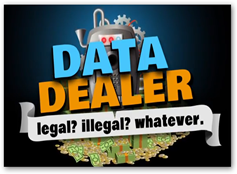
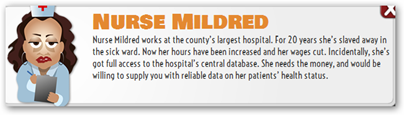
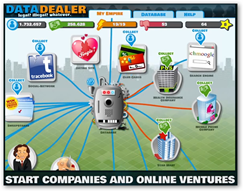
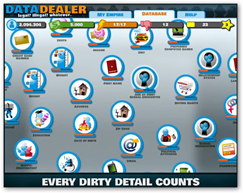
There's even a game looking for crowd funding to exploit how bad this is...video is pretty good, play "Data Dealer", "buy and sell the medical records purchased from a disgruntled nurse, set up websites and scrape and mine data, break in to other data miners sites and steal their data, just build it and they will come, insurance companies, banks, and so on"...If you like the video, they have a demo game here…if the data selling epidemic was not so horrific, this game would not exist.
Data Dealer…
Yes they are hawking on the poor and the middle class too and it's using technology and over segmentation to design for inequality to grow..sadly it's all modeled that way and time for all to wake up to that fact, including government as they are behind this 8 ball all the time as we lose because of that. This by the way is a big part of what keeps inequality going, it’s all math models and algorithms that execute. And we are blessed with yet another algorithmic math illit with the consumer protection agency too, gave him a chance but so far other than a couple small battles, Cordray is a big fail as he wants to build data bases now and learn and we are stuck again with someone like this running the consumer finance agency.
Here’s another from about a year ago where I stated this was going to be the biggest discriminatory attack on consumers, nothing like we have ever seen.
You cannot address any type of privacy or create any laws with teeth without an index and that would be a license…all proposed laws will fail miserable without it. Scroll on down to my footer and watch the 4 videos that will bring you up to date on how the math and modelers do it all and that’s what runs on servers 24/7 making life impacting decisions about all of us with either flawed models or models that lie for the sake of profit with little or no concern about ethics or who gets the short end of the stick. BD
Senate Commerce Committee Chairman Jay Rockefeller (D-W.Va.) said tracking by "data brokers" is worse than surveillance by the U.S. government.
During a Wednesday hearing on the data broker industry, Rockefeller compared data brokers’ tracking of Americans to government surveillance of Americans, saying the latter is less concerning.
“The [National Security Agency] is so secure in its protection of privacy as compared to this group that we’re talking to, these data brokers,” he said. “It’s not even close.”
Rockefeller also repeated accusations that three data brokers — Acxiom, Experian and Epsilon — failed to turn over information to the committee as it conducted its investigation into the data broker industry. The committee released its report on the investigation Wednesday.
“I’m putting these three companies on notice today,” he said, for “continuing to resist oversight” and failing to provide the requested information about where companies get information about consumers and to whom they sell that information.
 been approved in Europe, Canada and Australia. The Genzyme division of Sanofi produced the drug, Aubagio, which is a pill.
  as with medical records with the more information you have and can relate, the better interpretation you will get. 23AndMe, who was told by the FDA to stop is one of her sources uses to read her DNA.
  This does not mean they are bad people at all and it’s just the fact that technology has risen like the Phoenix bird and the demands are way beyond what traditional perceptions and thinking can handle, i.e. the “Sebelius Syndrome” as she’s right in there too at the top of all of it.
  gastroenterology practices, the only ones in the region from their network. Since that was the case it appears perhaps the United decisions and algorithmic formulas used to make the cuts of doctors seeing Medicare Advantage patients came up short in the “big data” department as that’s part of the big complaint here, to not rule out all potential specialists and family practice doctors in regions, so patients don’t end up with big road trips to see a doctor when needed.
 but one thing they all have in common is that each subsidiary is responsible for putting profit dollars to the corporate conglomerate bottom line. Some subsidiaries are related in business functions. Some subsidiaries are in fact investors that put money into low income housing projects and partner with banks. If the name QSSI sounds familiar it should as they were one of the contractors, who later became the lead contractor with Healthcare.Gov. QSSI is a government contracting company that was purchased by United Healthcare about 2 weeks or so after they were awarded the contract to work on portions of the Healthcare.Gov project.
  medical records software companies and so on. About 1/3 of the revenue for United comes in from subsidiaries that are not directly in the insurance business, mostly software and software consultants.
  and has been used for underwriting assessments among other things. I watch what happens in the OC and in addition to being a subsidiary or a subsidiary of a subsidiary (aka tiered subsidiaries) they also own 51% or controlling interest of other physician’s groups and formed a new company with their Memorial Foundation to tier some additional interest, such as “Wave Imaging” and “SimonMed”.
  for the DOD as well such as group inoculations and physicals too. United by the way does have a “military” subsidiary that handles that end of their business and the Tri-Care agreement figures in there too and you may or may not remember that
  insurance exchanges I know more of you are now much more familiar with the job the integrator does with aligning all the proper technologies to work together and integrator or not the big complex systems today have issues so you can’ always say failures are due to the lack of having an integrator as look at Deloitte, CGI, and a few others that are having issues outside of the Federal government with state and other government entities with contract and performance failures. The company also created yet another subsidiary, a
  the “human” element at times are certainly questionable.
 When you make that kind of money you can’t just “give”…but the pressure is on and it appears the CEO will be giving some of that reimbursement money back.



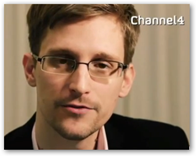 If you have been reading the news, Snowden says his work has been done, with brining the awareness to the forefront. He still has more documents he could release but I don’t see any more of consequence to be released unless someone turns the heat on him.
 out to explore the huge research and modeling tools it has to predict unintentional consequences when creating laws. Read the two links below on how Congress could be helping themselves.
  the woman being treated had TB and died later, and an autopsy discovered the TB bacteria. She gave birth to twins and one of the babies died. Now letters have gone out for all who could have been exposed to come in for testing. One hospital worker has the active form of the disease along with one other patient. About 140 had contact with the hospital worker.
  a real good and factual job.
 Ok so here’s the query masters looking at keywords like “phallus” in the content and guess how they all found me. This is where the problems lie today with some of this…they tell you that data mining will help you reach your audience, well I’m not a good audience for this topic with every frigging product someone develops and wants to market and again just added it for some different content on my blog. For those of you that are fans you might want to read


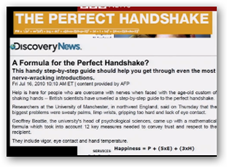 this with some big math projects as again the incentive is there to “sell you a formulas that can make nonsense believable”…”the perfect butt” example is great…but think about this and the similarities you see out there in one article after another when journalists interview a data base and create “national news”…”it must be real because it has a square root in the formula”..”just the fact that the formula exists makes it believable and worth media attention” ..”numerical nonsense is everywhere”…watch the entire video in the footer..
 back seat here for us 99% for sure. So this is my concern for the news content for next year in how much of the content will be tweaked to “serve us what those who write code think we should see”…scary but it’s going that way as Forbes already has a “journalist bot” that goes to the web and write news articles and interviews data bases to present the value as it has been programmed to see with machine learning. By the way Forbes media is for sale and they are trying to get some money of course for the time they took to develop it. They are not alone with this type of automation as someone else developed software than can write books..the patent and information about the 100,000 books written
 place and there’s plenty of signs it looks like so all are warned up front not to pee in the elevators. I can think of some places in New York that might jump all over this, as it’s been years but that smell came around here and there in areas of their mass transit system. I’m sure other cities have the same problem too.
  have some pretty big name clients onboard so in addition to marketing this might be a good move to ensure and drive more client connections with additional offerings. Complexities in marketing are growing too <grin>. The Eloqua platform has a ton of apps already available. On another note you may have also read where the Oracle Foundation is longer giving new grants out to further research relative to stopping the aging process, I guess Mr. Ellison as much as he has joked about it as well with interviews may have come to the conclusion that it’s going to happen one way or another and is letting Google do their thing with investing…so maybe he knows something we don’t:)
 market close at $19.52.
 nsurers Sell Tons of Data, Gets Flawed Data When Data Buyers Uses Out of Context Too
 until this is addressed as the two are connected. It's because of the data selling easy money that privacy is so hard to come by. Content of this post link below and a lot more has been sent by me to the FTC.
 do hair, nails, and so on. This is one of the biggest rips hurting consumers and they can't see it, touch it or talk to it as the formulas and math models all run on server 24/7 and do the work as they are coded to do.
  good, play "Data Dealer", "buy and sell the medical records purchased from a disgruntled nurse, set up websites and scrape and mine data, break in to other data miners sites and steal their data, just build it and they will come, insurance companies, banks, and so on"...If you like the video,
  segmentation to design for inequality to grow..sadly it's all modeled that way and time for all to wake up to that fact, including government as they are behind this 8 ball all the time as we lose because of that. This by the way is a big part of what keeps inequality going, it’s all math models and algorithms that execute. And we are blessed with yet another algorithmic math illit with the consumer protection agency too, gave him a chance but so far other than a couple small battles, Cordray is a big fail as he wants to build data bases now and learn and we are stuck again with someone like this running the consumer finance agency.
  to be the biggest discriminatory attack on consumers, nothing like we have ever seen.