Companies Making Big Dollars Without People – Healthcare Can’t Do That As We are the Product

This was in the LA Times and makes some very good points about economic times.  How are the companies making big dollars and yet unemployment is not getting any better?  Businesses today with technology are finding ways to increase profits without the rank and file workers, even companies imagewho are doing well are continuing to lay off as technology moves in and takes over functions that people used to do.  We have talked about this for years but today it’s a reality.

Healthcare is at an unfair advantage here, and yes there’s a lot of room for improvement, we are still the product being given care, we are marketed, and so on.  Certainly we are seeing some big changes with data systems, medical devices, etc. all heading in that direction, but it can’t move as fast as what other industries are doing as again it is all about us.   There’s a robotic scientist out there now creating it’s own drugs in the news lately, so even in areas where you think this is not possible, well, think again.  Healthcare too is following the trending of business with replacing humans with technology, but being we are the product, it is still the “human” business and there’s only so far you can go at a time and we are seeing major paradigms being changed every day.  How do we incorporate technology into healthcare without being overly disruptive?  That in my opinion is a million dollar question.

Maybe The Real Problem With The Economy Is That It Doesn't Need Us

Healthcare companies want to stay in business and make money of course, but how can they compete with other industries who can slim down quickly and that are not as dependent on research and development, that touts break throughs almost every day it seems?  The jobs that have moved overseas due to cost are not coming back here, unless we can compete with the same payment structures, and in most cases, we can’t. 

I report quite a bit here on medical devices, and recently quite a bit about those that create data, data that can be used in health records for better care and this is one big mixed bag on it’s own.  There are very few laws out there that add much protection when it comes to privacy too as how do you regulate new technology that is bursting at the seems.  How does a hospital budget for this?  Nobody has come along and figured this out yet.

How are we all going to live with some of these devices that used to be a human talking to us?  How is the data going to be used for better healthcare and how it is going to be potentially used against me?  We have to not deny that side exists as well with all the emphasis on cutting costs.  We read about it all the time in the news with algorithms and scoring procedures denying claims. 

“Department of Algorithms – Do We Need One of These to Regulate Upcoming Laws?

We also have members of Congress out of touch with where technology is headed as in this post below, with asking Health IT companies for information that is ambiguous, read a little and some of the paper it was probably written upon could have been saved and I slated that using some social networks would have put the Congressman right in touch so much faster than the process of asking for some of the information he inquired about, and perhaps he may have asked for different information if read up enough. 

Chuck Grassley’s Questions for Health IT – He Should Use Social Networks As Most of His Answers Can Be Found There

The bottom line is that corporations don’t need as many human resources as they used to and this happens quickly sometimes too, so where do all the displaced people go, Wall Street isn’t giving us any answers either.  The disparity on the economy linking back to the way it once did with investors is pretty much gone. 

This just really makes more of a case as to why healthcare should not be money driven, it just can’t catch up with the rest of the world and probably will always be a step behind, and much of this brought about by necessary regulations and conditions that NEED to be there for our protection as well.  Now add in the “daily breakthrough” for the day and the job gets just a little bit tougher.  BD 

Times still are hard out there for workers, but corporate America overall has been managing remarkably well -- as reflected in share imageprices.
Many companies, for example, have benefited from investors' robust appetite for bonds this year as credit markets have loosened. As long-term interest rates have dived, investors have rushed to lock in yields on fixed-income securities.

Westlake Village-based Dole Food Co. was able to go public on Oct. 22, selling 35.7 million shares at $12.50 each. Its investors may be having buyer's remorse, with the stock at $11.74 on Friday. But that doesn't matter to Dole at the moment: The $446 million the firm raised allowed it to pay off a chunk of debt, boosting its credit rating.
Probably the most important element of support for stock prices since this spring has been corporate earnings reports. Though many companies still earned less than they did a year earlier, before the economy crumbled, results have handily beaten investors' expectations.

Jobless Americans, understandably, would prefer to see some of that cash spent on hiring. But we know from government data on employment that many companies either continue to shed workers or remain reluctant to add staff, even amid signs that the recession is over.
Allen Sinai, head of Decision Economics Inc. in New York, believes that corporate managers may be surprised at how well their companies are faring even after deep reductions in head count.
”They're making good money without people," Sinai said, in what may be only a modest overstatement.

For stocks, a correction may come, but probably not a calamity -- latimes.com

Mom Who Lost Hands and Legs At Hospital 6 Years Ago Depends on Help from Children

This is a sad story indeed when you look at all this woman went through, after being misdiagnosed at the hospital when she had a kidney stone and was sent home.  Her 2 children help her get the day started with helping her put on her hands and legs, and thank goodness she has those.  The court case is being appealed so that portion is not over yet.  Miscommunication and different diagnoses between doctors lead to her being release.  You almost want to cry when you hear her daughter state that she is mad with “God” for letting this happen. 

She lost her job and her marriage through all of this too.  Nice to see the video with her great attitude and moving forward as this has to be difficult and a big chore just putting herself together every day with the help of her kids.  BD


(CNN) -- Every morning, Lisa Strong's 10-year-old son lifts her heavy prosthetic legs and screws them into the levers in her knees. He reaches for a pair of pants and pulls them up around her waist.

Then, at the bathroom mirror, her 11-year-old daughter gingerly wiggles into the space between her mother's arms, which are big and bulky and plastic, stiff like a mannequin's. The girl twists a tube of soft pink lipstick and glides it over her mother's lips.

But miscommunication between doctors and different diagnoses eventually led to her being discharged without having the kidney stone treated. That led to a rare tissue inflammation called "the line of demarcation," seen as a darkening of the skin in the extremities that slowly creeps upward.

"My fingers were turning black and curling. They looked charred," she said. "My toes were turning blue and black. It wouldn't stop. I had no idea what was happening to me," she recalled.

Kids care for mom without arms, legs - CNN.com

The Health Internet – Government Looking to Expand The National Health Information Network For Public Use

The National Health Information Network already exists and to date has never been tested for the public to use, but the move to shift all of healthcare to it’s own network is a big one, so imageI would guess you could think of a separate entire entity here, used for healthcare information only.  The government has had several Code-A_Thons” for developers to write code and create new algorithms.  I wrote about this a short while back.  Doctors from the military currently use the network as well as Social Security to exchange medical record information. 

 HHS sponsoring a “code-a-thon” to improve the connect gateway ...

There’s another Code-A-Thon coming up in November in Oregon. image

“The November Code-A-Thon will be held on the West Coast and has moved to a two-day format! Portland State University and Oregon State University are co-hosting the event to be held on the Portland State University campus at the University Place Hotel.”

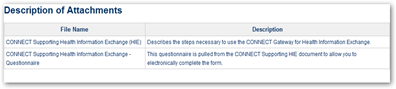
The Connect site has documents on how to use the open source software to create a Health Information Exchange, so again perhaps we will eventually see the health record exchanges as we know them today, moving to the Health Internet when it can be retooled for use outside the US military.  The open source code can be downloaded by anyone.  BD 

image 

Hoping to provide the backbone for a grand plan to put the nation's medical records online, federal officials have been quietly retooling an obscure government data-sharing service into a robust new Health Internet.

The concept has drawn intense interest from technology firms, including Microsoft and Google, which are scrambling to find new--and profitable--uses for digital medical records and the cyber health-care services they are starting to spawn.

Aneesh Chopra, President Obama's chief technology officer, and Todd Park, who holds a similar position with the U.S. Department of Health and Human Services, previewed the plan late last month to an enthusiastic audience of health information technology professionals in Boston.

The administration hopes the Health Internet could be in operation by early next year and that its technological infrastructure will encourage millions of people to more readily exchange their medical records with doctors and hospitals online. Technical barriers and concerns about privacy have so far kept most people's health data in closed networks or paper files.

Like the Internet itself, the existing health data-sharing service -- called the National Health Information Network -- was created for government use, in this case to allow doctors to exchange medical information from veterans' and military hospitals as well as for speeding up processing of Social Security disability claims. Though it's never been tested for wide public use, officials expect to quickly retool it to do so.

The system relies on open-source software called CONNECT, which was developed by more than 20 federal agencies to share health information. Officials have spent millions of dollars on the system, but expect to adapt it for public use at little additional cost.


Microsoft, which makes personal health records software called Health Vault, agrees. Google has a similar free product called Google Health. Both firms in recent months have announced partnerships with online health care ventures ranging from pharmacy services to companies that deliver medical care by videoconference.

Earlier this month, Google announced a deal with Florida-based MDLiveCare, which offers doctor consultations by video, phone or email. The company charges a monthly membership fee and $35 for a doctor consultation, according to its Web site. Patients can use Google Health to send their records back and forth to these doctors and other health-care providers. Microsoft has a similar arrangement with a company called AmericanWell.

Sean Nolan, chief architect and general manager of Microsoft's Health Solutions Group, said the Health Internet offers a "really great opportunity" for consumers to assume more responsibility for their health.

Microsoft expects this digital revolution to both improve the quality of medical care and "make it a ton more efficient. Both can happen at the same time," Nolan said. As an example, he said that massive amounts of data collected from patients can help health officials spot adverse drug reactions more quickly, thus saving lives.

He acknowledged that personal health record firms might sell patient data to drug companies and other health researchers, but said that Microsoft would never do so without the patient's consent. A Microsoft fact sheet on HealthVault says: "We do not use your health information for commercial purposes unless we ask and you clearly tell us we may."

Government Pushes To Create A New Health Internet

15 States Including California Are Suing Amgen – Alleging Kickbacks and Overfill Billings to Boost Sales of Aranesp

The drug, Aranesp is used with chemotherapy and chronic renal failure to increase red blood cells and was approved by the FDA in 2001. We are hearing more about drug marketing today and now it’s spilling over to the “biotech” drug companies for investigation.image

The suit states that providers were bribed and taxpayers we left footing the bill for sample products and some patients may have been over dosed without clinical cause.   The drug is one of the top sellers for Amgen and recently sales have dropped, as which has happened with many drugs today, over concerns of side effects.  Anemia drugs are the largest expenditure for Medicare.  The overfilling process is at the heart of the matter with billing with one nurse that was paid more than 31k for her influence with encouraging others to use the drug.  If the overfill amount was provided free with the samples, why was it billed appears to be the question here. This one looks complicated to me and once it’s in court who knows where this one will go, one more legal suit questioning the marketing and validity of pharma.  BD 

The suit alleges that the Thousand Oaks biotech company offered medical providers kickbacks to boost sales of its drug Aranesp, leading to fraudulent claims for Medicare and Medicaid reimbursement.

New York, California and 13 other states are accusing biotech giant Amgen Inc. of offering kickbacks to  medical providers to boost sales across the country of its anemia drug Aranesp, which increasingly has been beset by safety concerns.image
In a suit filed Friday in federal court in Massachusetts, the states accuse Amgen sales representatives of encouraging doctors and other healthcare providers to bill insurers for Aranesp that the practitioners received free from the company, according to a statement issued by New York Atty. Gen. Andrew Cuomo.

The suit also alleges that Amgen, of Thousand Oaks, conspired with two other defendants -- drug wholesaler ASD Healthcare and group drug-purchasing network International Nephrology -- to offer "illegal inducements" to medical providers to increase sales of Aranesp. These allegedly included sham consulting agreements, weekend retreats and other rewards.

The lawsuit against Amgen focuses on a practice known as "overfill." Aranesp is often sold in one-dose vials. Pharmaceutical industry standards require that drug makers include a small amount of medicine in excess of the prescribed dosage -- known as overfill -- in such vials, according to the suit.

The states involved in the lawsuit accuse Amgen of violating a variety of state laws, including fraud, false claims and unjust-enrichment statutes. The suit is seeking triple damages and civil penalties, which in some states amount to $10,000 per violation.

California among 15 states suing Amgen over anemia drug -- latimes.com
FDA Warns Proctor and Gamble – You Can’t Market Cold and Flu Medicine Combined with Vitamin C as It is Illegal

If you liked having vitamin C in your cold and flu medication from Vicks, well it looks like some changes might on on hand here as the FDA states that Vitamin C lacks sufficient data as being effective in preventing or treating a cold.  That’s right, you read this correctly, so if you have a cold or the flu and want to take vitamin C, go buy a separate bottle.  I know myself I take Vitamin C when I feel a cold or flu coming on.  Recently in the news Proctor and Gamble has been looking to get out of the “prescription” medication business.  image

Not too long ago we also were told that Cheerios, due to their advertising was also considered a “drug” by the FDA, so you can see how the interpretation on being correct is now being scrutinized by the FDA to ensure accurate information is being given to the consumers.  In order to un muddy some waters here, it appears that they are maybe trying to clear the advertising so individuals don’t mistake misreading of labels and perhaps think that Vicks could be viewed as a vitamin supplement?  So don’t go looking to Vicks for vitamin supplements it appears.  I’m sure there will be more news to follow, and according to the article here, this is not the first warning received.  BD 

FDA: Procter & Gamble Unlawfully Marketing Two Vicks Cold and Flu Medicines Containing Vitamin C SILVER SPRING, Md., Oct. 30 /PRNewswire-USNewswire/ -- The U.S. Food and Drug Administration today sent a warning letter to Procter & Gamble notifying the company that its Vicks DayQuil Plus Vitamin C and Vicks Nyquil Plus Vitamin C are illegally marketed combinations of drug ingredients and a dietary ingredient. (Logo: http://www.newscom.com/cgi-bin/prnh/20090824/FDALOGO ) Both of the over-the-counter (OTC) medicines, which contain vitamin C in addition to several drug ingredients, are marketed as treatments for cold and flu symptoms. The FDA took the action against the Cincinnati-based company: -- To clarify that these single dosage form combinations of drug ingredients and dietary ingredients legally cannot be marketed because they have not been proven safe and effective, and -- Because the agency previously determined that there are insufficient data to show that vitamin C is safe and effective in preventing or treating the image common cold.

Under its OTC monograph system, the FDA allows some OTC drugs to be marketed without agency approval. Such drugs must comply with applicable monographs,which are regulations that set requirements for the drugs' labeling,formulations and indications. The two Vicks products do not comply with theapplicable FDA monograph and must first be evaluated and approved under theFDA's new drug approval process to be legally marketed.

FDA: Procter & Gamble Unlawfully Marketing Two Vicks Cold and Flu Medicines Containing Vitamin C | Reuters

Myriad's BRACAnalysis Tests Scrutinized by Insurance Carriers – Many Do Not Qualify and Myriad Marketing Questioned

I believe everyone probably remembers when this test first became available for women to see if they would have a genetic background that would see if they had a risk for developing breast/ovarian cancer.  As time moves forward we now have additional information and the insurers are analyzing the women and the information they are receiving from such tests.  Humana and Aetna are also looking at the requests received for the test. 

image

Originally when the test came out, it was certainly viewed as valuable and still is, but the question lies on who really needs the test, again with additional information collected and recent reports on questionable over treatment of breast cancer in some areas.

Marketing of the test is now being questioned along with being sure that women are actually getting the correct and enough decisive information to impact treatment decisions.  Myriad, the company with the rights to the test of course still wants to maintain market share of providing the test and there have been a couple recent challenges in this area too with other companies wanting to participate and not have proprietary set of algorithms done just at one company.  Again, as in much of healthcare as technology and research moves forward, we are looking at potential change here, and the company of course is looking to keep the testing process as is so as not to lose revenue.

The Genomic Test for BRACAnalysis (Breast Cancer) To Be Scrutinized by United Health Care

I think the questioning here of the test somewhat shows how genomics is evolving with the additional information we are getting and more so how it interfaces with patient care.  We talk about being overloaded with information today, and the field of genomics is no exception in the amount of data the processes that are run to get to the core information we are looking for to work our way into better personalized medicine.  As you can see from the diagram below, it’s not one simple test but has 3 different focuses.  BD 

image

Several insurers have instated prior authorization, prior notification, and mandatory genetic counseling procedures prior to covering Myriad's BRACAnalysis test to ensure that the test is being given to the right patients.

Data from two national insurers, Humana and Aetna, shows that around 20 percent of requests for the test do not meet requirements for BRCA testing under their policy. A United Healthcare official has cited competitors' data suggesting that as much as 80 percent of requests for Myriad's BRCA test are withdrawn after pre-certification and genetic counseling procedures are conducted.

According to Sue Friedman, executive director of the patient advocacy group Facing Our Risk of Cancer Empowered, a growing number of breast and ovarian cancer patients are reporting instances of receiving either too little or the wrong information about their genetic risk for developing cancer from commercial firms

Insurers Tracking Unnecessary Testing with Myriad's BRACAnalysis Tests | Pharmacogenomics Reporter | DxPGx | GenomeWeb

Healthcare Sit Ins Continue For Mobilization for Healthcare - United Healthcare CEO Agrees to Meet With the Group

The sit ins this week were at Human, Blue Cross and United Healthcare and apparently with the help of cancer patient Robert Darling who was imageinquiring about his bone marrow transplant where he’s been waiting with no communication for 5 years from anyone other than assistants who could not make or relay a decision.  They were able to get the attention of a employee of United who relayed the message that the CEO of United Healthcare would meet with the group within a week.  The peaceful sit ins this week in San Francisco put the building under lockdown.  More arrests were made this week with people refusing to leave and peacefully arrested for being on the premises. 

Video from Rhode Island Sit In.

image

You can read more about the activity from a couple weeks ago at the link below.  There are both retired and active physicians and nurses participating in this group as well as consumers.  Earlier today I had posted about Aetna’s CEO getting some trick or treaters with their issues and notes left on his doorstep.  Stay tuned as the movement for single payer progresses.   BD

Mobilization for Health Care for All – “Sit Ins” At Health Insurance Offices Campaign Supporting Single Payor Plan

Yesterday [Oct. 28th], the next wave of the Mobilization for Health Care for All began with great success. See below for a list of media coverage of the actions.
In 11 cities across the country, hundreds of everyday Americans who want Medicare for All confronted the insurance companies and demanded that they redirect the money they're spending to control our democracy to pay for the care they deny to their members. Almost every company refused to even talk to us, and 37 people were arrested including doctor Matt Hendrickson at a Cigna office in Glendale, California. Dozens more - like the 30 people who blockaded the Blue Cross office in San Francisco for hours - sat in but weren't arrested. 

image

In Rhode Island, however, the protestors who joined cancer patient Robert Darling in occupying the UnitedHealthcare office won the first concessions of our campaign - a company representative agreed to give an answer to Robert about paying for his previous bone marrow transplant within 24 hours and to arrange a meeting for the group with the UnitedHealthcare CEO within a week! After 115 arrests in 18 cities, these companies are starting to feel the heat of our movement. And with more than 900 people now signed up to sit-in, this battle is just beginning.

image

Today, the Mobilization continued in Louisville, Kentucky and Baltimore, Maryland. The brave folks in Louisville are in the 9th hour of their sit-in inside the Humana headquarters as we send out this email. Humana is trying to wait them out, but may are prepared to stay overnight if they have to.
In Baltimore, four people were arrested at a CareFirst (Blue Cross) office including two doctors. One of those doctors, Margaret Flowers of the "Baucus 8," has withheld her name and is planning to stay in jail until the CEO of CareFirst, Chet Burrell, agrees to a public meeting with her.

Dollars & Sense blog: Next Wave of Health-Care Sit-Ins | Dollars & Sense

23andMe Personal Genomics Company Lays Off Some Workers

The reason for the layoffs was slated to current economic conditions.  I think what the company is trying to do is in the long run a good thing with bringing an awareness and information to consumers, but still maybe a bit of a luxury item with many just trying to get by at present.  23 and Me is a consumer DNA company that analyzes and provides information on 119 disease traits and ancestry.  About a year ago the company put out a nice post addressing if Jimmy and Warren Buffett were related, a good read.  BD 

Personal genomics company 23andMe Inc. has reportedly let go of a number of workers.image

The TechCrunch blog said the company started by Anne Wojcicki, the wife of Google Inc. founder Sergey Brin, offered the following explanation:

"We have reduced our staffing levels in a restructuring of our work force. This was a very difficult decision, but one that we felt was necessary to achieve 23andMe's long-term business development goals and maintain our strength in the industry.These cuts, which are a reflection of the current economic environment all companies are facing, will allow us to continue to invest in the growth of our Personal Genome Service and research endeavors."

In addition to backing from Brin and Google (NASDASQ:GOOG), Mountain View-based 23andMe has been funded by Genentech Inc. and Menlo Park-based New Enterprise Associates. Genentech was acquired earlier this year by Roche Holding Ltd.

Layoffs reported at Google-backed 23andMe - Silicon Valley / San Jose Business Journal:

Dennis Hopper Diagnosed with Prostate Cancer – Cancels all Travel and Production Plans

He had several filming commitments in action and hopefully full recovery is in the making for him, no word on whether the diagnosis is early or late imagestage.  BD 

LOS ANGELES - Dennis Hopper has been diagnosed with prostate cancer and is canceling all travel plans to focus on treatment.

Manager Sam Maydew says the 73-year-old actor and artist is being treated through a "special program" at the University of Southern California.

Asked about Hopper's prognosis, Maydew said, "We're hoping for the best."

Manager: Dennis Hopper has prostate cancer (AP) - Yahoo! Movies

SEEDIE – The Society for Exorbitantly Expensive and Difficult To Implement EHRs Submits Meaningful Use Recommendations

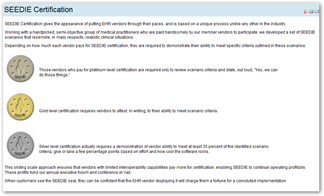
This site has been around for a while and looks like they have made some updates.  We all are so involved in getting digital health records on the map imageand this group takes a different look at the entire situation with a bit of humor.  Their EHR of choice is Extormity and it is worth the time to check out the pages of the site for some chuckles, but, some of what is published is really true, when you think of all the frustrations and issues that come with electronic medical records and the implementation processes.  We see it every day on forums and everywhere else on the web.

The site states they have a real deep focus on the word “meaning”.  We all would like to know more about that one too.  What is meaningful in one person’s opinion could be meaningless in another’s eyes so putting all this together is a big chore to say the least.  They want to make your perpetual investment a happy one, great humor and satire here. 

image

From the website:

Brantley Whittington/CEO

“My sole focus is on maximizing shareholder value, period…oh, and improving patient care, too.”

Whittington, a former Wall Street hedge fund manager, has a keen interest in EHR technology that dates back to a 2004 analyst report projecting exponential growth in the healthcare IT sector. Whittington provides leadership and vision, balancing perceived customer needs with the very real demands of Extormity investors.

Oliver Brindle/CTO

“Live long and prosper.”

Brindle, a surviving veteran of the vacuum tube and punch card era, is a leading expert in the Fortran programming language. In addition to writing proprietary code and maintaining Extormity’s complex operating architecture, Brindle is responsible for deciphering confusing industry acronyms including HL7, CCR and CCHIT.

Dr. Sonny Bartram/CMO

“I may have graduated last in my class at the Medical School at Universidad de Guatemala, but the parchment still says MD.”

Bartram, a retired GP, has authored and submitted a number of articles to peer reviewed publications on the financial consequences of serial malpractice suits in a general practice setting. Bartram’s recollections of practicing medicine bring a real world perspective to Extormity products and services.

image

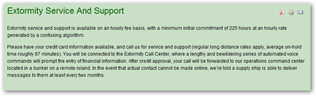
Of course, the Extormity EMR Software Suite must be integrated with other systems. Extormity software development engineers create custom, one-of-a-kind interfaces for each and every system or piece of equipment. In the event that we have already built an interface with a particular vendor, we employ a “reinvent the wheel” framework so that each of our customers receives a solution customized for their special needs, no matter how similar to work we have already performed for another client.

image

The pricing matrix screen, funny, your computer does not have enough memory capacity to display this (grin).  BD 

SEEDIE Submits Meaningful Use Recommendations
SEEDIE, the Society for Exorbitantly Expensive and Difficult to Implement EHRs, has submitted unsolicited recommendations to HHS regarding ARRA guidance and policy around physician incentives for EHR adoption.
“What is meaningful use?” asked executive director Sal Obfuscato at a recent SEEDIE executive retreat in Belize. “We believe the question is the answer, as man has always struggled to find meaning in this world.”

 
This insight led SEEDIE to suggest that certified EHR vendors should embed quotes from well known philosophers in their applications. This approach will prompt physicians and other caregivers to actively seek meaning as they document patient encounters.
“When I am treating a patient, a thought-provoking quote from Jean Paul Sartre or Voltaire is far more valuable than the ability to e-prescribe or adhere to evidence-based guidelines,” said Dr. Timothy Farragut, a Vermont pediatrician and SEEDIE board member. “You get so caught up in diagnosing a condition that you forget to ask yourself the important questions - why am I here, what does it all mean, can I still make my tee time?”
These recommendations are part of a SEEDIE effort to be designated as an ARRA certification body. “Unlike certification organizations that focus on objective functional requirements, our innovative approach to meaningful use is focused on a much deeper meaning of the word meaning,” said Obfuscato.

image
About SEEDIE
SEEDIE, the Society for Exorbitantly Expensive and Difficult to Implement EHR’s, is a healthcare IT standards organization that is completely funded and operated by a select group of proprietary electronic health record vendors.
Unlike independent, objective, professional organizations created to help medical professionals select and implement interoperable EHR solutions, SEEDIE promotes healthcare IT systems that play well in the sandbox if, and only if, it is in the best interests of a particular vendor. Learn more at www.seedie.org

Aetna Health Insurance CEO Gets Some Early Trick or Treaters At His Home – Healthcare Reform

Aetna CEO Ronald Williams had some surprise visitors with the not so usual “trick or treaters” on his door step.  The group has plans for more events and being the night before Halloween is called “beggars night” there could be additional activity this evening according to the article.  People dressed up in scrubs and had bags of Advil, cough drops and vitamins to hand out to his neighbors as well.image

The focus of the trick or treat march was to ask insurers to stop paying lobbyists to battle against the public plan action.  Mr. Williams did not answer the door and members of the group continued on to the neighbors' houses, occasionally with police patrol cars passing by, but not interrupting the process.  The group also left notes on the doorstep with their complaints and issues stated.  BD 

FARMINGTON — Jamie Mott wanted to tell Aetna CEO Ronald Williams that she wants to find fulfilling work despite a disability that leaves her in chronic pain and without adequate health care due to a “pre-existing” condition. image
So she and nearly a dozen other activists from Health Care For America Now! decided to take Mott’s case to Williams’ home here to hand out “treats” such as Advil and cough drops and personally ask him to stop denying coverage and bucking a public health care plan. 
“I think everyone is human and I’m hoping to put a human face on the health care crisis,” the 32-year-old Mott said minutes before she and the group knocked on Williams’ front door in the Devonwood section of town. “I’m hoping he’ll do the right thing and give access instead of denying it.”

The action was one of 40 tio be staged throughout the country through Halloween to ask large health insurance executives to stop “their tricks” by denying coverage and paying lobbyists to battle against a public health care option.

‘Trick-or-treaters’ protest outside Aetna exec’s door - The New Britain Herald News : New Britain, Conn., and surrounding areas (newbritainherald.com)

Bedwetting A Problem – There’s a Device For That - Wireless Urosensor

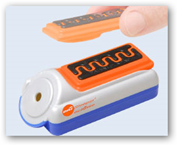
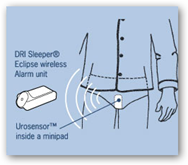
I am guessing this is targeted for children but I guess adults could benefit too.  It is a wireless alarm system that you strap on before you go to bed imageand when you are about to pass urine when the device detects moisture, off goes the alarm.  It is wireless so Mom and Dad can be in the other room to hear the alarm and dash in before the mess is created.

It is worn in your underwear and once the device gets a drop of moisture, the batteries shut down so there’s no longer any power through the unit.  I post on many devices on this blog, but have not seen one quite like this.  I would guess the next move on this is blue tooth so Mom and Dad can be anywhere and have the “peebody” identified anywhere (grin) so then you could make a phone call and wake them up and better yet connect this to the Child’s PHR so all incidents are recorded for a full analysis if you need that type of data:) 

Sorry for the wit and bit of dry humor here, but when you see so many healthcare devices popping out of the woodwork day in and day out, well you get the picture.  Anyway, it’s not too expensive and if you think you could convince little Johnny or Susie with a problem to buy in and put this in their underwear at bedtime, the device is here and designed like a “space rocket” for appeal?   BD 

From the website:

  • Special electronics for long term battery life of up to 3 years (not 7 days or 1 month as in some other alarms) 
  • The Urosensor™ docks on the DRI Sleeper® alarm unit when not being used and engages a second level of the battery saving technology.
  • World Patent Pending Urosensor™ technology – it’s the only non-metal urine sensor ever. So there’s no corrosion by urine, no skin irritation, and easy to clean for instant reuse.
  • The special electronics make the wireless Urosensor the thinnest of them all.
  • Plus all these features:
    • No wires between alarm and sensor.
    • DRI Sleeper® alarm unit size: 80 x 40 x 20mm (3 x 1.5 x 0.75 inches)
    • Designed like a small 'space rocket' for child appeal.
    • High volume with a tamper-proof volume adjustment. image
    • Plenty of detecting area to detect the urine.
    • The Urosensor™ can transmit to more than one DRI Sleeper® alarm unit, and so there can be another receiver in a parent's or carer's room.

      How to use the Eclipse Bedwetting Alarm:

      1.   Put the Urosensor™ in the underwear (inside a minipad is best - click for alternatives).
      2.   Place the DRI Sleeper® alarm unit on a table away from the bed so the child has to wake completely to turn it off.
      3.   Switch on the DRI Sleeper® alarm and that's all.

      When the Urosensor™ is wet with the first drops of urine, it sends a radio signal to the extra loud DRI Sleeper® alarm unit and triggers the alarm – treatment has begun.

    Allied Health Bed Wetting Solutions

    Pfizer Along With Johnson and Johnson Invest in Cancer Medical Device - Novo-Cure Stopping Growth of Tumor and Potential Reversal

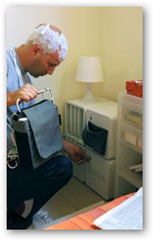
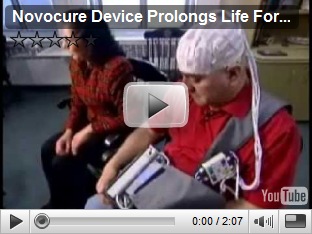
    49 Patients in Clinical Trials in the US are wearing this device that slows down or reverses the growth of cancer.  It has a battery pack and weighs around 6-7 pounds.  Watch the video to see someone in a trial wearing the unit and how it goes with him all day.

    It looks to be a bit of an inconvenience, but not so when you consider what the alternative is by all means, the patients are still alive and carrying on a somewhat normal life, just a bit of baggage to keep the cancer from growing and potentially even reducing the size of the tumors.

    With both Pfizer and J and & showing an interest with investing, along with favorable trial numbers, it must be working.  This is the first type of device like this I have run across on the web.  As technology grows with the device perhaps it will eventually evolve into a smaller unit in time, as it seems everything with technology goes in that direction, smaller and more powerful.  This has to be a blessing to those who are currently enrolled and using the device with the type of cancer they have by all means.  BD 

    Schering-Plough Corp. CEO Fred Hassan isn't too keen on the idea of pharmaceutical companies moving back into the medical device imagebusiness. The retiring CEO, in a wide-ranging talk last month at our Pharmaceutical Strategic Alliances conference in New York, warned pharma folks against straying too far afield and acquiring or incorporating drug and diagnostic companies into their main business. Such entities are best left separate or in a decentralized structure, he said. (See "What Fred Said: Schering-Plough's Hassan on Life in Big Pharma," The Pink Sheet, September 28, 2009.

    To some, his warning serves as another signal that pharmaceutical companies have renewed interest in investing in and possibly acquiring medical device companies after many shed themselves of device-oriented businesses a decade or more ago. At least one pharmaceutical company "kicked the tires" when Ardian Inc., maker of a catheter treatment for hypertension, raised a $47 million Series C round. Perhaps the recent investment in a low-profile company, NovoCure Ltd., by Pfizer Inc. and Johnson & Johnson Development Corp. is the first indication that there's truth to those whispers.

    From the Website:

    The NovoTTF-100A device is currently being tested in an FDA approved Pivotal (Phase III) clinical trial for newly diagnosed GBM patients.  The device is also being tested in a 236 patient FDA approved Pivotal (Phase III) clinical trial for recurrent GBM patients that has concluded enrollment but is ongoing and no results have been reported to date.  The device has previously been tested in two European pilot trials.  The data from these small pilot trials suggest the NovoTTF-100A may increase the length of time before disease progression and increase median overall survival of GBM patients.

    Medical Devices Today: Pfizer, J&J See Promise, Make Investment in Cancer Device Company

    How to Bill and Code H1N1 Immunizations – Video With Information

    You can’t bill for the immunization as the government is paying for it, but the injection process/service is billable.  Also, many insurance companies are picking up the deductible for many patients in their plans, so one of those where you might want to check and find out.  The video also discussed the ICD-9 code and a few other details.  BD

    http://www.youtube.com/watch?v=DZz7eAeGmhc

    What is a Yacker Tracker – Ask Kaiser About Noise Control in Hospitals

    I think everyone who has been in a hospital for care at some point in time can agree, they can be noisy.  The Yacker Tracker at the facility in Hawaii helps keep this in check.  Not only do we monitor data today, but add noise to the list too.  It looks very similar to a traffic signal.  They also have aimage “low tech” answer for nurses that do not want to be disturbed, those giving medications to patients as one example.  Some nurses might like the idea of wearing one full time(grin).   At any rate a visual that notifies others to no disturb when concentration and focus is needed and this will also contribute to less potential errors. BD 

    Kaiser Permanente Hawaii has an answer for a common complaint from hospital patients that they can't sleep because it's too noisy.  It's a Yacker Tracker.

    The noise meter, installed last August in 15 units covering all nursing stations at Moanalua Medical Center, works something like a traffic signal. A computerized light stays green until noise rises above a certain level, then a yellow warning light starts flashing.

    The Moanalua hospital's quietness increased to 48.64 percent from January to April this year, up from 35 percent during the same period last year, she said. The average for hospital quietness nationwide is 50 percent, according to an Avatar survey, she said.

    Kaiser also has a solution for nurses who don't like being distracted when giving patients medicine. An inch-wide reflective sash -- the equivalent of a "do not disturb" sign -- was designed for them at Kaiser Permanente's Sidney Garfield Innovation Center in Northern California. Kaiser Hawaii implemented it last August along with the noise meter.

    image

    Barring an emergency, the MedRite "non-interruption gear" signals everyone to leave the nurse alone until it's removed.

    Shhhhh! - Hawaii News - Starbulletin.com

    Roadside Street Doctors Are A Thriving Business in India

    I had to read this one twice when I looked at the numbers quoted, there are twice as many “quack doctors” as qualified doctors in the country.  It is against the law to practice medicine without a license but enforcement efforts or small or don’t exist.  They also pay “bribe” money to be left alone and if the heat rises, they move to another location.

    The Street Doctors state they use traditional methods of healing and help the poor who cannot afford private healthcare.  We have problems in the imageUS but we don’t see doctors on the street with a small outdoor office and practice.  The doctors use many herbs to help consult and “cure” in their words problems as major as paralysis.  Again, the numbers of Street Doctors when I read this article is mind boggling compared to licensed physicians.  BD

    New Delhi, India (CNN) -- Sitting on an iron bench along a busy street, Chaman Lal sticks his fingers into a mug full of a greasy concoction and then applies the dark-red brew to areas where his patients complain of pain.

    Lal -- who does not have a license to practice medicine, but claims to be a successful bone doctor and traditional healer -- says this potion of 18 herbs is a cure-all. His large signboard, placed along the roadside, claims he can even treat paralysis.

    Part of India's massive informal economy, these street-side medicine men and women are called quacks by the medical association here -- but they say they are traditional healers. They cater to a huge market of poor people who cannot afford costly private health care. The number of such practitioners is unknown.

    "There's no firm estimate, but I can say that for every 100,000 qualified doctors in our country, there are 200,000 quacks," said Ashok Adhao, president of the Indian Medical Association. "The practice is condemnable."

    "We do face problems when police and municipal officers come. But we manage it" by paying bribes, said Shiv Kumar, a caretaker of a sexual disorder-treatment clinic.

    Rajiv Singh, a clinic owner lying on a cot outside and under a bridge of New Delhi's prestigious Metro rail, said if his business starts to fall off, he will simply break camp and look for another location with potential new clients. Here, such a move is not a big deal.

    He also said the work he and others like him are doing is effective.

    Roadside doctors with no degrees thrive in India - CNN.com

    GE HealthCare to Work With CDC on Tracking H1N1 Flu in the US With Medical Records – Creating eHealth Connected Medical and PHR Records Outside the US

    GE has a couple of things going on here today, first of all with the tracking of H1N1 with a report every 24 hours being generated.  GE will be using it’s imagedata base of 14 million records to query for the information.  GE Health sells and installed their own EHR system Centricity and has additional software offerings.

    Secondly in the news today GE has announced their new eHealth web platform which is a business site to connect providers and payers, and will provide a personal health record. 

    Anytime a business intelligence arm of healthcare comes in with offerings, my stance is to ask questions and then ask more questions.  Some of the PHRs may not be as private as you think, and in this case GE Healthcare states they are focusing on PHRs for individuals outside the US.  The websites states that the patient is in control with what information is shared and seen by who. 

    Unlike Google Health and HealthVault, it costs $60.00 a year and has a diabetes module that can be added on for $30.00 a year.  The website states that you need to give notice in the final 3 months of the annual contract to cancel. 

    image

    Their PHR has a place for devices that connect and report data. 

    image

    Your LifeSensor Benefits At a Glance (for payers and insurance companies from the website)

    • Lower utilization costs.
    • Promote disease management and wellness programs.
    • Help employers increase employee productivity and reduce employee absenteeism.
    • Eliminate unnecessary office visits and tests.
    • Promote pay-for-performance programs.
    • Attract small and large group employers.
    • Improve the accuracy of matching and identifying data.
    • Increase member brand loyalty.
    • Integrate medical information and claims systems seamlessly .
    • Keep confidential member data safe and secure.

    All of this is combined on one website portal for patients, providers, payers and hospitals.  BD


    GE Healthcare and the Centers For Disease Control struck a one-year deal to set up what the healthcare conglomerate calls a "real-time" monitor of Swine Flu activity in the United States.

    The agreement calls for Fairfield, CT.-based GE Healthcare's Medical Quality Improvement Consortium to provide a report to the CDC every 24 hours from its database of 14 million electronic medical records. The company says the reports will enable the center to monitor the spread of both the H1N1 influenza virus (commonly referred to as Swine Flu) and seasonal influenza strains.

    "This was the first time the CDC has even had this type of potential to gather this data, so they kind of said, 'Let's give it a shot,'" Dente said. The deal began with a conversation between himself and a colleague at the CDC back in April, when the first reports of H1N1 began to widely circulate around the globe.

    UPDATE: CDC taps GE Healthcare to track Swine Flu | MassDevice - Medical Device Industry News


    G.E. said it was investing $90 million to get the new eHealth unit going. Its offerings include software for securely storing and sharing patient information, a Web portal that can pull patient information from various sources and present it to doctor, and a Web-based personal health record, called LifeSensor. It was built by a G.E. partner, InterComponentWare.

    So is G.E. going head-to-head in the emerging field of personal health records — controlled by individuals, not a doctor, hospital or insurer — with the likes of Google and Microsoft?

    Not really, Mr. Wanchoo said. EHealth will be an international business, and health ministries in places like Saudi Arabia and Singapore want to build digital health networks and also want personal health records to be part of those networks. Google and Microsoft, Mr. Wanchoo said, are not yet offering personal health records in many nations.

    http://bits.blogs.nytimes.com/2009/10/29/ges-bid-to-connect-computerized-health-records/

    Aetna Takes a Year to Settle $31,000.00 Claim – Thought They Had a Doctor In Network Who Could Have Performed Special Surgery and Found Out They Did Not

    This is an interesting story about a woman who was told up front her cost would be $6000.00 out of pocket up front.  After she had the unique surgery that would allow her to breath freely again, her claim was denied.  The local news station here got involved and finally got her claim paid.image  

    The informed patient here knew up front there was nobody in network who could perform the surgery and did all her homework, and you can see the comments regarding the CPT Codes, etc. used in the argument.  Again, more than likely scoring the claim and persistence to prove there was a doctor in network through data mining and running additional algorithms in the search,  failed to find any information other than what had been claimed by the patient all along.  Even when you do your homework up front, algorithmic scoring on claims can still lead to a denial and then you really have a battle on your hands and thank goodness the television news team helped her out.  BD 


    One of our viewers needed a surgery that only a handful of people in the world could do. Fortunately, one of those surgeons was here in the Valley but he was out-of-network. As this case shows, when you use a provider not in your health plan, you’ve got some legwork to do upfront.

    The surgery was an amazing success. Alice’s airway was widened and her jaw repositioned. But strangely, Aetna denied her claim.

    "They argued procedure codes that weren't covered and they referred me to CPT bulletins. Alice knew her out-of-network surgeon was the only one qualified for the procedure. The confusion began when Aetna ruled that they had surgeons in-network who could perform it. After more than a year, two failed appeals, and our involvement, Aetna acknowledged that Alice was right (Aetna did not have a comparable surgeon within their network) and that’s whey they paid the claim. We thank them for working with us to resolve this matter.

    Unique surgery pits viewer vs. insurer

    Interview with Curtis Schroeder, CEO Bumrungrad International Hospital and Nate McLemore, Health Solutions at Microsoft – International Personal Health Records with HealthVault

    This week I spent a day at the World Medical Tourism Conference in Los Angeles and had a few minutes for an informal quick interview with Curtis Schroeder CEO imageBumrungrad International Hospital and Nate McLemore, Senior Director  Bus. Development Health Solutions at Microsoft.  In the news this week, HealthVault began it’s first steps in going international and Bumrungrad International Hospital is the beginning partner to bring US personal health records together to provide an exchange with patient permission between the US and the hospital in Thailand by using Microsoft HealthVault. 
    One item we discussed as well is the power of the patient to make the decisions to share, with HealthVault, it is totally up to the patient to decide on what information gets shared, and we discussed the explanation to physicians who perhaps were asking for more information, the fact that it needs to be shared by the patient, as the PHR belongs to the them.  Mr. Schroeder from Bumrungrad made one very good point in how the entire Amalga HIS records system works at the hospital, it’s all under one roof, in other words, everything comes together well and there’s no having to search different applications for the information the physicians may need, it is fast and efficient and contributes genuinely to better patient care. 
    For one example, tests are not duplicated needlessly and that not only saves money, but time and inconvenience for the patients in not having to redo a diagnostic medical test that already contains the information required to review to diagnose and/or treat a condition. 
    Curtis Schroeder is from here in the US, in California with roots right in the same areas of Orange County where I am presently located.  He has been in Thailand over 17 years.  Nate McLemore also brought up the use of data reporting devices and their use with HealthVault and the focus on moving heavier into this area, as again, it makes it easy and simple for data to be added without the manual typing we all thrive upon image(not).  This is one further move into the area of enabling and engaging patients in their own healthcare and along with this comes knowledge at the same time.  In one example, Nate references the “Walk Me” program, which integrates with a pedometer and connect so HealthVault, so individuals  can track and see how much walking they are actually doing in a day, or perhaps track over a longer length of time, so we can really see how much walking we really are doing. 

    After the interview I took some additional time to walk around the floor to speak with the exhibitors and learned quite a bit and I’ll save my summary of what I took in for another post of it’s own.  One comment I heard quite a bit though from people from other countries though is the fact that they are well aware of our antiquated paper records, the word is out.  Everyone I spoke with today was using electronic medical records, all the countries represented.  My personal thanks for both Nate and Craig for taking a few minutes from their business schedules today to share a few words today.  BD

    HealthVault Goes International – Partnering with Bumrungrad Hospital in Thailand for Medical Travelers

    Stryker Biotech and its Top Management Indicted – Alleged Illegal Bone Putty and Medical Device Marketing

    Some of the executives could face up to 20 years in prison along with fines, there are a number of management individuals named in the case.  Earlier this year we had another company charged with unlawful clinical trials when 3 patients died on the operating table, and one other interesting fact imagesomewhat ties this together was that Norian was in a legal battle with Stryker over patent issues.  

    At Norian Four Executives Charged in Connection With Unlawful Clinical Trials – 3 Patients Died on the Operating Table

    In addition to the “recipes” in question, there was also the question of the number of patients allowed by the FDA to be treated with OP-1.  The company released a statement about the indictment and that can be read here.   BD

    BOSTON, Oct. 28 /PRNewswire-USNewswire/ -- Stryker Biotech, LLC, a corporation based in Hopkinton, Massachusetts, and its former imagepresident, Mark Philip of Lexington, Massachusetts, and its current sales managers, William Heppner of Illinois, David Ard of California, and Jeff Whitaker of North Carolina, were charged today in federal court with participating in a fraudulent marketing scheme of medical devices used during invasive spinal and long bone surgeries. Stryker Biotech and Mark Philip were also charged with making false statements to the United States Food and Drug Administration ("FDA").

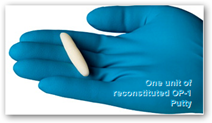
    The Indictment alleges that all of the defendants participated in an illegal marketing scheme to promote medical devices used during invasive surgeries,and in doing so have defrauded medical professionals and the FDA. Inparticular, the defendants are alleged to have promoted devices known as OP-1Implant and OP-1 Putty. image

    It is alleged that some of these untested "recipes" called formedical personnel to mold the combined product into "cigars," "tootsie rolls"or "Vienna sausages." The Indictment charges that the defendants knew thatsuch a combination had never been studied in a clinical trial and had neverbeen presented to or approved by the FDA. It is alleged that the reason thedefendants promoted the OP-1 products in a mixture with Calstrux was becausewithout a mixing agent, the OP-1 products were at a competitive disadvantagewith other legal products. The Indictment also alleges that serious medicalproblems arose in a number of patients from this untested mix of products.

    Stryker Biotech and its Top Management Indicted for Illegal Promotion of Medical Devices Used in Invasive Surgeries | Reuters