This is good news and bad news but the good news we’ll take right now as there won’t be any big administrative billing nightmares as have been experienced in the past. After the CMS 10 day hold is when that would have kicked in and it is a mess. So we can be happy about that and who knows when Congress might entertain hiring some Quants who can “model” the repeal of the SGR. They might as well at some point start keeping up with the insurers who are hiring quants like I’ve never seen. They are no longer just for Hedge Funds.
It is pretty bad when that word “math” comes around with financial models and folks tend to run for the hills, but at least this time we didn’t have the usual default topic of Women’s Health run up the flag pole. I have already kind of figured it out that when laws require a lot of math and financial calculations, they run over to talk abortions. So again at least we were spared that show this year. I did watch a few minutes of it and Senator Coburn made some good points about his disgust in not being able to fix the SGR. He got into the math and fake formulas and I like to see that addressed no matter who it is, but it all could not come together today. That Plos One study is looking more accurate all the time as it states the fear of math gives people “real physical” pain:)
In addition some of the discussion rambled off topic a little bit, not bad stuff but things that need to be talked about too but maybe just not today. So they took the easy road and with the roll out of Healthcare.Gov delaying the ICD10 roll out was probably a no brainer as the Hill is probably not too high on the words “trust me” when it comes to technology decisions from HHS and CMS. We still have that “Sebelius Syndrome” floating around.
She’s not the only who has it either but got the name from so many public blunders when trying to talk about technology and got it somewhat humorously wrong so many times.
The big thing is with ICD10 is have it work and have plenty of time to test and debug and debug and debug. It was kind of nuts earlier this year when CMS was not going to test end to end and said the roll out date was firm, so yeah we heard that one before with Healthcare.Gov and there’s still issues. This way too if there happens to be any code that has not been completed yet, they have time. The ICD10 add on was not really discussed and was just put there so I don’t that was an issue with either side to agree on it. Sure there has been a lot of money spent I recognize that but if a delay means better preparedness and roll out, so be it with the complex IT Infrastructures out there. In the House we had this and tacked on 5 years for the insurance penalty of the ACA. Who knows that could still happen somewhere else.
ICD10 software and coding is nothing more than rolling out a whole new set of algorithms that have to play with the ones we currently have, its all computer code and data mechanics.
So why didn’t we do ICD10 when everyone had their data in silos (grin), I just had to say that:) Long and short here the Hill just doesn’t want to do math and hire some Quants to model it for them. Again I have beat the horse to death with so many posts about Congress getting that Office of Technology Assessment to help them with some of this. It’s going to smack them in the face sooner or later as you can’t just focus on verbiage anymore, need to tie in the technology with some digital centric laws spelling a few things out.
Again I do have to say though that Tom Coburn was on the money today with addressing the fact that this has not been fixed and has needed a fix since 1999. BD
Not the best time for extended maintenance to hit but what do you do? This is part of every major web service around but the timing could not be worse. Hopefully it runs as needed and nothing out of the ordinary occurs to delay it even further. I’ll say one thing, the government sure has learned a ton of lessons today when it comes to complex IT infrastructures.
More and more us humans have to adjust to the algorithms’ schedules everywhere you turn. So as what has been done before if you try to visit, you go to the virtual waiting room to wait. BD
(Reuters) - The website for people to enroll in U.S. private health insurance was unavailable early Monday morning, just hours before the deadline for the first wave of enrollment under the healthcare law.
Representatives for the Department of Health and Human Services, in a statement, confirmed the access problems to www.HealthCare.gov and said the website's usual maintenance time had been extended, but that the site was "coming back up."
Maybe this is something worth discussing as it certainly exists out there and since I cover many areas of healthcare, I’m seeing more and more of this with one hospital system doing very well, like UPMC, a non profit with a billion a year in excess revenue (that is profit talk for non profits) and then others struggling. So much of the time we see news articles that state the ones having problems “don’t operate efficiently” and while there may be some truth to some of that, the divide here is growing all the time and that can’t be the only reason for the disparity. Health IT can’t solve it all or even work at all in some areas to where the cards dealt vary so much. Below you can read about the City of Pittsburgh suing UPMC as they could use some of that money. Again you may have real estate that gets sold, you have to look at the demographic areas the hospitals serve and last but not least, reimbursement as that can be all over the place.
Some hospitals have better assets to offset some of the reimbursement issues that are pretty much on the rise everywhere and sometimes I think some hospitals too get brow beaten over the fact that they can’t make money when in fact it’s the cards they were dealt to begin with. Some may not have assets to fall back on and some don’t have money to keep up with enough IT investments and yet they are in the same CMS arena to perform the same with what they do. Sure there are some adjustments out there and some of those help out for sure with non profits in particular but some get outdate too and as economic times change, they don’t work as well, or if the verbiage in the law gets interpreted with “selected context” some get windfalls too. We don’t see the latter too often by comparison, but it’s out there.
Just yesterday I wrote about an abrupt close of a hospital in Massachusetts that closed on Friday and even the Governor was powerless to do a thing as they were flat out of money. We they doing things so badly efficiency wise that they were a “bad hospital” without enough technology? I don’t think so and again go back to the demographic areas they serve and look at the reimbursement issues the hospital was having.
Sometimes in the non profit areas you do see one hospital helping another and I go back a few years ago with Kaiser Permanente sending money to Grady Hospital in Atlanta, which was great but again they have to watch their own business and can’t be on the hook to save all hospitals either. That was at a time when other hospitals in Atlanta said we would like to help but have our own problems.
A couple months ago, 6 hospitals went up for sale here in California as they were out of money and it barely made the news. Again are we going to do the same “shame” story here again and blame management for all of it when in fact there were many issues that lead to this? It seems to be what you read anymore with folks searching for a simple reason for this re-occurrence that keeps happening? It is time to stop to stop beating that drum and do some better in depth studies as to why this keeps repeating itself?
Another contrast here in Los Angeles with Cedar Sinai, they seem to have quite a bit of money to keep up buying up physician practices as one doctor recently stated “they made me an offer I couldn’t refuse at it was that good”. We know the reason for this type of activity comes back to reimbursement again as they can charge more to Medicare and some insurers when a patient is treated at a hospital owned facility and they are not by far the only hospital doing this. The uneven levels of excess profits are not just limited to non profits either, here’s one example..
So this being said, we now have issues like this with either doctors or hospitals wanting to help patients with their insurance premiums and the logic behind this is not hard to figure out the ROI as if they help keep a patient insured it’s going to cut the losses the doctor or hospital has to absorb and the patient gets the care with reimbursement from the insurance company. Sure I see the discussion here as to “which” patients will get this kind of help but I would rather see that and at least some patients get the care they need rather than it not take place.
As I have said, Obamacare and all of healthcare really for that matter is a big Attack of the Killer Algorithms..those damn algorithms can bring everything to a stop for sure until decisions are made about how they should work.
Now when this comes up for discussion we have the politicians getting involved with discussion that will probably just go nowhere for now at least. With consolidation of hospitals today charges don’t seem to be going down at all and consumers with our inequality issues can bear the burden. You can read the post below how the two individuals here who are largely both caught up in the Sebelius Syndrome overall are going to talk about this…so how do make a law on this topic? That’s a really good question as you will end up denying care where it could be possible for patients.
Long and short here is the failure of quite a few models here and why it is important to model in the hopes of catching a lot of unintended consequences before they occur and you will never catch all of them but if you see some ahead of time it does help. Politicians tend to just suck in anything they read at times and we end up with quantitated justifications for things that are not true, and again this comes back to “those measurement” we see on hospitals all the time that are supposed to be care and safety related, but we certainly can’t fool ourselves and say that money has no part here, because it does.
So there you go perhaps a new topic to begin giving attention, “Inequality for Hospitals” as it does exist and how long before we really start taking a look? So far inequality for consumers has been talked about but that’s about it as politicians refuse or lack the intelligence to see how all of this is modeled. It’s all math models and subsequent algorithmic processes running on servers 24/7 whether it’s consumers or hospitals that keep the inequality movement growing sadly.
You can explore more of this in the financial world here with a collection of links and videos that talk about Algo Duping and the Attacks of the Killer Algorithms provided by people smarter than me that have taken time for several years now to educate and give the warning and when politicians decide to come into the “real” world from their virtual perceptions, who knows. That is also a big problem as well as I recently discussed that topic at the link below too.
The hospital had emerged from bankruptcy a couple years ago and it appears that money could not be made here due to the fact that a big percentage of the payments come from Medicare. The compensates the hospital with 66 cents for every dollar spent so there’s the gap. The hospital relies on Medicaid funding. The state has underpaid for years so again we have hospitals like UMPC making a billion in excess profits for a non profit and then we have one like this that can’t keep their doors open. Profits and losses for hospitals are all over the books.
The state audited their books after bankruptcy. Fund would be available if the state declares the hospital a “critical care” facility but the hospital has to be 25 miles away from the next nearest acute center care hospital, and it is 23 miles so someone has to change a law I guess. Just a few days prior the Governor said the hospital should survive. 500 jobs were lost. Makes politicians look useless when the money’s gone. On Tuesday the hospital officials said it would close on Friday and that it did. Northern Berkshire Healthcare is the parent company of the hospital. BD
NORTH ADAMS, Mass. (WWLP) – Questions that many people in Berkshire County are asking include how did the hospital get into this financial crisis? Can anything be done to get out of it?
North Adams Regional Hospital filed for bankruptcy back in 2011 and their finances were audited by the attorney general’s office. The state may have contributed to the root of their financial issues.
SEIU Union Spokesperson Jeff Hall told 22News that 46% of the hospitals patients were on Medicare and that the state only reimburses the hospital about 66-cents for every dollar of care provided, leaving the hospital with a gap that can be filled only through donations.
Sometimes that happens to where no matter what you do with an engineered system, if too much of of the coding uses doesn’t work well then you could be wasting a lot of time trying to fix it. Sometimes it may be just a module that you can re-write and replace to work with the other modules but from what I am reading here it might be past the point of return here if this is the latest decision, plus fixing it might be more expensive too than a total new system and you still have some corrupt floating around even after a repair. You can read below where the subsidiary of United Healthcare was called in to see what they could do.
If perhaps the model used in Connecticut is similar enough to where it can work with the needs of the state of Maryland, perhaps it could be used. Each state model was different and had different contractors and some same and some different technologies used. Deloitte is the one being called in to fix this one and they have had some bad situations too so there’s big hero contractor that can fix all.
This would be the first state to chuck it with the entire system, although we know, but nobody has told us officially that there are parts of Healthcare.Gov that were re-written modules too. That’s just how it works. If nothing else, folks are finding out how complex IT infrastructures are today and you just run it up the flagpole and give a due date and expect everything to be fine. The federal program is still having issues with code working with other code and I said the other day that pretty much all of healthcare is just a bunch of algorithms that won’t or can’t work together. In saying that too, we also add in politics and other situations that make it difficult as folks don’t seem to realize that you can work forever on the verbiage of laws, but the code running on servers 24/7 is what executes.
The fear of acknowledging this fact was pretty clear a couple years ago when the director of HHS, came out and gave a talk that said “hurry it up”:) It kind of has some satire and humor to it in the fact that most of the time developers and those writing code are working at 150% anyway so add that novice perception into the batch and the technologists just look at who’s talking and say “huh”…or they get aggravated at the level of digital illiteracy when such speeches are made to the public with politicians with a bunch of bees in her bonnet basically with the fear of this real issue making her look bad, but nothing you can do about it.
Here too this “audit” is yet another weird perception as how many experts does the OIG have to accomplish this with the Feds, and last I looked the White House when the site failed had to go searching for them, but that’s the weird and kind of goofy stuff you hear from folks with zero data mechanics knowledge or experience and they try to either explain or do a CYA.
The exchange in Maryland has worked but again if they are ready to chuck it, well that tends to say there’s some truckloads of bad code still hanging around that’s not worth fixing. It’s like buying a house that is in really bad need of repair with everything run down and not working versus leveling it and starting over. Same thing works for code and get the right algorithms to work. BD
Maryland officials are set to replace the state’s online health-insurance exchange with technology from Connecticut’s insurance marketplace, according to two people familiar with the decision, an acknowledgment that a system that has cost at least $125.5 million is broken beyond repair.
The board of the Maryland exchange plans to vote on the change Tuesday, the day after the end of the first enrollment period for the state’s residents under the 2010 Affordable Care Act.
Maryland is not alone in having deep-seated problems with its health marketplace. Technical issues also have plagued Oregon, Minnesota and Hawaii. But Maryland will be the first to walk away from its site, a particular embarrassment for Lt. Gov. Anthony G. Brown (D), who was placed in charged of implementing health-care reform in Maryland by Gov. Martin O’Malley (D).
Henry said the exchange has cost $125.5 million to develop and operate.
As of last Saturday, 49,293 Maryland residents had enrolled in a private plan through the exchange, far short of the state’s original goal of 150,000 enrollments and shy even of its revised estimate of 75,000 to 100,000.
This unwelcomed phenomena that exists today…”The Grays”….
Well somebody had to say it and sure we are experiencing the return of virtual reality which there’s nothing wrong with it for gaming or viewing let’s say a movie or just a more vivid experience. When virtual reality first came out, well it was pretty definitive as everyone knew the game plan. You check in and become someone you want to be in a virtual world and play around, have some fun, meet some other virtual people and hopefully when you are done you return back to your normal “real world” self. Some people really got into and a few even got into a little trouble a few years back with getting confused but those were kind of isolated cases. Again everyone understood that when you checked in to your virtual world it was just that, virtual.
Well let’s move forward a few years and look at where things have gone. Technology is moving via leaps and bounds and just two years ago we didn’t have what we have today. Two years ago some of the technologies we have out there today were not even thought of yet. There’s more elements out there today with virtual reality to mix with and unfortunately it’s getting folks confused with where values are. I have made the comments that if I had to choose between being connected to Facebook or using a Bill Gates toilet, well the real world tells me I need a toilet first if you will:)
We see stock values way over inflated on what we place on virtual technologies. When you take social networks, for the most part, what do you have? You have a bunch of apps that connect you to something or someone and it’s all code, data and queries stored on servers.No tangibles here to speak of other than the cost of the hardware and yet we see stocks go way out of line here. Sure there’s value but not to the levels of what we are seeing. Come on, huge stock price values and IPOs on data and apps sitting on servers somewhere? They are intangibles and they are out of balance with the values placed on the “real world”. We need both, and boy am I seeing some very confused folks out there any more.
Data has value, no doubt but you are marketed as well and and your value as a human compared to an algorithm, well it’s not very good. With complexities today and marketing, watch people on a dating site. It’s like going into a store with way too many decisions and then you are given more opportunities for some “click bait” to view even more and the site makes money as you move through a series of pages through ad exposure. You have some very smart mathematicians that know how to work you and keep you coming back. In other words don’t find your match, just keep coming back as the site will entertain you and keep you convinced that you need it. This is another form of the “gray” areas as meeting someone online is hard enough as you meet them a fraction at a time. So add on all the other money making noise and they got you.
It was kind of funny today that I read an article that Google is doing to do a study “to learn how people work” so is that ironic?They seem to hire quite of them and after how many years in business they don’t know how people work? I read another article that said employees at Google can’t separate their work from their personal lives..hmmm..a little gray here too? It’s kind of funny they need a study as we all kind of know, and self included you have to shut it for a few hours, days, etc. to get your feet totally back in the real world.
Heck even last year the Algorithms were not educated enough at Google and said I was a real duck and suspended me as the machines did not recognize it as a surname, that worked everywhere else in the world and I had to deal with the virtual Google Plus world and substantiate that I was “real”. In the virtual world I could not exist there without a “machine compliant” name. See how the virtual world messed with me and next time it could be something serious like a credit report or background virtual issue, as flawed data is on the rise due to the current data selling epidemic we have.
I keep talking about one topic over and over too and that is “people don’t work that way” and I reference that when I keep reading about how developers and companies in the mHealth business can’t hook the consumers. There’s a few reason besides just not wanting to be involved and that includes the data selling aspect as we all pretty much know it’s double sword and there’s the danger of some of your information getting out there and being used out of context. You know with data and what ever context you decide to apply, you can make a person look like a hero or a zero, only the query monster knows for sure.
This strangeness has even spread to TED, and if this happens I’m done with TED:) It’s an X-Prize (AI X-Prize) to do a Ted presentation with artificial intelligence. I agree again with Larry Ellison (more below) who’s business is technology that people are more interested in people. Sure the virtuals are not going away but with what I see and the gray areas growing, do we need to create bigger gray areas. So what’s next, quantified virtual worlds?
I have never seen a time when people jump all over statistics like magpies. I’m not saying they are all bad by any means, but anymore it’s like the peanut gallery that jumps up and rolls off numbers over and over. A Los Angeles Time writer recently commented on that too saying “consumer are drowning in data” and we are. I see it and get tired of it, so add on a bunch of magpie type repeats and it’s like “gosh how do I get away from some of this”:) I like to read studies and statistics but I don’t want to be drowning in them with maximum doses in my face all the time. Some of the studies and articles are just pure bunk too. We end up with way too much quantitated justifications for things that are not true, usually because someone is trying to sell something. Now I’m not saying it’s all bunk because it is not but it gets mixed in with the good stuff, and duped you are.
Here we go again with the “gray” areas that constitute a lot of confusion with folks not knowing where’s the real and virtual worlds, and where you draw the line? If you like this clip below then venture down to the footer and watch the entire video #1, it’s one of the best out there to make this point. What did I read and is that credible? A question that’s worth a mention today before you suck in everything as some is good and some is marketing.
Press releases though are usually a good spot to place statistics and that’s respectable as you can link what the “sell” aspect is with the studies or stats mentioned, but when we get these wild statistic news stories that are not attached, what is their point you do have to wonder?
Larry Ellison gave some really good feedback, kind off the cuff in his lecture given at his HCM conference. He’s very disturbed with kids that are just spending their time on video games, so we go back to the virtual worlds again. Go to the end at the Q and A for his “personal” comments at the link below.
He’s says there’s a virtual ball instead of a real ball with games and everyone gets to be LeBron with virtual reality. Kids are confused he says, everyone thinks they are LeBron. If your game playing or life is more fun in the virtual world, it’s a danger. Virtual relationships..again we go back to dating sites. The impact of technology on children right now he says is both fabulous and terrible.
In the end Ellison says, we are really more interested in people even with our interest in technology and I think he’s right on that and there’s a bit of rub as some of that is being lost with the pace we have with technology today. We can’t slow technology down but we can control the rate at which we absorb it personally. We can’t control though how it evolves around us and it confuses people. What’s real and what’s virtual?
Again go hang around a dating site and you see all these areas to click and read and look at pictures and then are presented with more, or there’s little amusements there to ask a person to upload more pictures, and that will keep you busy if you want to appease all of the requests:) The sites can keep you very busy and you can lose your focus as why you are there. The funniest one was a site that sends you a flow sheet to visualize it for you, again the interactions until you move off the site and meet someone in person, it’s all virtual. I sit there and kind of laugh at some of that as if want to know me better, then talk rather than give me some kind of virtual busy work to do:) It’s how you get sucked in. If a person loaded up fake pictures, then they’ll probably load up some more fake pictures for you:)
The movie HER, and really all you need to see is the trailer and you can get the message on how this guy substituted a real relationship with a virtual one that made him happy, so there we go with some of those “gray” areas. This is worth embedding the trailer here again to make the point. Sometimes folks don’t even realize they are just living for this bit of attention on the web and then lose touch with what’s real out there.
If you go back a few months you can also read where Bill Gates said “the internet will not save the world” so again maturity here with technology and where it can really benefit. Both Bill Gates and Larry Ellison were the early pioneers and understand “data mechanics” better than anyone else out there and again have the maturity to see beyond the end of their nose by all means and we should listen to both of them.
So again virtual reality has it’s place but when the lines get gray that help you determine where the virtual worlds leave off and where the real world kicks back in, it gets pretty fuzzy out there. I run into people all the time with what I call weird or strange perceptions as they carry some of this over into the real world and there are companies that profit richly from it, so be careful.
HER Movie
And here’s one more clip..Mike Osinski “with software you can do something about everything” but you have to live in the real world and he knows a bit about virtual worlds as he wrote the software all the banks used for the mortgage scam that banks used improperly and drug so many of us into a virtual world. The big refinance was all mastered and created in a “virtual world”. So keep that thought if you will.
The whole country was sucked into that virtual world where banks did real stock transactions where the sales and models were not representative of the real world, (I’d call it virtual risk at this point) but hopefully we are little smarter now. If you like the clip then go down to the footer and watch video #2, the Quants of Wall Street to learn more about how that virtual world functioned. As Larry Ellison said on his HCM talk, we though we were Lebron. This video was made about 3 years ago, so not new knowledge here at all.
So with all the tech insanity we seem to be experiencing of late, well time to keep it in check and allow consumers time to digest some of it and not “dummy down” folks for profit either.
This video from Dr. Sean Gourley, physicist and CEO of QUID might make you think a little bit. He tells us last year 51% of the traffic on the internet were bots, the rest humans. Last year it's up to 61% bots and the rest humans, so what's going on here. He uses a chart to show the human value with the value of the bot, and it's doing better than human value.
Dr. Gourley states we do need algorithms to manage the complex world, but who's algorithms are they, and will I benefit one could ask as well. We know in this process that bot are going to get more access for sure and the human access looks like it will dwarf that. So again trying to look and dig deep, there's some good questions or things to think about here for sure.
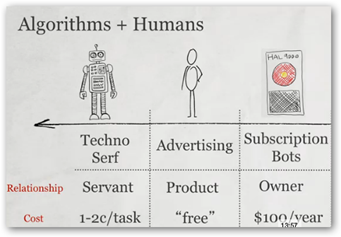
So who's going to be the biggest benefactor here? Is the next number going to be stating 71% of the internet is bots and the rest humans, so what is the real function to connect Facebook with drones? Who’s going to really benefit? A lot of bots and the company that owns them and makes money from them…bots are worth about $100 and humans are worth zero and are basically tech slaves. Sure some folks will get internet connectivity and that’s not a bad thing but at a cost and it will support the growing world of bots and their profitability not the humans as we become what Dr. Gourley states, the techno slaves that only fill in where the bots can’t go.
Anyway I hope I made the point here about the growing “gray” areas we have with virtual technologies and be aware as you might accidentally find yourself subscribing to the virtual values and losing some of your own “real world values”. All those new folks getting access will be able to be LeBron too. The essay below is great and worth reading, be a skeptic when you need to be and you might ask is it real or is it virtual sometimes to help keep your balance, I do it:) I want to be aware and cognizant of when thing venture out of the virtual world and have impact on what’s going on in my real world, the one that really counts. Talking with quants and mathematicians who design and model a lot of the virtual worlds out there can be big help to learn. Read the publication below as well.
If this has generated some interest, then dive in for the full on education on the Attack of the Killer Algorithms videos at the link below. It’s computer code and math models that over stepped lines of efficiencies we all want and have turned into “qualifiers” that will score your out of opportunities in the US, this is what’s happened to the middle class.
Everything pretty much stops anymore when the systems “go down” or “don’t work” and this is yet one more situation and folks have gone for over 3 months with no stamps or payments. We know systems are going to fail and when you get into massive government projects like this, well I think it’s time to do what hospitals doe when their systems go down, they have a temporary “paper” back up system. It is just that “temporary” and not meant to replace electronic medical records at all but it can be used in an organized formatted process when needed and data gets entered later. What’s wrong with this? If used this way, paper saves lives and doesn’t kill, as again it’s only temporary and folks are smart to have a back up system that can be used immediately.
Several states including California have had issued to where the cards didn’t work when they were used at stores to buy groceries and there was a back log but I don’t seem to remember 3 months before things were taken care of for the consumer. Xerox was the contractor that had a computer glitch in 17 states that left consumers having to abandon their groceries at the stores.
According to this article, same old story with the “Sebelius Syndrome” here too thinking there’s miracle IT infrastructures out there and they rush out and put the system in place and operating before enough testing and other bug finding procedures can be accomplished. With Healthcare.Gov it was folks thinking Algorithm fairies would pull them through along with a few prayers. Code doesn’t work that way and you can pray all you want but it’s not going to help if the algorithms are not working together. Obamacare is a mess of Killer Algorithms you could say as well as in addition to errors and not getting access, many don’t know what they have, if their policies are in place, what doctors they can see and so on.
Accenture is on the hook for this one with software made by a subsidiary of IBM. Many churches have helped to supply groceries to those who could not get their food stamps. BD
On the 13th of every month, she has counted on seeing a $600 payment on her food-stamp debit card. But now, that payment is a month late.
Simon and thousands like her in North Carolina had enough to worry about before a computer glitch began to fray this basic part of the social safety net.
Last July, government computers across the state repeatedly crashed, preventing caseworkers from processing food stamp applications and recertifications for weeks. Eight months later, North Carolina officials are still scrambling to clear the resulting backlog. The food stamp delays can be traced to troubles with a computer system designed by Accenture, one of the world’s largest consulting firms. The company is among a small group of politically connected technology contractors that receive government business across the country despite previous criticism of their work.
Accenture won the North Carolina contract after spending thousands of dollars on political contributions and lobbying in the state. North Carolina hired Accenture even though at least six other states -- Colorado, Florida, Wyoming, Kansas, Wisconsin and Texas -- have canceled contracts with the company in the past decade over problems with its computer systems.
But the backlog kept growing. By the end of last year, more than 30,000 families in North Carolina had waited more than a month to receive food stamps -- a violation of federal rules that require routine applications be processed within 30 days. About one third of those families had waited three months or more.
This is a difficult one to really comment on one way or another here. You read this and you wonder “were there mental problems here”, was the information shared with a psychiatrist actually shared without following procedures? Obviously if one has real mental health issues, that’s something to be dealt with. On the other hand, was the conversation as he stated “just venting” on something he vocalized but would not act upon too?
The guns that were seized were returned to him after the fact. He is stating that his medical records were shared with the police department and this was aimed at discouraging him from filing a disability claim. If he is in fact not able to serve then perhaps disability is in order? I see the other side too with looking for abuse of the system being something to be aware of too and from what I read in this article there’s a few other “stress” cases pending as well. Is the effort to save money coming down to more scrutiny on disability claims too?
So back to the medical records issue here, I guess we have to wait and see the process of how it all took place as far as what was shared and with who. Again, perhaps some of this was scraped from the web too? This comes back around to all who sell and share data having a license and a public disclosure of what kind of data they sell and share and with who so people can at least know where the information came from. I’m sure lawsuits involving data provided in a case like this one with wanting to know the “roots” of where the data came from might soon be on more agendas. I think bit of transparency here with who’s buying, selling and sharing data is a good idea so people know where to look, otherwise it’s almost a sure bet you get a lawsuit to investigate. It’s certainly more money for lawyers. BD
A former Milwaukee police sergeant with a long history of misconduct complaints who is now on duty disability retirement for stress is suing the city, contending that his medical records were improperly shared.
Jason Mucha received duty disability after saying publicity over the complaints left him paranoid, depressed and suicidal, according to his application.
Mucha told a psychiatrist he had thoughts of "suicide by cop" and dreamed of attending a department command staff meeting with a rifle and shooting until he was shot.
Mucha's lawsuit says the information was sent by the City of Milwaukee Employees' Retirement System to the police department in November 2012.
CORRECTION: This is Spirit Aerospace and not Spirit Airlines as I originally stated if you have already read this post. Anything related to Spirit Airlines has been removed, my error.
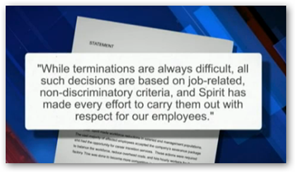
The Union and the Employees filed suit with the EEOC Commission, 360 employees were let loose in July. It just so happened that this all occurred a few weeks after the company had changed to a funded insurance program. If you watch the video you can listen to one man talk about how he applied for the exact same job that was open after he was laid off. He never heard a word back.
The company of course says they never used medical records but again time to dig in and see where maybe some wellness data was collected and so forth. The company is not supposed to see those records and maybe they didn’t. Maybe it was a 3rd party consultant who saw the records and made their recommendations? We don’t know as we have no clue on who get to see what data, where it is shared and possibly sold as well.
The company did call back 22 employees in November. We live in the world where stats rule and ethics seem to be second place and you would have to living under a rock not to be aware of this. We have what are called “risk assessments’ that are done with health insurance and even a mortality assessment can be bought from the MIB in some cases. We all know “age” is a factor with a risk assessment that can’t be changed and it is not supposed to be used to discriminate but without being there, how do we know? We don’t.
Now with data mining and matching that could have been done easy enough too. A very high percentage of the layoffs were people who were older and had health conditions. I have covered that here before and a few weeks ago 60 Minutes did a good dive in there on the re-query and rematch. You talk to most proficient Quants and Data Scientists that have been around for a while and re-match, they just consider it part of the job as they all do it all kinds of data.
Here’s another example with insurance companies buying your Visa and MasterCard records, how hard would it be to identify someone with diabetes for example if they are filling prescriptions for insulin…so I think what we have here is perhaps a case where “official” medical records may not have been mined but there was plenty of other kinds of data to mine that would give them the information they may have wanted.
Here’s a visual and how that can be matched on the web which was done a few months back. With so much on the web it can be matched with a good Query Monster on board to do the work.
Not too long ago it was saline and granted there’s probably not much money made in producing Nitroglycerin as is the case with saline but these are staples and items hospitals need to have on hand. It’s so bad now that hospitals are afraid of running out. How about a virtual experience with saline or nitroglycerin? Well I’m afraid it just doesn’t exist and this is the real world here, the one we live in. The tablet and other versions seem to be ok but the ER is the place where the drips are needed.
We still have shortages of cancer drugs showing up as well and again there’s no virtual experience available there either. What I am saying here is that we seem to be out of balance with taking care of our basic real world needs and are jumping all over technology which is ok, but we can wait or live without some of it, so the real world is calling out again as if the shelves were empty, well that person having a cardiac arrest would be out of luck, but let’s strap on that virtual head viewer and experience this in a way we have never seen before.
If we had better balance and more folks aware of where the virtual world leaves off and where the real world begins, I think some of this would start to resolve itself. The lethal injection drugs are also in short supply and it’s ingredients are made outside the US. About 300 drug still remain on the long term shortage list in all. BD
The drug nitroglycerin has long been an emergency room staple, a front-line drug that is often the first thing doctors try when a patient shows up with a heart attack.
So when Baxter International, the country’s only manufacturer of injectable nitroglycerin, recently told hospitals that it was sharply cutting shipments of the drug, the news sent pharmacists and emergency room doctors into a panic. Hospitals have been struggling for years with intermittent shortages of the drug, but with the latest news, doctors worried they could actually run out.
Baxter, based in Deerfield, Ill., has been rationing supplies of injectable nitroglycerin since January because it has not been able to keep up with demand after the two other manufacturers of the drug, Hospira and American Regent, stopped selling their products because of manufacturing problems and delays. The drug is so common, and in such demand, that nearly every emergency department in the country could be expected to keep it in stock, experts said.
Nitroglycerin, which helps open the blood vessels, has been used for more than a century to treat patients with heart disease. In some situations, doctors can treat patients with a paste that is applied to the skin, or with tablets that are dissolved under the tongue. But for people experiencing serious heart attacks or congestive heart failure, only the intravenous form will work.
This one was password protected so some relief there and so far no cases of the date being used has been reported. Again as in so many of these stories, it’s once more the 3rd party vendor as they travel around who knows where with patients records on portable computers over and over. BD
LEXINGTON, Ky. (WKYT) -
UK HealthCare is warning more than a thousand patients about a possible breach of their personal health information.
According to UK Hospital officials, Talyst, a vendor that provides pharmacy billing management services, reported a password protected laptop had been stolen in early February.
The employee had access to 1,079 patients' information like date of birth, medical records and medication. Some patients' insurance carrier and ID number may also have been on the stolen laptop.
But after investigating, hospital officials determined that social security numbers and bank account information was not on the laptop and they don't believe anyone's information has been misused.
No this not a software package you buy off the shelf but it’s getting closer you could say as they have now in addition to law enforcement will sell the API access, which developers use to write an app to commercial businesses. What does this mean? Well your local convenience store, gas station, hospital, etc. will now be able to use the technology once they find a developer to write the software application for them to match against know criminals on file. It’s not cheap if you want 500,000 transactions a month so it all depends on how busy the area one would be monitoring is.
The service would be based on a monthly subscription fee. Obviously there are some needed places where it would benefit in highly secure areas but again what’s the future here? Will this be everywhere once the APIs become more common place? Currently the company clients are all law enforcement agencies. BD
Animetrics, a Conway, N.H., company that helps law enforcement agencies around the world catch criminals, is now selling its facial-recognition technology through commercial licensing.
One of Anemetrics' clients is working on allowing customers to try on sunglasses through the use of a computer-generated 3-D image of themselves without stepping foot in a store, according to Paul Schuepp, president and CEO.
Government work included subcontract work with the U.S. Department of Defense involving projects he isn't allowed to talk about because they are classified. Others using the software include the New York Police Department and the Massachusetts jail system.
Companies using Animetrics' FaceR API pay a monthly fee. A company wanting 500,000 transactions a month, for example, would pay $900 a month.
The technology has its limits, such as when it comes to identifying from grainy surveillance videos who robbed a convenience store.
There’s certainly nothing new about “middleware” but the difference is in the platform designs we have today and the devices that work with them. Zoeticx has a bit of a unique answer and it accesses and contains the information on a temporary bases from the servers where the patient medical records are stored. If I am reading this correctly after the devices is inactive or no longer in use, the connect where a temporary cache of records stores the data goes away.
This is not a new process and is basically how most middleware works but the key here is the security and the devices as well as individuals that have access. Only devices that are “registered” with the Zoeticx server services will have access. It does require “client service” apps to work and that supports the services such as alerts, record access, etc. provided. The server works with a gateway that supports many different brands of medical records.
Then you move on to the apps and again those can be on a phone, and Ipad and it actually replaces the the medical record format of the medical record for easy access from one screen. What’s kind of funny in a way is that when I look at the design it kind of takes me back a few years to the Common User Interface from Microsoft that never took off but sometimes you see similar or same ideas circle back around again and maybe in just a little different format. I wrote about the Common User Interface on this blog a few times and when watching the video that’s what it reminded me of.
Let’s have a little fun here for a moment when talking about the user interface, watch this video below. When I was at HIMSS in 2008 I ran with this demo on a tablet and those were the “earlier” days of EMRs and it was so funny back then as all the vendors were asking me “who’s system is that” thinking they had missed something. It was a demo I picked up at a Microsoft Tech Net meeting but did great for demonstrating a tablet, which is why I was there. See how the two designs here share some familiarity? Sometimes technology has has brew a little bit and parts of it comes back in different places and in different ways. This demo in 2008 was way ahead of what was out there.
So back on track here with the CareIntelligence software it connects the doctors, patient at home, hospital so all can collaborate. It looks interesting and seems to offer a user friendly interface along with required gateway security to connect to various electronic medical records systems. I did see somewhere that Allscripts was working with them for an interface or may already have one by now. BD
What is is interesting is that for some reason people think that using telemedicine will save money by cutting down the time for doctors versus an inpatient visit and according to this report that holds no water at all; however the use of mHealth efforts combined with in office visits certainly seems to be having a positive impact on care for the good. It’s all about being better educated and informed for both the doctor and the patient.
The various technology tools took 6 years to grow to where they are now and at the same time they had other changes in procedures and technology in other areas that were not mHealth but rather may have touched some of the technology services with the line of care. Again it’s the same person, the doctor whether it’s in person or as the “desktop medicine” function still needing time either way. Overall the message in this article is that savings are slow to show up which is basically pretty normal but in the “instant” world we live in today people don’t associate the fact that mHealth still takes time. They do low tech solutions too as well as high tech.
The study was completed in northern California for the report. So you can forget all the financial hoopla you read about big dollars being saved as we are still humans moving through the system. Sure there are things like being able to get your lab reports online when you are home saves time instead of having another visit or having a nurse tell you, but one is available to discuss, but again how do you “really” measure that? You can’t but you know there’s time saved and for those in the world today that want “everything” quantified, well life is going to be even more frustrating as there’s a lot you can but you can’t tie dollars to every minute of the day, as people don’t work that way.
Mayo Clinic pretty much said the same thing with their study, in the fact that putting in a patient portal has zero impact on face to face visits, patient still came in for care when they needed it and perhaps they should have looked a the care side and maybe they did, but wasn’t mentioned in the article. I thought it was funny too as I read folks commenting that this was a failure as far as “saving money”. Again that goes to show you where people’s heads are at sometimes. e-Patient Dave and I chatted a tiny bit about it too and he was kind of surprised too that “folks thought putting a portal in place was going to save a lot of money” at Mayo. What we both agreed on though is that mHealth and portals when used do help with care and communication, again that gets over looked as everyone seems to think it all has to save a buck as a first priority. Care and information is the real name of the game here. BD
Robert Pearl, MD, executive director of the Kaiser Permanente Medical Group, points in a report to the benefits of integrating mobile technology into all levels of a healthcare delivery system.
A secure e-mail service allows users to attach images (such as a digital picture of a rash, for instance) in a message to a Kaiser dermatologist. In 80 percent of those cases, the dermatologist was able to offer a definitive diagnosis and prescribe without an office visit.
A mobile service targeted at Kaiser patients scheduled for surgery includes self-care information, answers to common questions about the surgery and video coaching from doctors to patients who are experiencing difficulties before or after surgery. In all, the service resulted in one fewer in-person visit per patient than occurred among those who did not take advantage of these systems.
The suite of Internet, mobile and video tools designed by Kaiser is delivered to 3.4 million members, 8,000 doctors and 21 hospitals in northern California. Launched in 2008, it grew from 4.1 million virtual visits to the 10.5 million visits in 2013.
In that report, “Kaiser Permanente Northern California: Current Experiences with Internet, Mobile and Video Technologies, (The Kaiser Report),” Pearl doesn't shy away from the challenges yet to be overcome in Kaiser’s delivery system. And all the claims are backed with stats from independent studies.
What’s more, the Kaiser Report notes that it took six years of “concentrated effort” to increase online registration from 20 percent to its current 73 percent level. Also, while virtual visits are initially less expensive than office visits, they still require physician time and, often, a follow-up office visit.
This is an odd one here and the entire press release reads below. Did the risk and cost algorithms change in the middle of all of this? In read the press release, United approved the evaluations with pre-operative tests to see if patients qualified and then refuses both the surgery and the tests? Ok one thing to refuse the surgery but gee when you have tests going at least pay for that.
Patients were obese and did qualify but you tell me, is is now more expensive to help slim folks down and rather just let stay fat instead? We do all these studies about losing weight being beneficial and I know you can’t be just a “little” over weight to qualify by any means. So with everything that company does, driven by analytics, I ask did something change here with the analytics? Did a mortality risk assessment prove these folks will have shorter lives and thus cost the company less maybe? Nobody pulled this type of decision out of their head this day and age I think and we all know health insurers can make a stop over to the MIB and get a mortality assessment if they need one and probably all this data might end up there too and there might be some data to sell possibly to create some studies that might be used to substantiate decisions.
California does not issue licenses to surgery centers and yet they want one. That’s an old one for stalling claims, I can go back about 8 to 10 years in seeing that response. It happens in other states too with denials and anyone who does billing will tell you the same thing. The press release also says this division of their Optum subsidiary is in the Philippines. In addition are we seeing “being fat” is pre-existing too. No wonder they want all those Visa and MasterCard records to see what size clothes you could be buying. Optum, let’s see don’t know which division but former HHS director Steve Larson works somewhere over there.
Now granted in Los Angeles we had one Lap Band clinic that had problems but that clinic is not referenced here. That was a different deal with an unsafe clinic and false advertising and they all are not like that one, it was one case. United is still making record profits by the way and at the same time firing doctors that take care of Medicare Advantage patients.
Just yesterday though they had no problem with some bad algorithms kicking out a check for over $175,000 to fix a hammer tow in New York. A few months ago they bid and won a contract in Maryland and the county has to rescind it as they had no doctors in the area to see the patients, which was a retiree HMO plan.
The company is getting so big with 15 pages of subsidiaries listed at the SEC as well so you seem to find one of their subsidiaries floating around somewhere in almost every area of healthcare. Banks and insurance companies anymore are really just big software companies and software in the words of Bill Gates is nothing more than a bunch of algorithms that need to work together.
Ok so after coving all of this for about seven years now, where’s the study and the algorithmic formulas that lead to these decisions, and there were some around were they not? This is ground into all our heads now with years of experience with “algorithm says” and if you haven’t woken up to that fact yet, well you might start thinking about it. So I guess this is the next legal battle here and I might guess there will be plenty of data probably to substantiate the decisions if in fact this is the case here. When I think about the $175,098 that was so easily kicked out on a check to fix a couple hammer toes, well you know that could have bought a few lap band surgeries, maybe? BD
LOS ANGELES--(EON: Enhanced Online News)--United Healthcare, one of the nation's largest health insurance companies, along with hundreds of employer-funded health plans, was sued March 20, 2014 in U.S. Federal District Court in Los Angeles by Hooper, Lundy & Bookman, PC for alleged refusal to pay for Lap-Band surgeries which United Healthcare previously authorized for morbidly obese patients. The complaint alleges a "deliberate, willful and concerted effort" to deny health insurance coverage for lap-band surgery constituting discrimination against the morbidly obese. The plaintiffs in the case are Los Angeles-based surgical centers and physicians to whom the patients went for the Lap-Band surgeries.
“This is a classic case of an insurance company putting profits over people,” said Daron Tooch, of the Los Angeles law firm Hooper, Lundy & Bookman that filed the case on behalf of the surgical centers. Tooch stated, "almost everyone in America with health insurance knows exactly what this case is about -- a health insurance company whose employees and representatives are taught to 'just say no' or to delay, delay, delay rather than pay claims for Lap-Band surgery, which has long been recognized as a legitimate basis for dealing with morbidly obese individuals."
The complaint alleges that United authorized hundreds of patients to undergo pre-operative tests to determine whether the patients qualified for the Lap-Band surgery, but refuses to pay for the preoperative tests or the Lap-Band surgeries despite the fact that the patients qualify for the surgery.
The complaint alleges that United has created pre-textual excuses for refusing to process or to pay the claims. In many instances, United has refused to pay for post-surgery adjustments to the Lap-Bands. As a result, these patients are unable to receive the additional medically necessary care they need, and to which they are entitled, and are being held financially liable for the care they have already received. Many of these patients are foregoing receiving the necessary medical services because of the financial liability.
The complaint alleges that United:
Makes repeated and redundant requests for unspecified medical records, even where records had already been provided on multiple occasions, and when the surgical centers call to find out what specific records are missing, United cannot provide such information.
Forwards the surgical center claims for "further review" by United's wholly owned subsidiary, OptumInsight, which apparently is located in the Philippines, without forwarding the medical records along with the claims. United promises the OptumInsight will take 15-30 days, when in fact the so-called review takes years with no payment resulting from the "review."
Asserts that one or more of the surgical facilities was not listed in United's database of health providers as a reason for non-payment, even though claims had previously been paid to those same facilities and even though United sometimes paid the surgeon who performed the surgery.
Demands surgery center licenses, even though California does not issue licenses to surgery centers.
Denies claims because the patient supposedly did not have coverage, for instance, because of a pre-existing condition, when such coverage in fact existed.
The surgery centers and physicians seek a federal court order requiring United Healthcare and the ERISA plans to honor their obligations owed to the insured employees and to pay for the Lap-Band and related surgical claims in good faith and expeditiously.
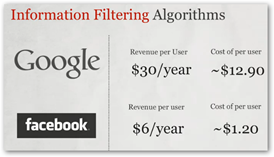
I have featured the good doctor over at the Algo Duping/Attack of the Killer Algorithm pages before and here we have an update since that lecture and guess what, he’s giving us the very same warning again. The algorithms are running the financial market and as I said not too long ago, that’s the problem with Obamacare too, same model algorithms not playing well together. We are still stuck with a Congress that can’t see this yet. They are still stuck on asking the FDA about emails and probably not in touch with what the FDA has going for us. Sure FDA is not perfect but they are miles ahead of most other HHS departments by far.
61% of all Internet traffic is non human..it’s algorithmic. He describes all the algorithms that load when you land on a web page. This is where the FTC has lost control by their own admission.
We actually need algorithms to navigate the complex world we have today, but who’s are they and who are they serving and do they serve our best interest? Go to the Algo Duping page and watch the 4 videos in the footer of this blog to understand how tis works. Larry Ellison has been giving us warnings too and he knows it as he grew the business and creates software for efficiencies and not just mining and selling consumers by all means.
It was also good to see the folks at Nanex finally validated from an unusual source, Goldman Sachs as they did the Flash Crash for the SEC and were right on the money and for years people have been ignoring the fact that the mathematical algorithms are ruling and more so those who have control over how they run. Keep in mind that health insurers are hiring quants like I’ve never seen before as well, the folks who create the models. Better come out in the front before someone wants to see your proprietary code I guess with Goldman.
He goes into the Algorithms reading the news, and watch Video #2 below, Quants of Wall Street for more on how this works. Eric from Nanex and I had this conversation too about the rise of the new “journobots” and Professor Charlie Siefe (Video #1 below) has a new book coming out, one chapter all about the “journobots”…and I have said this in previous posts and why do you think Bezos bought the Washington post. He wants to make sure he has some kind of say in what kind of news gets reported. Eric basically said if there’s an element that can be created to control, they will do it. So again with news integrity could that gamed? Sure it could without someone watching the shop.
Mr. Gourley goes further into privacy and the algorithms holding part or a big chunk of your identity, which is also known as the “data selling epidemic”. Larry Page was dreaming a bit at TED last week with medical records you might say too.
Look at the image to the right, what are we? We’re the “free” product and servants to the Algorithms. At the end he says the same been said here is that we have to figure out what our relationship will be with the algorithms. There are those that will “dummy you down” as well and this is where inequality is modeled, with the algorithms, the system is rigged and the US is no longer the land of opportunity any longer as there’s some algorithm that going to deny you access to something, again still designed by humans. It’ no longer a fair playground so be aware and be a skeptic when you need to. That image again is pretty scary to see our value versus a bot. Watch out for the use of Quantitated Justifications to make money for things that are just not true as well. Watch both videos at the link below and see how bots can write news, books and make videos. This was what the whole Occupy Movement was about as I state when it began and even the protesters didn’t understand but knew something wasn’t right and this is it. BD
 tend to run for the hills, but at least this time we didn’t have the usual default topic of Women’s Health run up the flag pole. I have already kind of figured it out that when laws require a lot of math and financial calculations, they run over to talk abortions. So again at least we were spared that show this year. I did watch a few minutes of it and Senator Coburn made some good points about his disgust in not being able to fix the SGR. He got into the math and fake formulas and I like to see that addressed no matter who it is, but it all could not come together today. That Plos One study is looking more accurate all the time as it states the fear of math gives people “real physical” pain:)
  and debug and debug. It was kind of nuts earlier this year when CMS was not going to test end to end and said the roll out date was firm, so yeah we heard that one before with Healthcare.Gov and there’s still issues. This way too if there happens to be any code that has not been completed yet, they have time. The ICD10 add on was not really discussed and was just put there so I don’t that was an issue with either side to agree on it. Sure there has been a lot of money spent I recognize that but if a delay means better preparedness and roll out, so be it with the complex IT Infrastructures out there. In the House we had this and tacked on 5 years for the insurance penalty of the ACA. Who knows that could still happen somewhere else.
  This is part of every major web service around but the timing could not be worse. Hopefully it runs as needed and nothing out of the ordinary occurs to delay it even further. I’ll say one thing, the government sure has learned a ton of lessons today when it comes to complex IT infrastructures.
  healthcare, I’m seeing more and more of this with one hospital system doing very well, like UPMC, a non profit with a billion a year in excess revenue (that is profit talk for non profits) and then others struggling. So much of the time we see news articles that state the ones having problems “don’t operate efficiently” and while there may be some truth to some of that, the divide here is growing all the time and that can’t be the only reason for the disparity. Health IT can’t solve it all or even work at all in some areas to where the cards dealt vary so much. Below you can read about the City of Pittsburgh suing UPMC as they could use some of that money. Again you may have real estate that gets sold, you have to look at the demographic areas the hospitals serve and last but not least, reimbursement as that can be all over the place.
  out of money and it barely made the news. Again are we going to do the same “shame” story here again and blame management for all of it when in fact there were many issues that lead to this? It seems to be what you read anymore with folks searching for a simple reason for this re-occurrence that keeps happening? It is time to stop to stop beating that drum and do some better in depth studies as to why this keeps repeating itself?
  of the Killer Algorithms
 the hospital with 66 cents for every dollar spent so there’s the gap. The hospital relies on Medicaid funding. The state has underpaid for years so again we have hospitals like UMPC making a billion in excess profits for a non profit and then we have one like this that can’t keep their doors open. Profits and losses for hospitals are all over the books.
  of the state of Maryland, perhaps it could be used. Each state model was different and had different contractors and some same and some different technologies used. Deloitte is the one being called in to fix this one and they have had some bad situations too so there’s big hero contractor that can fix all.
  We can’t slow technology down but we can control the rate at which we absorb it personally. We can’t control though how it evolves around us and it confuses people. What’s real and what’s virtual?
  benefit? A lot of bots and the company that owns them and makes money from them…bots are worth about $100 and humans are worth zero and are basically tech slaves. Sure some folks will get internet connectivity and that’s not a bad thing but at a cost and it will support the growing world of bots and their profitability not the humans as we become what Dr. Gourley states, the techno slaves that only fill in where the bots can’t go.
  meant to replace electronic medical records at all but it can be used in an organized formatted process when needed and data gets entered later. What’s wrong with this? If used this way, paper saves lives and doesn’t kill, as again it’s only temporary and folks are smart to have a back up system that can be used immediately.
  He is stating that his medical records were shared with the police department and this was aimed at discouraging him from filing a disability claim. If he is in fact not able to serve then perhaps disability is in order? I see the other side too with looking for abuse of the system being something to be aware of too and from what I read in this article there’s a few other “stress” cases pending as well. Is the effort to save money coming down to more scrutiny on disability claims too?
  were let loose in July. It just so happened that this all occurred a few weeks after the company had changed to a funded insurance program. If you watch the video you can
 It’s so bad now that hospitals are afraid of running out. How about a virtual experience with saline or nitroglycerin? Well I’m afraid it just doesn’t exist and this is the real world here, the one we live in. The tablet and other versions seem to be ok but the ER is the place where the drips are needed.
  health information.
  an app to commercial businesses. What does this mean? Well your local convenience store, gas station, hospital, etc. will now be able to use the technology once they find a developer to write the software application for them to match against know criminals on file. It’s not cheap if you want 500,000 transactions a month so it all depends on how busy the area one would be monitoring is.
  and contains the information on a temporary bases from the servers where the patient medical records are stored. If I am reading this correctly after the devices is inactive or no longer in use, the connect where a temporary cache of records stores the data goes away.
 video below. When I was at HIMSS in 2008 I ran with this demo on a tablet and those were the “earlier” days of EMRs and it was so funny back then as all the vendors were asking me “who’s system is that” thinking they had missed something. It was a demo I picked up at a Microsoft Tech Net meeting but did great for demonstrating a tablet, which is why I was there. See how the two designs here share some familiarity? Sometimes technology has has brew a little bit and parts of it comes back in different places and in different ways. This demo in 2008 was way ahead of what was out there.

 kicking out a check for over $175,000 to fix a hammer tow in New York. A few months ago they bid and won a contract in Maryland and the county has to rescind it as they had no doctors in the area to see the patients, which was a retiree HMO plan.
  The algorithms are running the financial market and as I said not too long ago, that’s the problem with Obamacare too, same model algorithms not playing well together. We are still stuck with a Congress that can’t see this yet. They are still stuck on asking the FDA about emails and probably not in touch with what the FDA has going for us. Sure FDA is not perfect but they are miles ahead of most other HHS departments by far.
  they did the Flash Crash for the SEC and were right on the money and for years people have been ignoring the fact that the mathematical algorithms are ruling and more so those who have control over how they run. Keep in mind that health insurers are hiring quants like I’ve never seen before as well, the folks who create the models. Better come out in the front before someone wants to see your proprietary code I guess with Goldman.

 to make sure he has some kind of say in what kind of news gets reported. Eric basically said if there’s an element that can be created to control, they will do it. So again with news integrity could that gamed? Sure it could without someone watching the shop.
  the system is rigged and the US is no longer the land of opportunity any longer as there’s some algorithm that going to deny you access to something, again still designed by humans. It’ no longer a fair playground so be aware and be a skeptic when you need to. That image again is pretty scary to see our value versus a bot. Watch out for the use of Quantitated Justifications to make money for things that are just not true as well. Watch both videos at the link below and see how bots can write news, books and make videos. This was what the whole Occupy Movement was about as I state when it began and even the protesters didn’t understand but knew something wasn’t right and this is it. BD