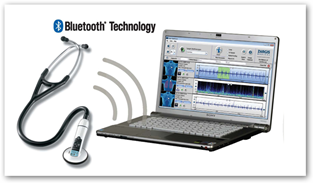
Bluetooth stethoscope Available from 3M HealthCare – Wireless Heartbeats

With the device and software, you also get a visual as well as sound.  The price is not cheap at almost $400.00, but in time like everything else it may imagecome down in price.   The sound file can be stored on a PC, and well, better yet think about Personal Health Records too, the heartbeat of your PHR.  HealthVault I know is working with connecting more devices to, so perhaps in time an interface that would allow the sound file to be share with the PHR too. 

Just think, our heartbeats are becoming a permanent record here, and you can listen at any time, or if you want to get out a little bit, think of the sound file as a new “ring tone” for you cell phone. (grin).  If you are a cardiologist, you can get ready to start storing some data and perhaps even use the software and information to compare.  Our heartbeats have now gone wireless.   While we are on the subject, don’t forget the blue tooth inhaler soon to make it’s mark.  BD 

From the website:

3M has partnered with Zargis® Medical to bring you two great software programs that work with your 3M™ Littmann® Electronic Stethoscope Model 3200.

Zargis® StethAssist™ software, included FREE with purchase of a Littmann® Model 3200 stethoscope, helps you visualize and share heart and lung sounds.

Zargis® Cardioscan™ software, sold separately, helps identify suspected heart murmurs with a Class I indication.

That ubiquitous symbol of the medical profession, the stethoscope, is finally undergoing a 21st century tech makeover. The next time you drop by the doctor's, his acoustic listening implement may well sport Bluetooth connectivity and an LCD panel.

3M Health Care has announced the Littmann Electronic Stethoscope, which packs features most headphone users would be familiar with, such as noise cancellation and greater sound clarity. 

With the souped-up hearing, the Littman then transmits lung, heart, and body sounds wirelessly to the bundled Zargis StethAssist program for further analysis, as well as to keep a record on file. Which is all good for patients and physicians. That said, the cost has also been upgraded to a pricey $379, which hopefully won't trickle down too much on your next visit to the clinic.

image 

Bluetooth stethoscope: The better to hear you with | Crave - CNET

eClinicalWorks Partners with Correctional Medical Services, Inc.

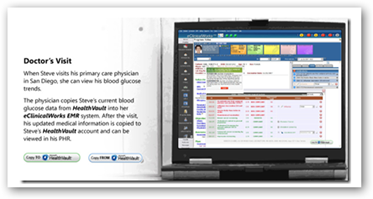
One more big move for eClinicalWorks in the expansion of EMR/EHRs, this time with correctional facilities.  I believe that eClinicalWorks was a big pioneer in working with their software as it certainly seems to be very popular as an ambulatory medical records program, and they were the first EMR to connect with Personal Health Records too, Google Health and HealthVault.  We also see a version at CVS Minute Clinics too.  Again, their system appears to be the “most connected” medical records system on the market, and even available at Sam’s Club too.  I believe there is also a Linux version so again, that would really stand to expand their horizons with interoperability in many scenarios.  BD 

The Relationship will Bring Together Award-winning Electronic Medical Records System and Health Services Provider to Improve image Communication Among Providers and Patients within Correctional Facilities WESTBOROUGH, Mass.--(Business Wire)-- eClinicalWorks, a market leader in ambulatory clinical systems, today announced that the company has entered into an agreement with Correctional Medical Services, Inc. (CMS), a leading provider of health services for prisons and jails nationwide for over 30 years, to provide its electronic medical records (EMR) solution to correctional facilities affiliated with CMS. CMS facilities using the eClinicalWorks EMR will be able to streamline processes and promote patient care.

image

The system will also permit providers to utilize chronic and preventative care measures, including those that are unique to this setting such as suicide watch alerts and detox monitoring. eClinicalWorks will work with CMS to enhance its Electronic Medication Administration Record (EMAR) as well as intake process flows and a mental health module.

eClinicalWorks Enters Partnership with Correctional Medical Services, Inc. | Reuters

Related Reading:

Connecticut’s Stamford Hospital Selects eClinicalWorks To Connect Physicians - Software as a Service

Sam's Club – eClinicalWorks – Here’s the Web page…

HealthVault Connects with eClinicalWorks EHR, NextGen EHR/EMR Systems and more…Shop Wal-Mart (Sam’s Club) in the Spring

HealthNet in Indianapolis Receives Grant for EHR/EMR systems – eClinicalWorks Selected
eClinicalWorks Users Annual Meeting – Integration and the Future of EHRS and PHRs
eClinicalWorks Electronic Medical Records Scores with 2 new large installations
Tufts Medical Center In Boston to Subsidize EHRs
Hoag Hospital Selects eClinicalWorks for Its EHR Subsidy Program- Newport Beach, CA

Republicans Abandoning Health Care Talks? – Grassley Raising Money for Re-election By Opposing Obama HealthCare Reform

The opposition is ready and has a commercial to debut on television, video below.  Back in January though, I watched the film put out by the Senate Finance committee and didn’t see anyone in the room who knew much about electronic records and none seemed to know what a PHR was, so how imageinvolved in their own healthcare are our Congressmen and Congress women?  It’s just my opinion here but I certainly think some first hands on experience on what is to be prescribed for the rest of the citizens can’t hurt, so we don’t end up with “Magpie Healthcare”.  BD 

It's increasingly clear that the Obama administration's health care reform plan will happen via budget reconciliation, which requires a simple majority in the Senate instead of a filibuster-proof majority. 
At his briefing earlier today, White House Press Secretary Robert Gibbs blasted Sen. Mike Enzi (R-WY) -- one of the "gang of six" negotiators on the Senate Finance Committee seeking a bipartisan health care compromise -- for repeating "generic Republican talking points" in his party's weekly radio address.


This comes as news breaks that Sen. Charles Grassley (R-IA) -- the top Republican on the Senate Finance Committee -- is actually raising money for his re-election campaign on the basis of stopping President Obama's health care reform efforts.

Republicans Abandoning Health Care Talks? -- Taegan Goddard's Political Wire

“Fatostatin” – 3 In One Drug – Lose Weight, Reverse Diabetes and Lower Your Cholesterol

I do like the tagged name, “Fatostatin” kind of says it all and does it all.  It is working on mice and now if it will work on humans, well we might be onimage to something.  You can do three things with one treatment/pill, lose weight, reverse diabetes and lower your cholesterol.  All that seems to be missing is blood pressure regulation. 

Don’t get too excited yet, it is still in the very early stages so stay tuned.  BD 

WASHINGTON (Reuters) – Researchers searching for a cure for obesity said on Thursday they have developed a drug that not only makes mice lose weight, but reverses diabetes and lowers their cholesterol, too.

The drug, which they have dubbed fatostatin, stops the body from making fat, instead releasing the energy from food. They hope it may lead to a pill that would fight obesity, diabetes and cholesterol, all at once.

Genetic tests showed the drug affected 63 different genes.

The drug also had effects on prostate cancer cells they said -- something that may help explain links between prostate cancer and obesity.

New fat-fighting drug has anti-diabetes action too - Yahoo! News

CVS Caremark to offer free Flu Shots for unemployed – Minute Clinics and Vouchers

If you get your shot at a Minute Clinic, add it to your PHR, HealthVault or Google Health.  A few weeks ago I had a little time and spoke to a physician’s assistant at one of the Clinics in Orange County.  We talked about the PHRs and she was right up to date on how to guide a patient into the process, impressive!  BD 

WOONSOCKET, R.I. (Aug. 31) CVS Caremark is offering 100,000 free seasonal flu shots to those who are unemployed as part of a nationwide flu vaccination effort, the company announced on Monday.

The program will include on-site flu clinics at One-Stop Career Center locations and distribution of vouchers for free flu shots at CVS/pharmacy or MinuteClinic. One-Stop Career Centers offer tools and training to job seekers.

In addition to offering $3 million in free flu vaccinations for the unemployed, the company is offering several options for consumers to get a flu shot.

Beginning Sept. 1, seasonal flu shots will be available daily, without an appointment, at more than 500 MinuteClinic locations. Starting Sept. 15, more than 9,000 flu shot clinic events will be held in select CVS/pharmacy stores nationwide. Vaccinations are covered by more insurance plans.

CVS Caremark to offer free vaccines for unemployed - Drug Store News

Heidelberg MEDDAC Orthopedic Clinic Writes In To Tell Us Their Success With Using Dragon Naturally Speaking

This was a comment made under an old post and deserves it’s own post.  Hats off to Dr. Morgan who took the time to add his comments on how speech imagerecognition is working in Heidelberg, Germany.  When a physician in our military overseas takes the time to write and comment at this blog, it gets it’s own post by all means, especially when we hear from the Chief of Surgery!  We appreciate what you do for us!

He did say there was a learning curve but it was not necessarily the speech recognition on it’s own, there was the integration with the AHLTA EMR system, which in 2008 at HIMMS I was able to see with a short tour provided by the individuals from the military at their booth.  Thank you again for taking time out to write!  BD 

U.S. Military Embraces Nuance's Dragon NaturallySpeaking Medical to Drive Clinical Documentation with AHLTA

The use of Dragon Naturally Speaking along with text expander software As-U-Type has dramatically altered the productivity in the Heidelberg MEDDAC orthopedic clinic. We are now able to interface with a cumbersome EHR (AHLTA) in a more efficient manner. After designing a clinic around these new interfacing modalities and giving the providers some time to fully implement the new software, the productivity per provider skyrocketed. 2 Surgeons were able to perform 80% of the RVU's that 5 Surgeons provided a year earlier. image


The implementation takes some time and there are some significant learning pains to break through. After we broke through these pains, we noticed that we were happier in our practice and our patients appreciated our efficiency. Patient complaints dropped and satisfaction with the office visits improved.

Jeffrey S. Morgan, MD
LTC MC US Army
Chief of Surgery
HMEDDAC

Related Blog Post From Federal Telemedicine News

Related Reading:

New Study Shows Nuance’s Dragon Medical Accelerates Transition to Electronic Medical Records

Nuance Previews Enterprise Workstation Version 8 at HIMSS
U.S. Military Embraces Nuance's Dragon NaturallySpeaking Medical to Drive Clinical Documentation with AHLTA
Nuance and IBM to license and integrate speech technologies
Nuance to Acquire eScription...software as a service...
Nuance takes over Philips Speech Recognition Systems
More Than 70,000 Healthcare Providers Use Dragon Medical for Voice-Driven Clinical Documentation

U.S. Congress has an inadequate understanding Value of Health IT – HIMMS Opening Session

Vice President Joe Biden Talks About Healthcare Reform – White House Wants Videos from Citizens

image

Joe Biden states his feelings and the problems with health insurance and is asking for citizens to contribute questions and videos. 

There’s a new online tool to find out how reform will help.  It takes a minute or two and answers are given after answering your questions.  Also, they want videos for the White House website with stories from citizens telling their stories and will be posting this week.  This sounds very similar to what Michael Moore did with Sicko not too long ago, bringing the issue to the forefront too.  BD

http://www.whitehouse.gov/realitycheck/771?e=12&ref=image

Health Fraud Scores Could Be a Contributing Factor to Medical Claims Being Denied

To help fight fraud, your healthcare claim could be getting a big “score”.  In other words we are once again depending on those algorithms to determine what couldimage be determined as fraud.  If your claim gets a “big” score, then perhaps the red tape and battle is on.  This is somewhat the same technology that is used by the banking industry; however, in healthcare items are not as cut and dry, thus we will have even more calculated and derived algorithms to better mine the functionality of this process.

Insurers state they do not use these algorithms to deny claims, but rather bring it to the attention of someone to review, and well we all know what that means, delay and whatever else comes down the tubes there to prove that the claim is legitimate, regardless of what type of “score” the algorithms produced.  This is known as a “false positive” where you may have to somewhat prove your authenticity and innocence and the fact that you need care! 

Once a fraud investigation begins, forget HIPAA, as there is no privacy here and the investigating process does not protect your medical records as they become part of the investigation process, and contractors are required to meet HIPAA compliance, so when your medical records are viewed with an fraud investigation, who gets to see them?   The information is supposed to ignore names, social security numbers, etc. but one fraud program from Ingenix included the patient address to score to see if the patient is traveling to receive medical care, one additional parameter used to create the “score”.   

algo

Are We Ever Going to Get Some Algorithm Centric Laws Passed for Healthcare!

As a physician, if you want to see how much information is out there on the web about yourself, sign up for the free NEPSI e-prescribing program and you will be presented with a number of questions to answer to ensure that it is in fact really you signing up.  You will see questions that ask about where you lived 20 years ago and perhaps even names of individuals you know present and in the past that pretty much only you will know

the answers to, this is data mining and is actually a good thing to prevent someone fraudulent from signing up, but on the other hand, welcome to internet data mining, an eye opener.  I have had this conversation with a few physicians that were amazed at what was presented in the way of questions. 

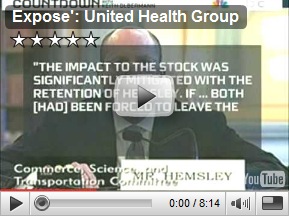
In a related video, Keith Olbermann takes a look at healthcare reform and traces back the history of Mr. Hensley of United Healthcare and the Arthur Anderson connection where he was formerly employed along with the back dated stock options where investors sued twice on this issue.  Also discussed is the losing proposal of “co-ops”.   We learned that lesson a long time ago in California.  I watched “co-ops” become useless in another industry, logistics, a number of years ago as marketing and sales strategies changed, the participating companies just would come in and cut the rates of the “co-op” to a lesser amount, so there went the pricing benefit.  Also, the way the “co=ops” were formulated in logistics and worth a mention is that they were a “non profit” organization and all members were also responsible for any legal actions and debt too.  I am not totally familiar with the way they are being proposed in healthcare, but if this item is included, beware of one more snag with a “co-op” proposed solution. BD

Goldman Stolen Code – Has Algorithmic Fraud Become A Business Model in HealthCare Too?

The political pressure to reduce health care costs is forcing many health insurance companies to reconsider how they detect and combat fraud. Health insurance fraud is estimated to cost insurers at least $68 billion to $70 billion a year, or 3% of total health care spending,

according to the National Health Care Anti-Fraud Association, or NHCAA, an industry group. (Fraud includes health care providers billing insurance companies for procedures that were never performed, performing services that are not medically necessary or overcharging for services.)

To detect fraud, insurers have historically used a so-called pay-and-chase method: They reviewed claims after paying them, and if fraud was suspected, they tried to recover their money. It was no easy task -- the worst case scenario could involve expensive collections efforts or lengthy courtroom battles.

Claim Denied? Health Fraud Score May Be to Blame at SmartMoney.com

Related Reading:

“Department of Algorithms – Do We Need One of These to Regulate Upcoming Laws?
Are We Ever Going to Get Some Algorithm Centric Laws Passed for Healthcare!
Goldman Stolen Code – Has Algorithmic Fraud Become A Business Model in HealthCare Too?
AARP Is Just Caught in the Middle of the Debate – Its the Algorithms That Call the Shots, Not Memberships in Senior Organizations
Health Care Insurers Suggest Algorithms and Business Intelligence solutions to provide health insurance solution
Is This a Case for a New Law – Illegal Algorithms? How Do You Sleep at Night Rockefeller asked the CEO of United Health Care
The 2 New Hot Words in Healthcare: Algorithms and Whistleblowers

Public Shredders Please! Medical Record Dumping On the Rise

It seems like there’s at least one story a week arising any more on paper records with medical information that could very well be used for identity theft.  We go to the gas station to get air and water for our cars and drop in 75 cents or a dollar, can’t someone do the same to allow people easy access to shredders?  Sure they are available at the store for purchase, but having a convenient location to handle this certainly would be a plus, and then I wouldn’t have to post articles like this too.  Here’s part of a post just from last week below.  BD 

We Need Public Shredders – More Paper Medical Records Found in a Dumpster

Somebody is missing the boat here, with all the emphasis on properly disposing of medical records, why do we not have public shredders?  You could imageinsert coins for the number of minutes you think you need and go to town.  We do that for water and air for our cars, so why not.  At least it would give people an outlet instead of records left out to expose personal identities.  Not too long ago a doctor burned down his house trying to burn the records in his chimney which got too hot and led to the house catching on fire.

(Greece, N.Y.) - Records found at a Greece apartment dumpster could have led to the identify theft of hundreds of people, if not for the actions of one woman.
Something about a rusted Ford pickup caught Wendy Tascione's attention.  She snapped a few photos while she watched…nine file boxes of full of personnel files were tossed into a dumpster.
”I thought, ‘Holy crow! This is somebody's information!" Wendy said. "There are just some things that I know that aren't right, and that was one of them."

Medical Records Tossed Into Dumpster - 13WHAM.com - Rochester News, Weather, and Sports

Related Reading:

Burning Medical Records Found Near Shopping Center – Paper Records Bon Fire in Kentucky

Where’s the Stimulus Money for Paper Shredders – We Could Certainly Use a Few More

It’s Raining Medical Records…They’re Blowing in the Wind
Stolen Maine hospital records found
Man Finds Thousands of Medical Records in Storage Unit he won with a bid $25.00 for the unknown contents
Hospital records in the wrong hands - patient given his records and those of 4 others
Medical records sold to teacher as scrap paper
Medical Records Found Dumped In Dallas Trash Bin
One New Dumping Ground in Texas for Paper Medical Records - Goodwill
Grocer finds medical records in Dumpster in Shreveport

Medical records found in apartment complex trash bin

Burning medical records results in fire in chimney

Social Media and Healthcare – It’s not Just for the Kids, Folks Over 50 Get It Too

This is great post to make a point, as I hear so much of the time from physicians, “my patients don’t know how to even use a computer and they imagewouldn’t use this, it’s a waste of time”.  Is it maybe the perception model being a little off here?   Here’s a case of a physician that sees it quite differently and if you read the entire post at the link, he rolls out some number too, 6 patients seen on Monday who found him through Facebook, Twitter or his own web site, in other words patients are out there reading and looking.  Tuesday, a bit more of the same, 2 new patients via Twitter were seen.  

Also worth noting here is the fact that he calculated he saved his medical assistant 2 hours of time pulling charts, etc. via the use of email.  I think this is great that time was taken to make note of this and perhaps others may listen up here too.  It’s not going away by any shape or form.  One observation of my own that I see quite frequently too is the use of e-prescribing or should I say the non-use. 

An office that is not using this technology has reams of paper flowing off the fax machines, phones ringing with pharmacies calling,and medical assistants running like crazy to keep up, and this too takes time away from being with patients.  Even if you have not gone with a complete electronic solution, just baby stepping in this direction is worth hours of removing the “Chinese fire drill” to the fax machine and the medical assistants once they are trained and using it, appreciate it as they are now free to spend more time with the patients and physicians.  I have made that comment quite frequently over the last few years, “why are you making the job of your medical assistant so chaotic”.  BD  image

Many social media "experts" my group has interviewed to help us with our #hcsm outreach have discounted the *elderly* and spoke of "their lack of adoption" of social media or electronic means of communication with a physician office.   I am here to tell you that those assertions\assumptions are patently false.  This week I received a communication from an 80+ yr old who recently had a total knee replacement.  They vacation up north and sent me a follow up picture of the wound and an embedded video of their gait!!!  It was incredible... and a phenomenal use of the various communication tools available to patients and physicians.

Furthermore, this week I received 65 emails from patients.  The vast majority were from patients over the age of 55.   Even when controlled for the avg age of all patients who emailed me that week, it was clear that the *older* patients are adopting digital communications and social media at a rate higher than that of younger generations.  It might not be a scientifically proven trend... but it is very encouraging.  This trend has certainly had an impact on the demographics we will target in any social media outreach program or campaign we use to engage the #health2.0 consumer.

My Experience with Social Media, Email and Healthcare #hcsm #hcr - The Orthopedic Posterous

Don't Drink Alcohol? You Have the Higher Risk of Depression – Study and Survey

This is the best research I have seen in a long time!  It is even in the journal “Addiction”.  Of course excessive drinking as we all know does not help your health, but if you stay within guidelines you are less apt to be depressed, so bring on the martinis, only one or two please.image

It continues on to say too that those who are abstinent could also develop signs or personality traits associated with mental illness, so one more potential reason to have a drink here and there, maybe?  Well I certainly don’t want to be depressed and I’m going to do my part, how about you (grin).  We talk about preventative medicine and lifestyle and perhaps this is one more missing piece of the puzzle.  It makes a great post too!  BD

Researchers writing in, ironically, the journal Addiction have associated abstaining from alcohol with an increased risk of depression.
Doesn't make sense, right?   Excessive alcohol consumption has been linked to poor physical and mental health but they cite evidence saying that levels of alcohol consumption that are too low may also be associated with poor mental health possibly - obviously, abstainers may have other issues or even be reformed heavy drinkers.

Those individuals who additionally labeled themselves as "abstainers" were at the highest risk of depression. Age, physical health problems, number of close friends or other factors can  explain some, but not all of this increased risk, they write. The authors also had access to reported levels of alcohol consumption 10 years prior to the main survey. This showed that fourteen percent of current abstainers had previously been heavy drinkers, but this did not explain all of the increased risk of depression amongst abstainers.

The authors conclude that in societies where some use of alcohol is the norm, abstinence may be associated with being socially marginalized or particular personality traits that may also be associated with mental illness.

Don't Drink Alcohol? You're More Likely To Be Depressed, Says Study

HealthCare Reform is a World of the Unknown – And the Same Can be Said For No Reform

I think this CEO of this small hospital system summed it up quite well, and in my own opinion, we need those Algorithmic Centric Laws as nobody really knows how they will be interpreted…

UNLESS and UNTIL….image

The computer code spells it out as 1000 pages of text doesn’t do much other than make a lot of money for attorneys anymore who try to figure out which and what algorithms apply, ask an office that specializes in this, they can tell you what they investigate and what they do.  So why do we not spell this out in logic terms and have correct and certified algorithms in the first place, unless we like killing time and wasting the time of others. 

We don’t live in the 70s where a text driven document says it all anymore and the algorithms say it and do the work.  If we spell out the algorithms at the start it would even cut short the amount of time the legal process has to go through as it would be spelled out and it would be open source for all to see how the formulas are run, instead of the deep dark hole we live in today with “propriety algorithms” that make a lot of money off of transactions when we could do it first hand, and yes there would be “algorithm updates”, as that’s just the world we live in, but just like Windows updates they could be easily distributed. 

“Department of Algorithms – Do We Need One of These to Regulate Upcoming Laws?
Are We Ever Going to Get Some Algorithm Centric Laws Passed for Healthcare!

The post post above  makes a very close comparison to the money making algorithms of Goldman and what is used in healthcare, worth the read and learn what potentially fraudulent algorithms or computer code is all about.  In the meantime we all sit waiting for a Congress to stop the meaningless talks and get logical to give us some real figures and information we can listen to and work with, as right now their lack of education and hands on experience with even some of the most simple matters is holding up the entire country.  We would like to see educational and literate action and not another series of Town Halls videos that hurt people and have little or no effect other than running up news ratings.  I will keep saying that learning needs to start at the top and again, not to beat a dead horse, that that “dud” town hall meeting this week really cinched it for me as far as seeing the big white elephant.  BD 

Goldman Stolen Code – Has Algorithmic Fraud Become A Business Model in HealthCare Too?

AUSTIN -- Charles J. Barnett's fears about a federal health-care overhaul are outrunning his hopes.

From his perch as the chief executive of a nonprofit hospital network that draws patients from 11 counties in Central Texas, Barnett sees plenty of problems in desperate need of fixing, especially in a state with a higher proportion of uninsured -- nearly one in four -- than any in the country. He has hopes for reform, particularly a larger pool of insured customers.

But then the what-ifs take over.  Margins are so fragile in health care," Barnett said, "that small, negative, unintended consequences can have a dramatic impact."

The mere act of providing coverage to more people would produce a new order of challenges in Travis County and its surrounding jurisdictions, where experts say doctors are in increasingly short supply. One in 10 Medicare patients already reports trouble finding a doctor and Seton projects a shortage of 2,900 physicians in the 11-county region by 2020, even without adding people with new coverage.

Hospital Executive Worries About 'What-Ifs' of Health-Care Reform - washingtonpost.com

Quicken for health benefits Discussed Again – Where Will the Education and Participation Come From?

First of all I am not picking on Quicken Health here as I understand the process of the programmatic algorithms used in conjunction with insurers and personal health records and this is a huge learning curve.  So huge, that I want to make a point of educating our leaders and all of US citizens on the changes in healthcare. 

UnitedHealthcare To Offer Quicken Health Expense Tracker to 700,000 Employer Health Plan Enrollees

Cigna to Offer Quicken Health Expense Tracker, United HealthCare in Beta – Easily Identify Balance Billings?

To those people who are very satisfied with your health insurance, how much have you used the plan and maybe even more importantly, how much have you used any of their technology solutions????   Big blank here???  If you do use the technology solutions you would be aware of the rapid changes taking place. 

It is difficult for me to help many when this is in fact “way over their head”.  Now I’m not talking just citizens and would like to once again make reference to the “dud” Town Hall meeting I attended this week by accident.  I say by accident as there was no prior notification and the phone just rang and said something to the tune of “Honey I’m Home, drop what you are doing and bring my cold beer” type of connotation.  This is reality and not what is seen on the internet, at least in my tiny corner of the OC, where we use new technology and yet still live in the 70s. 

If I had the chance to speak, well who knows what could have transpired.  Over all it was an amazing day in California, our very tech Governor visits Twitter and I get a Town Hall Meeting out of the 70s in the OC.  If you read the post, I have clearly given recognition too for those Congressmen who are using technology and I feel are perhaps a bit more in touch and are learning and making efforts. 

My Dud Telephone Town Hall Meeting from the 70s in the OC – HealthCare Was Primary Focus

When it comes to code and computer algorithms, there must be a lot of interest in this stuff as HHS had to turn folks away over the overwhelming response. 

image

The point of my rant here is to bring up education and the fact that we have people at so many levels on the learning curve, Congressmen from the 70s included, and if they are not using a PHR yet for healthcare information, how in the world are they going to learn how to use Quicken Health?  Do we need some big baby steps here and some basic PHR Training at all levels if we expect everyone to use them?   We had to learn how to use Windows before we could use Office type of analogy here.  We need some congressional algorithms here.  I know Intuit reads here so I hope I have not said anything in a negative fashion about the software, it’s just the the educational needs are huge and we need participation and education to benefit from using software.  BD

If you have health coverage, perhaps you've received that ominous-looking piece of mail from the insurance provider that declares: "This is not a bill," but looks a lot like one.

It’s called an "explanation of benefits." But the correspondence doesn’t seem to offer much of an explanation to anyone who lacks a medical degree or background as a company benefits manager.

Quicken for health benefits? - Fortune Brainstorm Tech

Related Reading:

Are We Ever Going to Get Some Algorithm Centric Laws Passed for Healthcare!

Cigna to Offer Quicken Health Expense Tracker, United HealthCare in Beta – Easily Identify Balance Billings?

IBM Files Patent For A TV Remote That Tweets

Interesting that IBM is looking to create some monetary action potentially here with a Twitter Remote.  This is just at the patent stage and if you image want more details, use the link below to read up at Tech Crunch.  Gee, everyone can walk around with their own Twitter remote soon, and just think how convenient it will be to Twitter from the OR or even the ER (grin, little satire here) just turn on the TV.  I am a big fan of Twitter but not sure if I want a remote 24/7 though as sometimes I like to escape Twitter World for a few hours or so and the remote might just do me in.  Psych drugs though could see an influx though as perhaps a new disease could be created with the addiction, “The Twitter Jitters” and we could have a pill for that too! (this is humor and don’t take this seriously unless you intend to create a disease that requires treatment). 

USA Today Talks About Twitter for HealthCare – Focus on TrialX to Locate Clinical Trials

Who’s next on the remote list, Facebook, well I guess they need to talk to IBM too.  BD  

 image

Slouchers on Twitter (you know who you are), take note: IBM is apparently working on technology that would enable you to blog or tweet straight from the remote control of your TV. The company has filed a patent for said technology with the USPTO, reports BaltTech.

According to the patent filing, the remote would even allow a viewer to not only communicate with a blogging service but also display responses to and from other bloggers with whom the viewer is communicating. That’s right, that means your buddies could be sending you an @reply or direct message with their opinions on the show (and the actress) and you’d be able to view the responses simply by using that super remote of yours.

IBM Files Patent For Geek Couch Potato Dream: A TV Remote That Tweets

Low Adherence for taking Medications – Its Those “Bad” Patients and “Bad” Doctors Again…

I just also read where UnitedHealthCare is going to offer a $20.00 discount today too on some of the higher priced drugs to encourage patients to take their meds. 

Well, with the stance of the FDA today on so many different drugs and information that is coming out, perhaps some consumers are doing theirimage homework first to make sure the drug is ok for them to take.  This is where medical records can be a big help in running the queries to see if in fact you may or may not be at risk with taking certain medications.  In the meantime, we have the reports that “bad” patients are not doing their part.

Is it money we want or good health?  At one time Aetna even had a “take your pill” lottery pilot program and I don’t know the latest on how it worked or if it did work.  

I’ll make one statement here for all of use patients:   Get us credible information on the drugs we take and let the informed patient work with their doctor to make these decisions.  We want to know if what takes care of our blood pressure today or cholesterol is going to choke out our liver in a few years for one.  Patients want to get treatment, but we also want to know every bit about the treatment and the cure, and with all the unknowns today in some areas, this is hard.  We want to know that the cure is not going to be worse than the condition, and number 2, we want to know that we can afford it! 

So, in short, let’s get the doctor/patient relationship back in hand here as that is the key, teamwork without everyone else butting in to make judgment on what is right and what is wrong. 

Give the doctors and the patients a break and quit categorizing us as “bad doctors” and “bad patients”, it’s getting to be a big annoyance and is very counter productive toward achieving better healthcare.  BD 

WOONSOCKET, R.I. (Aug. 27) More than 50% of adults under the age of 45 who are prescribed a medication to treat high cholesterol are not taking their medication as prescribed, according to the findings of a study released Thursday by CVS Caremark.

In fact, the study found that 58% of adults between the ages of 18 and 34 are not taking their cholesterol-lowering medications as prescribed.

The study examined adherence to cholesterol-lowering medications by evaluating de-identified data for more than 74,000 adult patients from the CVS Caremark Health Management Claims Database who incurred claims from a cholesterol-lowering medication between Jan. 1, 2008 and Dec. 31, 2008.

CVS Caremark study notes lack of adherence to cholesterol-lowering medications - Drug Store News

Cardiologists and Oncologists on the Brink with Healthcare Reform – Many State They Will Close Up Shop

This comes right back around to how doctors are paid with our fee for service arrangement.  These folks have families and bills to pay like the rest of us and if you put yourself in their shoes you might be feeling a bit of the same with going into an “unknown” area of compensation.  Algorithms are complicated today to determine everything related to healthcare. 

Some of most innovative areas of healthcare research and treatment though are coming from these same fields, cardiology and oncology and we need them to administer the treatment plans for cancer for one, and we need the cardiologist to work with us and development better lifestyles and imagetreatments for our hearts.  Oncologists have to pay upfront for the chemotherapy medications they keep on hand and sometimes there’s issues with compensation, many have even gone the route of paying out of pocket on some of expenses to take care of patients.  I chat with a physician who used to practice oncology and he gave it up a few years ago due to lack of compensation and turned himself into a family practice doctor.  He cited compensation and time and money for his reason to change so the trend is there and now he struggles with joining numerous HMOs for compensation and realizes he gets the “cherry picked” patients from the insurance companies but he did the math and found out that’s where he could do the best.  He’s not heartless by any means here and feels bad that he had to make these decisions as it wears on the patient/physician relationship, but it was just a matter of the system and the way he gets paid.  I do have to say this is the first time that I have heard any one physician be as descriptive, a good thing in a way as he is telling it like it is.
The “cherry picked” patients don’t take up as much of his time and he can see more this way.  The problem though is where does this leave everyone else as all doctors can’t rely on “cherry picked” patients by any means and provide good health care. 

The role of the cardiologist is changing rapidly too with technology as we have medical devices coming on the scene that help him/her and you the patient bring together treatment plans along with lifestyle.  We need those folks too, again as mentioned some of the most innovative technologies are being introduced and practiced in both fields. 

Both fields also have issues with health insurance reimbursements, I hear this first hand all the time, so we can’t ignore that fact and pretend it doesn’t exist, although at my Town Hall meeting this week, insurance reimbursement and issues were left wide out on the table with not much more said than “we are working on it” so I can’t even reiterate any potential solutions from what I heard. 

Granted, primary care needs money and are far underpaid in many areas, and they have taken their hit for the last few years and are the gateway to the specialists, but what do they do when the specialists are not there?   This is a big job to tackle and one issue rolls over into another area, so to put bandaids out there to fix one area and not do the other is futile too.  It all comes down to money and if the physicians were assured of income, well I bet we wouldn’t be having this conversation.   Technology can help in some areas, but the overall package of compensation needs a major overhaul so the doctors can figure out how they can pay their bills before we have the same thing with bankruptcies affecting doctors like what is happening to patients right now.  BD

Aug. 28 (Bloomberg) -- An Obama administration plan to cut Medicare payments to heart and cancer doctors by $1.4 billion next year is generating a backlash that’s undermining the president’s health-care overhaul.

While President Barack Obama and members of Congress have spent August debating health insurance and medical costs at public forums, specialists are waging what one advocate calls a “tooth and nail” fight against a separate initiative to boost the pay of family doctors, and cut fees for cardiologists and oncologists. The specialists, in newspaper columns and meetings with lawmakers, say patients will lose access to life-saving care, from pacemakers to chemotherapy.

“A fair number of cardiologists are looking at the accounting and saying ‘we can’t afford it,’” Bove said in a telephone interview.

Some oncologists in rural areas may stop offering chemotherapy in the office, forcing patients to travel to more- distant hospitals, said Allen S. Lichter, 63, CEO of the 27,000- member American Society of Clinical Oncology in Alexandria, Virginia.

If the proposal stands, “the bottom line is I’m going to close the office,” he said. “This is impossible for me to survive. If my partners and I don’t get a salary and run it for free, maybe then we can survive.”

Average total compensation for family doctors ranged from $150,763 to $204,370 a year, according to a 2008 survey by Modern Healthcare magazine. Cardiologists fetched from $332,900 to $561,875. Radiation oncologists, cancer doctors who specialize in radiation therapy, earned $357,000 to $463,293.

http://www.bloomberg.com/apps/news?pid=20601070&sid=apv3pcTOWVjk

Social Security Administration Linking Data with Microsoft HealthVault

If you are a regular reader here, I have been keeping up on the progress with Social Security and personal health records and now we are down to imagehaving a prototype linking the 2 together.  The main focus here has been for disability benefits.  Beth Israel Deaconess in Boston has had a pilot program ongoing for close to a year now with the exchange of healthcare data.  You can find more information under the related reading links below.

Social Security likes PHRs too – wanting to work with EMR and PHR software with pilot program

I have my 85 year old mother setup with HealthVault and I help her out and we work together on placing information in her account, to include her advanced directive and this is really helpful being we are geographically separated with me in California and her in Arizona.  It’s nice to have this digitally stored in case I need access should anything happen.  With disability claims this will speed up the process of getting information into the files and maybe even expedite the process.  In other related items Social Security is updating their data system to a more modern system before capacity is an issue with their current COBOL system. 

Social Security begins taking online applications – Available now

We are back to the algorithms that make this process happen, it’s all about software and getting collaborated and aggregated data where it needs to be.  BD 

The Social Security Administration is linking up with Microsoft to investigate ways that the software giant’s HealthVault personal health imagerecord could be used to speed the SSA’s disability benefits process.

A technical prototype linking the two organizations’ services is expected to be available later this year. The SSA said it will also collaborate with Microsoft on the study of current personal health records standards, and how any gaps in those standards could be bridged.

SSA has been working since earlier last year with both the Beth Israel Deaconess Medical Center in Boston and the Cleveland Clinic on pilot programs for doing just that. It’s also been working with two health information exchanges, the North Carolina Healthcare Information and Communications Alliance and MedVirginia, on ways to use the Nationwide Health Information Network (NHIN) for records retrieval.

Government Health IT

Related Reading:

Social Security budgets 24 Million for EHRs

Social Security likes PHRs too – wanting to work with EMR and PHR software with pilot program

EHRs go beyond treatment – Social Security Pilot Program with Beth Israel Deaconess Hospital in Boston

Social Security Disability - New Debit Card, Going Paperless
Social Security makes business case for interoperable EHRs with MedVirginia
New Data Center for Social Security as they face running short of space – Stimulus Funds

New CPT Codes - Billing Codes for Robot and Home Monitoring Services - Telemedicine

 That’s right, CPT Codes for Robots in the patient home, so all we need now are patients who have the robots (grin).  This is a further expansion of imagetelehealth.  These are for use in billing Medicare and Medicaid.  We have seen the robots used in hospitals that allow physicians to telecommute and this is the next step, in to the patient home.  The military even developed an all terrain robot for healthcare.  Unlike the ones in use at the hospitals, these do not appear to need a joy stick as they are “smarter” and made to be a companion in the home as well. 

Do you need to talk to your patient, send the robot in as it appears to be fully equipped and bill for it.   The video below is somewhat humorous in the fact that it reminds grandma to watch Jeopardy too.   The robot will carry bedpans around if needed and has a built in Blood Pressure monitor, Pulse monitor, or Oxygen if needed.  It appears now you will be able to bill for “robot time” as well as other telemedicine services that appear to be all tied into the code structure.  No word yet on the dollar amounts connected to the codes yet. 

How long before the CareBot talks to HealthVault too?  I had to add this in with all the other medical devices that now connect, so why not the robot too.  There are additional home monitoring devices included with the new batch of CPT Codes, such as items from Phillips, G.E. etc.  BD 

“The new CPT On-Line Service Codes allow payments to the physician such that a consumer can e-mail messages to a physician and/or they can receive payment for their review of medical information sent via a "home monitoring medical device."

“The Company's Mobile Security Robots (MSRs) augmented for Telemedicine allow health professionals and medical experts to remotely consult with patients and health care providers giving vital, cost effective, confidential medical services to virtually any location, rural or urban, national or international.   Using high quality cameras and data transfer, medical data, radiological images, sounds and patient records can be transferred from one site to another permitting physicians to consult with colleagues and specialized experts despite geographical separation.”

New Current Procedural Terminology (CPT) codes recently approved, for physicians only, will further enhance the cost/benefit ratios of personal companion robots for family care. 

These new CPT codes will increase physician productivity and revenue by billing for activities that have previously been considered unpaid administrative time for non-physical consultations such as telephonic or on-line consumer care using home monitoring medical devices. GeckoSystems is a dynamic leader in the emerging Mobile Service Robot (MSR) industry revolutionizing their development and usage with "Mobile Robot Solutions for Safety, Security and Service(TM)."

"The new Medicare/Medicaid payments for physicians' usage of home monitoring medical devices will cover multitasking, upgradeable personal companion robots such as the CareBot due to the cost effective, robust, and efficient coverage readily available with minimum modifications to the home itself other than the comparatively simple installation of WiFi coverage.

image

Wall Street News Alert: Hot Stock to Watch: GeckoSystems Intl. - August 27, 2009 | PHP Developer's Journal

Related Reading:

Military is Using Robotic Doctors too

Robots at Work in Orange County Hospitals – California
All Terrain Medical robot in development for the battlefield
Robodoc' coming to a hospital near you
Remote-Presence Robot Attends Patients at Ryder Trauma Center
Doctor monitoring via robot effective
Johns Hopkins demonstrates Robo Doc...
Remote-Presence Robot Attends Patients at Ryder Trauma Center
How technology is helping hospitals - UK
Doctor monitoring via robot effective
Johns Hopkins demonstrates Robo Doc...

The Genomic Test for BRACAnalysis (Breast Cancer) To Be Scrutinized by United Health Care

This is kind of a set back for women to find out if they have the potential of developing breast cancer, although it is not ruled out, the insurance company is starting a new procedure to having prior notification sent to their offices so they can monitor which patients are having the genomic blood test done.  United stated they may also contact the provider office to get additional information before an approval process takes place. image

The test costs $3000.00 and a spokesperson at United stated that 80% of the women being tested, should not be.  It appears if you can’t substantiate the test (and again I’m not sure how that is really done and what algorithmic formula would be used) you are on your own ticket to have to the test to see if you are more likely to develop breast or ovarian cancer.  Hopefully soon we may have a partial answer with complete sequencing taking place some day. 

Anyway, if you are covered by United you might be in for some more red tape to have the test covered and the articles says they will offer you genetic counseling.  It appears that having that upfront knowledge and having your carrier pay for the information that we thought was so great to know for early protection is suffering in the reigns and the availability to have the blood test may get a lot tougher.  BD 

United Healthcare is requiring that Myriad Genetics first inform the insurer before testing policy holders on its BRACAnalysis test to establish their hereditary genetic risk for breast and ovarian cancer.

"During the current difficult economic environment, United Healthcare recently instituted a prior notification requirement for BRACAnalysis," Gregory Critchfield, president of Myriad Genetics Laboratories, told analysts and investors during an earnings call this week. "We have been working very closely with United Healthcare to assist physicians [with regard to] UHC's prior notification policy."

By instituting a prior notification policy and placing Myriad in charge of determining which patients get tested, United Healthcare can monitor more closely which of its policy holders are receiving testing on BRACAnalysis. This type of strategy suggests that in the future, if United Healthcare finds that too many women are being unnecessarily tested on BRCA testing, the insurer may renegotiate its contract with Myriad.

In a July bulletin, United Healthcare informed Myriad that as of Aug. 16, the company must record and submit for verification the information required to assess a patient's genetic risk for the BRCA mutation and to make a coverage determination.

United Healthcare Issues Prior Notification Requirement for Myriad's BRACAnalysis Test | Pharmacogenomics Reporter | DxPGx | GenomeWeb

Related Reading:

Are We Ever Going to Get Some Algorithm Centric Laws Passed for Healthcare!
Brave New Films – “United Wealth Care” – It’s In the Algorithms
How Wall Street Lied to Its Computers – Software and Programming
Health Care Insurers Suggest Algorithms and Business Intelligence solutions to provide health insurance solution