Optum/United Healthcare Quietly Sold Optum Hospice to Compassus in December of 2016-And Compassus Is Now Contracted Under Optum Services to Manage the Facilities, Services and Provide the OptumCare Doctors

Optum certainly kept this very quiet when they sold their hospice facilities to Compassus and I don’t think they even told their own investors.   I could not locate any SEC 10k filings or even a Form D from a search I did and this sale took place a year ago.   Optum is not not out of this business though, they want to manage it instead, just as they manage surgeons and physicians with Surgical Care Affiliates and OptumCare doctors.  The worst nightmare for those in hospice has come true, the thought of Optum utilization managers prowling around Compassus Hospice facilities as they intend now to use Optum Hospice Services to manage them.  The old webpage of Optum Hospice is now gone as well, and has been replaced with a page featuring “hospice services”. 

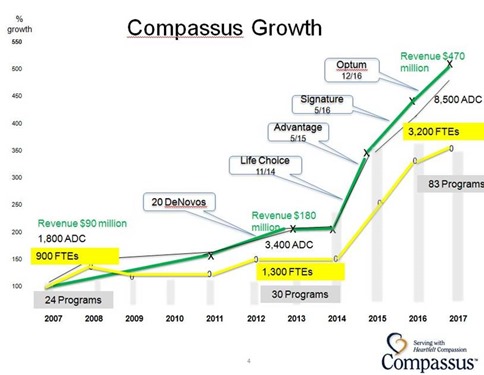
Hospice care by the algorithms is what we are looking at here with even more undue and not proven analytical scoring of patients taking place at their last days of their lives.  I think the screen from this Compasssus PowerPoint presentation on the revenue growth here tells the story of what this company’s (Compassus) goals are revenue and not patient care being the first priority.  You can see the other hospice services Compassus has acquired as well as Optum.  Their goal here is to create a model (made up of algorithmic functions) to design care for those patients in hospice services.  One might also guess that OptumRX will be the PBM of choice for these hospice facilities as well, all part of United Healthcare. 

clip_image001

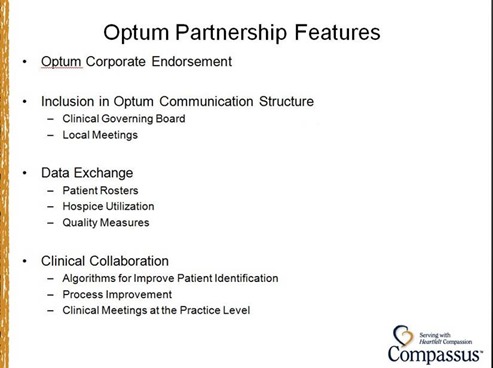
And here’s the management plan as you can see below with touting the Optum Partnership.  Compassus is owned by private equity firms,  Formation Capital and Audax Private Equity.  Private equity firms are currently draining the money out of nursing homes too, look at Kindred and HCR Manor (the one that Carlyle just walked away from as they couldn’t bleed it anymore).   With Kindred being purchased by Humana and two private equity firms, we can just assume that Humana is in there to make money from their Humana PBM from the drugs prescribed with the hospice services and the 2 private equity firms might be looking for any assets they can find to drain to line their own pockets, so that future there for patients and their care seems to look somewhat dim.  The real estate assets seem like they are always the first to be sold off, to leave the hospice and nursing home locations as “renters” for their facilities with high monthly payments, sometimes to another private equity firm held company that owns the properties. 

clip_image002

So after private equity has finished bleeding  US retailers to the point of bankruptcy, is this is the next level, nursing homes and hospice services for the next asset drain?  It certainly is beginning to look like it.  Unlike the retailer asset bleed, this time we are dealing with people’s lives and a big potential for patient endangerment, all for the sakes of the private equity companies being able to put more money in their own pockets.

Again, one has to wonder why this was kept secret and given no press at all, and it’s only now that the facilities themselves are making the name changes that this has come to light.  I would search out a non profit for a family member for sure versus this hospice for profit group here, as that’s what hospice should be, for the patient and not come with a profit portfolio at the starting gate.  BD

Algorithms, Scoring Metrics, Privacy and more in today’s Healthcare business world–The Healthcare Algo Cartel

This is a video of a recent presentation I did at the 74th Annual AAPS (American Association of Physicians and Surgeons) meeting.  I don’t do too much blogging anymore as I don’t want to be confused with all the “junk” news out there but thought this is worth a look and listen for all.

The presentation was initially intended for a physician crowd, but after I thought about it, consumers can learn a lot from this as well.  We have too many folks today choosing “virtual” values and getting lost in the real world and don’t realize what goes on behind the scenes, and it’s a lot, things you can’t see rising from corporate America to gain control of us lesser valued serfs it seems.Optum_moneyball

Every direction you turn today, somebody is mining up some behavior data and scoring you today, so we have so many scores, and many of them secret, who knows what value some big corporation or government is putting on our head today?  I’ve been writing about this for years and unfortunately we have gone beyond just good production software that helps us in life and in doing our jobs into a somewhat digital caste system.  I used to write software and this is my attempt here to let the average consumer know more about what’s really taking place out there.  I thought the Obama administration was getting way too virtual, but it seems the new Trump administration is just as bad with not seeing the real world and embracing virtual world values as well, so I guess it doesn’t matter which person or party is in control out there today, they don’t like the ugly real world and keep pushing virtual values on all of us to keep consumers in the dark.

I call it a “One Trick Algo” world and that’s what you’re getting too often out there today, some algorithms and computer code, written by corporate America to profit that tricks you into things you would rather not do if you knew the whole story.  I call this “Operation Perception Deception”, which was a post I wrote back in 2015 and sadly it’s getting bigger every day.  So take a look and see what’s going on behind the scenes in healthcare, and don’t deceive yourself too badly with virtual values as people can’t seem to be able to tell the difference anymore.  BD

Pharmacy Benefit Managers Invade Medical Records and Electronically Connect Cash Patients to RX Discount Cards-OptimizeRX-to SingleCare to OptumRX

This should not really come as a big surprise as what hasn’t the pharmacy benefit managment business touched?  So what is OptimizeRX?  Most have probably not heard of this software but it is a connect to EMRs that will send your prescription right to the pharmacy.  Oh, now you say, well imagethe PBMs do that and they do but what they have been missing is a way to collect data on patients who are not using their PBM prescription card or those who do not have one.  It’s all about getting more data about you to “score” and of course sell those scores to insurers and other interested parties.  Once the pharmacy has the transaction, it does not fall under HIPAA rules as it’s a prescription, linked to an EMR to provide a transaction.  As we all know, your medications in an EHR are protected but again, I’ll repeat this for those who still think HIPAA is covered at the pharmacy, it is not.  It’s been a sore spot for years with privacy.

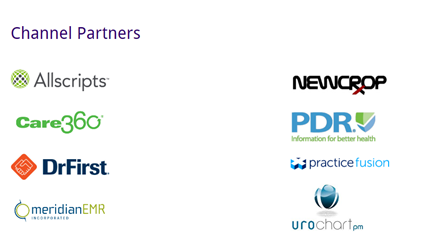
If your doctor is using one of the medical records systems in the image at the right, they are partners with OptimizerRX.  From the website:

“OptimizeRx® has developed an extensive network of EHR and eRx platform partners*, as well as partnerships with media and creative agencies, making it easy for marketers to achieve excellent reach with their HCP customers. View the partner network information below for details. EHR and eRx partners benefit from the partnership by adding OptimizeRx’s suite of services seamlessly into their platforms, providing relevant patient support, patient education and other services that are welcomed by their HCP customers. Integrating OptimizeRx into an EHR or eRx platform is simple and easy, and can usually be completed in less than eight hours!”

image

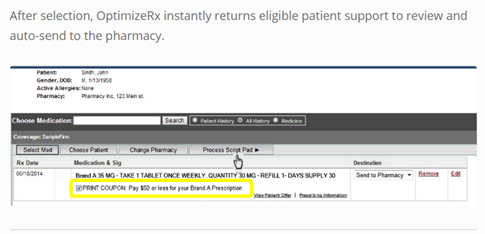
Did you catch this, it’s about marketing and at least they say as much.  When you look at the executive page, you’ll find most of these folks came from the pharmaceutical business.  Here’s another screenshot to “auto send” the prescription along with the RX pricing information direct to a pharmacy.  What this means is the price is locked in and a pharmacist has to honor that as it’s aready in the data base, precluding the availability to offer a cheaper discount.  Certainly it appears to make it easier for the patient, but is it the best price?  We don’t know.  In addition, the providers can print a coupon for those who say “no, don’t do that’. 

This RX discount card also can text and email you.  So there you go, it’s all about the data that drug companies and PBMs want on folks not using their PBM discounts.  If you let the MD do the auto send, you’re stuck with that price and can’t compare.  There’s this little item I wrote about a while back about medication adherence prediction compliance and if you are not aware of this game, read the link below and this has been around for a while and was originally created with Ingenix (OptumRX now) algorithms that goes back to 2010 when Express Scripts put out a press release on how they were going to score you, and they all do that now.  This is some real flawed information too as the 300 metrics used have zero to do with taking meds.  You get a bad nick for example if you are a male seeing a female MD and so on.  This is not science, it’s behavior bullshit that at best may show trending.  So this OptimizerRX is software to use the EMR to drag in the so called “Outliers” who pay cash and are not using a PBM discount.  Part of the job of a pharmacist today is to identify their outliers and fix them, but if the data is flawed and they pay cash, it’s just a bunch of flawed data.image

Patients Who Pay “Cash” When Filling Prescriptions Are Now Called “outliers, Pharmacists Required to Fix outliers as They Show Up As Non Medication Adherence Compliant With 5 Star Systems Full of Flawed Data…

Medication Adherence Predictions Enter the World of Quantitated Justifications For Things That Are Just Not True, Members of the Proprietary “Code Hosing” Clubs Out There Destroying Your Privacy

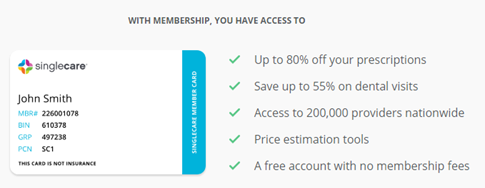
So now we have talked about OptimizeRX (which just happens to sound a lot like OptumRX) let’s move to the next step here and talk about the discount card.  Read the press release below, OptimizeRX has a partner called SingleCare, which actually resembles the HealthAllies company that Andy Slavitt and Senator’s Warren’s daughter sold to United Healthcare, except this one is free.  SingleCare includes other available discounts, a few of them but hey well all know it’s about getting the pharma PBM money to support the entire project, not a 20% discount at a gym or free teeth cleaning.

OptimizeRx Partners Exclusively with SingleCare to Bring Patient Savings and Price Transparency to Healthcare Providers at the Point of Prescribe

SingleCare started out much like Script Relief (another RX discount card that markets under a ton of names run by Loeb Enterprises in New York) to get some users of the discount so they could collect money from the PBM.  All the Script Relief cards make their money back from OptumRX on the fees and other charges and they pay independent sales people $10 a hit for every patient who activates a card.  Script Relief was originally connected with Catatmaran, which was bought by OptumRX (United Healthcare) and played a big role with Cigna getting sanctioned by CMS for a long time from selling Medicare D policies.  Here’s a couple archived links on tha topic and once the OptumRx purchased Catamaran, who was the in-house PBM for Cigna, all insured had a new PBM called United Healthcare (OptumRX) PBM.

United Healthcare Having a Big Bond Sale to Finance Purchase of Catamaran Pharmacy Benefit Management Company, Huge 10.5 Billion

United Healthcare Buys Catamaran Pharmacy Benefit Manager Just As the PBM Gets Hit With A Class Action Lawsuit For Low Balling Pharmacy Reimbursements..And More Patient Data to Sell and Analyze For Profit

So what kind of executives does SingleCare employ?  Well you could probably guess this one easyimage enough, former United Healthcare and big time former Catamaran executives.  Check it out.  In addition the company also says it will bill patients who use their discounted MD, dental cleaning, etc. services.  Yikes as a patient, I would much rather pay the doctor direct and not have some big corporate conglomerate chasing me who also wants my data to score and sell.  Many MDs have already figured out how these virtual credit cards hit them up for big fees anyway, so they keep part of that money for giving you a discount.

Health Plans and Claim Clearinghouses With Virtual Credit Cards-Racking Up Additional Fees From Doctors

So what PBM do you think is supporting this?  My guess would be OptumRX but you can’t find that stated anywhere, but hey put two and two together.  So if you use the card, you are added to a PBM data base with data to score and sell and again, we think it’s OptumRX.  If you noticed above, Allscripts is one of the partners and is it not a coincidence that all OptumCare MDs are required to use Allscripts?  Here’s more on that topic along with a picture I snapped of one of their OptumCare owned MDs in the OC.  Don’t forget too that all the Surgical Care Affiliate outpatient surgery facilities are now owned and will be run by OptumCare, so I might guess Allscripts will be over there too, or OptimizeRX will sign up more EHRs to bring in the SingleCare discount card over there too. 

OptumCare Doctors to Get allscripts Medical Records EHR–Optum Continues to Buy More Practices and Manage More Doctors Through Independent Physician Associations, Many of Which They Own

We also have this action going on relative to OptumRX and Catamaran with lawsuits being filed over the price of prescriptions when a cash offering is less expensive than what the PBM is offering.

Cigna & United Healthcare Face Class Action Suits-PBM Over Charging Customers for Prescriptions, OptumRX Pharmacy Benefit Management Software-“Front Running” Consumers With Killer Algorithms at the Drug Store

Pharmaceutical Wholesalers Inc. File Legal Complaint Against OptumRx “Aligning Its Interests” with the Big Three Drug Distributors in US, Thus Acting as an Agent of the Government With Accreditation Processes

Bottom line here is to get the algorithms connected to the EHRs now and get that price locked in and get the data from the folks who are not using a PBM price.

Also the MedExpress urgent care locations are also connected to, guess who, OptumRX and you might be seeing those SingleCare RX discount cards used there as well.  United Healthcare also has another service they market where they want to be the EHR integrator for Allscripts and other medical record companies.

Optum (United Healthcare) Buys MedExpress Urgent Care Business- 141 Full Service Clinics In 11 States–Company Advertises They Are In the Market to Buy Your MD Practice, As A “Too Big To Fail Insurer” Moves Forward With More Acquisitions

United Healthcare (Optum Insight Subsidiary) Wants To Be Your Allscripts, Epic And GE Centricity EHR Consulting Service Starting With Implementation And Beyond

How convenient to be an EHR integrator and get that OptimizeRX connected in there to the medical records to promote the SingleCare discounts and collect data on folks who are not using their PBM program or are paying cash.  By the way too, Optum is also now doing the billing for Quest Labs in case you missed that one.  Optum does the billing of course for their very close partner, the Mayo clinic, who’s CEO just took a board seat with Merck Pharmaceutical.  Are you seeing some kind of a pattern yet, maybe?  Of course if you are insured by United, you have been told to go to LabCorp for years for actual tests.

Quants of Optum Carve Out New Outsourced Billing Deal with Quest Labs, Will Also Serve to Enhance The Scoring & Data Selling Business Conducted by Both Companies via Powerful Subsidiaries

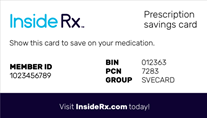
The prescription discount game is heating up out there and Express Scripts doesn’t want to be left out as they too now have an RX discount card, called Inside RX which is a partnership with GoodRX, as they too didn’t want to get left out of the lucrative “fee” business here.  Sounds like imageOptumRX was cutting them out of some of the money mabye, so off to Express Scripts they went. 

Here’s a post I did a while back with some good videos from actual independent pharmacists that tell you the story on how the RX discount cards work and how a lot of time they might still be able to give you a better cash price that doesn’t support all this markeing.

The Truth About Pharmacy Benefit Managers and Prescription Discount Cards–Created With Automated Algorithmic Processes That Enable Huge Profits-Consumers at Risk!

So backon topic here with SingleCare benefits, be aware of what’s going on with the algorithms of the PBMs as they are now invading medical records to get that script and and that data about you.  I would be very careful about wanting to use any of the texting and email services they offer as they collect and monitor everything today and will “score” your behavior with their services to toss some kind of risk in a profile about you!  Recently, VC arm of Optum/United Healthcare invested money in another cesspool Silicon Valley risk assessment company, Mindstrong to monitor people with cell phone behavior and when they get done scoring all that type of data, we’ll all be at risk for mental health issues if we “hesitate” on responding to text messages.

So be aware now as the PBMs have infiltrated medical records and stalking you there, with going beyond just regular PBM plans, they want to get data on everyone who pays cash to “score” and sell a data profile about you and your behavior.  Once you get locked with with your doctor doing an automatic send to the pharmacy, the pharmacist may not be able to offer you a less expensive price if they have one to offer on your medication.  BD 

“One Trick Algo World” Needs to be Licensed and Indexed–Spurious Correlations “For Profit” Are Out of Control

With prediction tools and apps being all the rage today, their reliability and accuracy are not always there.  Before the word “prediction” took over, we used to have words like “trending” and number crunches used for a lot of what we saw, but today it’s the big buzz word “prediction”.  Machine learning algorithms certainly can be useful but they too make errors.  A while back I connected data selling to lack of privacy and it got some attention, but I think not enough.

Excess Scoring of US Consumers, US Citizens-Scored into Oblivion By Proprietary Algorithms and Formulas, Never Duplicated or Tested for Accuracy-Profits of Big Business And A White House Executive Command To Continue the Abuse..

Today as companies see revenue streams disappear from their line of business, they turn to the easy solution of buying and selling consumer data, but it just doesn’t end there, they have to do something with it to create value, and that line of business today is called “scoring”.  It’s happening all around you and it’s evolved to what I call “Excess Scoring” as you have data scientists cranking and wrangling statistics and data every which way but loose to find out how to find some data with queries to sell.  Bloomberg bought a data mining company which they intend to use in house and also sell to their clients so they can predict the behavior of clients.  Bloomberg of course might be motivated as they stand to lose a lot of money when JP Morgan and Bank of America cut thousands of Bloomberg terminals which rent for $21,000 a year, which has been the life blood of the financial world for years.  Replace that revenue, mine and sell data. 

Bloomberg is only one of many examples out there too as you also see IBM pushing this cognitive data mining like crazy, and that’s what 13 quarter of declining sales and too many years of stock buybacks end up producing, where do you make up the lost revenue, mining and selling consumer data.  Sure there are some value areas with mining big data when it comes to “real” research like some in healthcare, but even some of that gets blurred as you end up being marketed to believe some app is a diagnosis tool, when in fact it’s nothing more than another risk assessment that gathers, mines and scores you and sells the data and the scores. 

CVS and IBM Watson Project–Please Make It Stop-13 Quarters of Declining Profits for IBM, Is This Is What We Get, More Algorithms Biting Us Constantly So More Data Can Be Mined and Sold Resulting In Excess “Scoring” of US Consumers..

Many healthcare companies get around the HIPAA areas with in fact not selling your data that they have, but rather just selling a “score” and there’s little HIPAA help there and with that, so goes any privacy.  When computer scientists and Quants are under pressure to create a revenue producing model, things go a bit crazy and correlations become spurious and data becomes flawed. 

Silicon Valley Is At It Again Confusing the Public With Calling Risk Assessments a Form of A Diagnosis Tool…

So what happens when the data becomes flawed?  Are there avenues for consumers to use to correct the flawed data and scores being produced and sold for money, which by the way is a $180 Billion dollar a year business?  Few and limited.  Argus Analytics is one firm that buys up credit card data and puts out tons of “scores” about your behavior patterns.  How many of you have heard of that company?  Probably not many I would guess.  BDEX

Argus Analytics Produces “Share of Credit Card” Data On Consumers - Digs Up The Dirt on Your Credit Card Behavior Patterns-US Consumer Protection Agency Is A Client-We Are Paying for Richard Cordray’s Slow Education Process

There have been some very faint efforts in Congress, they spend a lot of time talking about it, but again you have lawyers selling pixie dust that some magical new algorithms are going to protect consumers and on the deception goes.  With indexing and licensing data sellers, at least we would know who they are and where go to corrected flawed data.  Do we have that now? No!  You can find some of them but not all, especially the obscure companies that are taking the data and “scoring” you and selling those results. 

Senators Create a Bill to Go After the Data Brokers Selling Our Personal Data But It Doesn’t Go Far Enough-Tons of Companies And Banks Are Also Selling Our Data and Repackaging Information About Us…

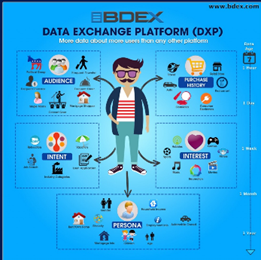
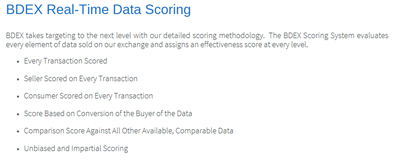
BDEX is a “scoring” and data selling company, you probably never heard of.  Take look over there and see what’s going on with “scoring” you and your data.  They’re getting everything they can get their hands on and also tech and promote (and make money)showing others how to score you as well.  You’ll find Live Ramp from Acxiom over there too as a partner, Acxiom one of the biggest data brokers around. 

Most people have no clue that all their electronic transactions are for sale, there’s no privacy so use cash when you can if you want a little bit of privacy.  It’s all over the place and read the link below on now how CMS wants to sell Medicare data (link below).  Andy Slavitt, former director at CMS is a big promoter of “scoring everything and everybody” with a background of being a former Goldman banker and a high ranking United Healthcare Executive that racked everyone over the coals.  His big claim to fame was the error producing Ingenix Algorithms with physician pay and then later with medication adherence predictions with Express Scripts, selling algos to them.  The lawsuits still continue.  CMS wants to “approve” those who get the chance to buy and sell your Medicare data though, but we know how that goes, no regulation there as all as again, we don’t know who all the data sellers are in the US and exactly what they do? 

CMS Medicare Proposing More Data Selling of Both Private and Medicare Patient Claim Data - A New Dignity And Privacy Attack on Both Consumers and Doctors

Unfortunately Data Scores get used frequently out of context and you have no idea how many times and how you have been scored.  When it comes to skewing a correlation to make imagemoney, data scientists and quants will stop at nothing if it makes money as their job may depend on it.  So in fairness there’s some outside pressure to keep a job that might make them cheat a bit and go spurious.

The World Privacy Forum was all over this a couple years ago with their extensive report “The Secret Scoring of America” and it’s a good report.   In virtual worlds everyone gets to be LeBron, but in the real world, there’s only one LeBron.  We can thank Larry Ellison for those words of wisdom as sure he sees it loud and clear as well.  He’s a software engineer by trade and people that write code and create software are all very much aware of the bad side, but choose whether or not to talk about it.  Take note of the Alter egos of software engineers, data scientists and anyone who codes for big profits, i.e. Facebook. 

World Privacy Forum Report - The Scoring of America: How Secret Consumer Scores Threaten Your Privacy and Your Future - One Big Element that Fuels the Continued Attack of Killer Algorithms & Demise of the Middle Class Creating Profiteering And/Or Denial of Access

As consumers it’s only right that we at least know who’s scoring us and using our data when it gets flawed.  Are we to live out lives out with flawed profile created about us for the sake of corporations making big money selling it? Why even get out of bed every day when we are “scored” to the hilt with risk assessments that are like a ball and chain around our ankles I ask? 

Junk Science Appearing Everywhere, Even The White House “PR Templated” Correspondence Creates Spurious Correlations…

Sure there’s some useful scoring going on out there and we need some of that but there’s a lot of it that’s gone over the top.  Even UCLA this week came out and said they suggested to stop using the BMI to determine a person’s over all health.  Data Scorers can take that number and wrangle it into a massive amount of other data bases and turn you into a huge “risk” assessment that shouldn’t be allowed to walk on this earth!  That’s where we are getting today as more and more bogus risk assessments are created that are nothing more than algorithms and math models to make money.

Step one for any real privacy to exist is to determine who all the data sellers are and what they sell.  I’ve had honest quants and mathematicians alike as well as the World Privacy Forum agree with this as a first step of action versus the whacked out perceptions that are being promoted out there now as privacy efforts.  How about when you get (your data) gets repackaged and sold?  None of the privacy dupes are talking about that and it does exist.  If you don’t think this exists, you have been spending too much time living in some virtual worlds out there that exist.  Look at the recent case with Uber and Unroll.me. 

Anthem Data Breach–Crooks Want to Sell Data Too–The Impact of the “Data Selling For Profit Epidemic” That Exists in the US With Scoring Consumers Removing Access and Human Dignity

Prescription medication adherence scoring turns you into a non compliant Outlier and that data gets sold all over the place.  Most have no clue on how much money gets made selling your prescription data.  If you pay cash and they can’t find enough credit card data to prove you are filling a prescription, you default to being a non compliant Outlier.  Nice, huh?  How do you fix that?  These scores are all secret and you can’t get them, so you now there’s a double whammy, secret scores and secret data sellers you have no access to, can’t fix anything as a consumer that corporations “score” about you for a profile. 

The post below was generated by a conversation I had with a real pharmacist with these concerns.  Read it and take a look at bogus metrics being used to substantiate your behavior, which of course as humans is subject to vary every time we change our minds, so a lot of flawed data reported about you here with their scores.  The pharmacies have to make their numbers, not so much worry about how they educate you, just make those numbers using this flawed software. 

Patients Who Pay “Cash” When Filling Prescriptions Are Now Called “Outliers, Pharmacists Required to Fix Outliers as They Show Up As Non Medication Adherence Compliant With 5 Star Systems Full of Flawed Data…

Oh Crap, Now Hospitals Are Now Buying Data From Acxiom - Data Selling Epidemic Continues to Evade on Personal Privacy As “Algo Duped-Stat Rat” People Try to Implement Virtual Models That Won’t Work…

Again this is  a calling for those in our Congress to stop and do something for the consumer, give us at least the opportunity to know who’s scoring and selling our data?  We have to fight years ago to get that right for credit data and it’s gone way beyond that now with bringing in all other types of business entities with their secret scoring.  I guess at some point when the data scientists correlate to the point to where their spurious numbers are too far even for the dupes of hazard society to believe, well who knows what we might see, attacks on data centers?  So here’s my campaign that’s been out there for a few years now and I predicted this about 3 years ago too that data selling with skewing context about consumers would be the greatest attack on our liberties we’ve ever seen, all for the sake of corporations make money.  Scroll down and watch the 4 videos in the footer for some additional information from folks smarter than me. BD

Index and License all Data Sellers- Who Are they?  Put the brakes on this corporate profit making epidemic!

Related Reading from some archived posts:
Gamification–You Have Won and Now We Know All About You - It Didn’t Cost One Cent-Insurance Companies Have Games To Find Out More About You Too– “Attack of Killer Algorithms” Chapter 11
Congress To Investigate the Data Sellers - Need To Create a Law to Tax Them As The Algorithms Used For This Business Generate Billions of Dollars, Partly Why Corporate Profits Are So High - Remove the Medical Device Tax as They Produce Needed Jobs/Tangibles
PLOS One Abstract–Methodology for Detecting Manipulation of “P Values” To Show Significant Statistical Value, “Inappropriate Fiddling” Which Can Lead to “Algo Duping” Situations And Numbers
Big Data/Analytics If Used Out of Context and Without True Values Stand To Be A Huge Discriminatory Practice Against Consumers–More Honest Data Scientists Needed to Formulate Accuracy/Value To Keep Algo Duping For Profit Out of the Game
Hiding, Falsifying, And Accelerating Risk Has Become the Achilles Heel of the US Economy As the “Real” World” Clashes With the Values Created From a World of “Fictional Values” Of Formulas and Math
“Data Scientists”– An Oxymoron? Is Finding the Value in Data Bases Queried Together in the Business World To Make Money Actually Science?
Cathy O’Neil, Mathematician/Quant: Wall Street Quants The Culture, Big Data Mechanics, Algorithms, Data Mining, Lack of Privacy, Web Profiling, Health Insurance Profiles and Modeling Abuse…
Does the US Government Need a Department of Modeling and Algorithms–Is Data Addiction and Abuse the Next Up and Coming 12 Step Program, Some Classic Posts & Topics Revisited
Insurance Companies Are Buying Up Consumer Spending Data-Time is Here to License and Tax the Data Sellers-As Insurers Sell Tons of Data, Gets Flawed Data When Data Buyers Uses Out of Context Too
Big Data–The Data Science Code of Ethics-Designed By Those Who Create Models - Don’t Fall Victim To Write Fictitious Code and Models Just to Make Money With Clients Demanding Such
Modeling for Inequality With Segmentation, Insurance Industry Uses Backwards Segmentation As Some Models Stand to Threaten Overall Democracy
Data Floating Around the Web and You Don’t Know How It Got There? Time to License and Excise Tax Data Sellers–Identify “Flawed Data” Epidemic At The Root of the Problem
Licensing and Excise Taxing Data Sellers, Facial Recognition Yet One More Tool Used To Secure & Match Data - The Epidemic, Billions in Profits for Banks and US Corporations Using Killer Algorithms to Further Erode Consumer Privacy
FTC “Reclaim Your Name Campaign” Not Good Enough–No Path for Regulation Identified–All Data Sellers Including Banks, Insurers, Etc. Should Be Required to Buy a License
Data Selling Game Now Exploits the Non Regulated Billion Dollar Epidemic–”Data Dealer” The Attack of the Killer Algorithms Gamified
Pharma and Health Insurance Companies Pairing Up, Humana’s Analytics Subsidiary and Lilly To Figure Out How to Save (Make) Money and Provide Better Patient Care–Selling Research Data That Competes With FDA Sentinel Initiative
Insurance Company “In-Network” Complex Erroneous Algorithms Continue to Wreak Havoc With Patients and Doctors When It Comes To Coverage and Purchasing Insurance–Time to Begin “Sniffing Some Data”, To Include Labeling And Identifying Killer Algorithms
MasterCard As Well As Other Financial Institutions Using Big Data To Get Into Your “Online Pants” As Many Consumers Seem To Be Accidentally And Inadvertently Leaving Their “Internet Fly” Open
White House Office of Science and Technology Policy (OSTP) and MIT Co-hosting Public Workshop - Big Data Privacy-Not Possible Unless We License and Excise Tax The Sellers, The Corporate Profit Epidemic Continues to Spread
Big Data In Farming, Back to the Data Selling Business Once Again With Concerns of Where the Data is Sold and Who Uses It To Profit, Paying for IP With the Food We Eat Today
60 Minutes Blasts The Data Sellers, FTC Admits They Have Lost Control - Time To License and Excise Tax “ALL” Data Sellers, Banks, Companies, Etc. - Congress Needs to Act On This…
Fraud Algorithms Failing at Indiegogo Crowd Funding Site-Some Getting Through With Physicists Claiming the Technology Claimed Is Not Possible-Healthcare Related Apps/Devices
Limitations And Risks Of Machine Ethics (That Really Don’t Exist) - Abstract Basically Substantiating the Existence of What I Coined As “The Attacks of the Killer Algorithms”…

DOJ Enters WhistleBlower Law Suit Against United Healthcare–Risk Fiddling for Profit, A Walk Back Down Ingenix Memory Lane Again

Here we go again, back to those Ingenix algorithms and business models, getting a rerun of sorts of what occurred in 2011.  In 2011 there was one main lawsuit from the AMA along with many others that were filed (some being still settled) over using formulas that short changed doctors and patients on out of network chargees.  In addition, all other insurers who licensed and used the formulas were also drugimage into court for settlements.  This was a big deal and now we have another lawsuit with again, other insurers being named for using the formulas of Ingenix once again.  Here’s a case that has not settled yet as an example and one that just recently settled.
Cigna Legal Case With Ingenix Flawed Formulas for Out of Network Payments Allowed to Proceed Under ERISA, Can’t Avoid the Claims…
Ingenix (Optum-United Healthcare) Lawsuits Still Bouncing Around Out There–One Recently Settled in New Jersey With Horizon Blue Cross Blue Shield That Was Still Using the Flawed and Corrupt Data Base for Out of Network Payment Calculations

A couple years ago Medicare said they were going to rerun the Medicare risk assessment scores, so there was no secret as to what was going to occur with an audit.

CMS to Rerun the Medicare Advantage Risk Scores–Dating Back to 2008 To Catch the Automated Risk Fiddlers of Said Insurer Fraud Amounting to Around $70 Billion–Be Ready For It…

There are other lawsuits on the books that have not settled yet in other areas, like this one with mental health that could go to a class action suit too.

Class Action Lawsuit Filed Against UnitedHealthGroup and Their Various Subsidiaries There Of Relative to Mental Health Claim Denials & Violation of Parity Laws

Here’s a back link to the big settlement by the AMA.  Again this is only one of many and at the time I was writing a series of blog posts called “The Attack of the Killer Algorithms and this was chapter 19. 

AMA Announces Doctors And Patients Can Expect To See the UnitedHealthCare/IngenixClass Action Settlement Checks In the Mail Soon - Out of Network Short Payments–Attack of
the Killer Algorithms Chapter 19
UnitedHealthcare ERISA Class Action Lawsuit Expanded to Include DME and Ambulatory Surgical Center Providers

If you missed this along the way, things go so ugly with the Ingenix name, United Healthcare changed it to Optum, which you see all over the place today, as they are buying up broke doctor practices and urgent care centers like they are going out of style.  There’s 2 sides to United Healthcare, one that does insurance and the other Optum side that’s buying up and creating software was well as consuming and acquiring companies that have anything to do with doctors.

UnitedHealth Group Announced Re-Branding of Business Units-Focus on “Optum”–Changes IngenixName to OptumInsight

So again with this new lawsuit, which was created from the efforts of a high ranking former United Healthcare executive, not just an employee, we are seeing the same process again, Ingenix algorithms and models followed to fiddle with risk scores, make patients look sicker and get more money from the government this time instead of doctors.

Express Scripts ended up at one point in time a while back buying the old United Healthcare pharmacy benefit business and acquired some software and algorithms in the process and in 2010 was bragging how they are going to predict if you will take your medications.  This flawed scoring still goes on today.

Express Scripts- New Program to Contact and Predict Patients Who May Not Be Taking Their Medicine Based On IngenixAlgorithms–We Want the Revenue Please Don’t Stop
Medication Adherence Predictions Enter the World of Quantitated Justifications For Things That Are Just Not True, Members of the Proprietary “Code Hosing” Clubs Out There Destroying Your Privacy

The entire lawsuit can be read here and there’s quite a few pages to the pdf to read.  Benjamin Poehling was the former high ranking executive that filed the whistle blower lawsuit.  It’s kind of uncanny that Poehling came from Arthur Andersen, where the current CEO of United Healthcare worked as Anderson’s CFO and all the Enron issues were on his watch.  Enron lead to the end of the Arthur Andersen auditing firm due to fraud.  Here’s a few quotes from the suit…


“United’s senior management push relentlessly to increase United’s revenue from risk adjustment. Tellingly, UHMR has assigned risk adjustment to its Finance Department, not one of its clinical departments. (Relator was assigned to his job despite having no clinical background.) In 2010 and 2011, UHMR has implemented projects referred to as “remediation plans”, “focus area projects,” or “affordability agendas” to increase IOI.

UHG engages in an aggressive and extensive effort to find a justification or pretext to submit risk adjustment claims for additional diagnoses—regardless of whether the patient had or was actually treated for the diagnosis in the relevant period by a qualifying provider. United’s program has some components that are broad-based, and others that target specific high value HCCs. As an overall goal, UHG attempts to reach each of its members at least once every two years through one of its programs designed to find additional risk adjustment claims.

Ingenix conducts chart reviews on behalf of UHMR, UHCS, and commercial clients. In the retrospective chart review process, Ingenix identifies provider charts to review and arranges for the charts to be collected. It uses both internal coders and also contracts with external vendors to review and code the charts. 129. These vendors review charts using a blind review. In a blind review, the reviewer codes every imagecondition he or she identifies from the chart without knowing what codes the provider identified from the chart previously. Thus, the reviewer works from the raw chart material and reaches independent conclusions.
Under the COI program, United pays providers approximately $100 for each diabetes patient they assess for diabetes complications, submit a supporting diagnosis via a claim, and submit a medical record with matching documentation. In addition, it pays $200 for each doctor that receives training on the COI program and diagnosis coding. Recently, the COI program has expanded to other conditions that United suspects are frequently undercoded, such as chronic kidney disease (“CKD”), and chronic pulmonary disease (“COPD”).

Relator knows that at least the following United executives know about some or all of the problems discussed herein, and have participated in the scheme to continue submitting fraudulent claims and to refuse to correct previously submitted false claims: Stephen Hemsley, UHG Chief Executive Officer; Gail Boudreaux, UHG Executive Vice President and CEO of United Healthcare; Larry Renfro, Optum CEO; Tom Paul, UHMR Chief Executive Officer; Cindy Polich, UHMR President; Lee Valenta, Ingenix’s former Chief Operating Officer (and current President of Ingenix’s Life Sciences Division); Jack Larsen, former CFO of PSMG (and current CEO of UHCS); Scott Theisen, UHMR Senior Vice President of Finance; Jeff Dumcum, Senior Vice President of Ingenix; and David Orbuch, PSMG Chief Compliance Officer.

And this….

“United’s refusal to correct errors in its risk adjustment claims is so extreme that it submits risk adjustment claims to CMS for diagnoses taken from claims that it itself refuses to pay as being fraudulent and/or abusive.

United developed “playbooks” containing ideas for increasing its risk scores. These playbooks are garnering top-level attention at the company while the myriad problems with United’s risk adjustment programs and processes go unresolved. 195. United conceals the one-way nature of its risk adjustment programs from CMS and even its investors. For example, United’s remediation plan for 2010 that sought to increase IOI by $800 million allocated $100 million to “Project 7.” Project 7 was United’s codeword for initiatives to increase risk adjustment payments. The company used a codeword (as opposed to “growth,” “enrollment,” or “claims”) because it did not want CMS or other investigatory government agencies to know it had a campaign to claim an additional $100 million through risk score increases.

United customizes its kickbacks depending on the nature of its overall reimbursement arrangement with the provider group. The providers United chooses to pay additional amounts for increased risk scores are those that do not already have an incentive to upcode diagnoses. United uses three basic payment structures for its providers: (1) percent of premium capitated providers, which receive a percent of United’s CMS premiums for its patients; (2) “fixed” capitated providers, which receive PMPM payments from United that are not tied to United’s CMS premiums; and (3) feefor-service providers, which are paid based on the claims they submit to United.”


If you made it through those paragraphs you can easily see how complex insurers have made medical billing for sure.  Once again we come back to the business models of Ingenix and some of the automation in the IRAD data base to work these claims.  Here’s another billing subsidiary United bought, again we’re talking coding and billing here.

Ingenix (Wholly Owned Technology Subsidiary of UnitedHealth to Acquire A-Life Coding Software/Services–Tons of Money and Profit With Coding Transactions and Algorithms - Subsidiary Watch

I talk too about the United/Optum incest at times too with HHS and CMS and here’s a blast from a few years ago…this was the beginning of pushing “population health” that all know the term and nobody really knows what it does half the time to even include vendors of the algorithmic processes.  This is where the government bought yet another United Healthcare model.

"Reach for the Top" Program Combines Prototype from Ingenix (A Wholly Owned Subsidiary of United Healthcare) for Public/Private Community Health Data on HHS.Gov Site

Simon Stevens, who is now running the NHS and worked at United Healthcare a few years ago had this to say…

United Health Care Says Cheaper Efficient Doctors and Reducing Hospital Visits by the Elderly Would Help Reduce the Cost of Healthcare

Former Acting director of CMS, Andy Slavitt claims Simon is a good friend of his and let’s not forget that Andy Slavitt was the CEO of Ingenix when a lot of this was going on.  Larry Renfro came in later from his executive position at AARP to run the Ingenix show. 

United Healthcare sure seems to be lining up some big executives as well with last year hiring the former CEO of Stanford University Healthcare to work for United as a VP and recently in the UK, Optum hired Nick Seddon, who worked for David Cameron as his special healthcare adviser.  There’s a group in the UK that is also bringing attention to the fact that one company, United/Optum has been taking over way too much ground and is not leaving enough competition out there with other countries. 

The entire suit takes a while to read but there’s a ton of detailed explanations as to what United and other insurers taking advantage of their consulting and billing services are accused of.  Again, do leopards change their spots?  Here’s another suit you might want to read about…it just does not stop when you have complex built algorithms that can spin around faster than you can take a deep breath to score and stick you with more risks than you ever dreamed of, all for the sake of making money from the government. 

Cigna & United Healthcare Face Class Action Suits-PBM Over Charging Customers for Prescriptions, OptumRX Pharmacy Benefit Management Software-“Front Running” Consumers With Killer Algorithms at the Drug Store

Feel free to search this blog, there’s plenty of information like this written since 2008 on how companies cheat with computer code and algorithms…BD 


United Healthcare, the largest provider of Medicare Advantage (MA plans) services, is being sued by the Department of Justice (DOJ) for fraud. To give you a sense of United Healthcare’s size consider that just their third quarter revenue was $46.3 billion, up 11.6 per cent from the same period a year earlier, and the bulk of the growth was billing services and data analysis for healthcare groups, which ws up 34 percent since the beginning of 2016.

Medical charts, the primary source of diagnostic data were reviewed looking for incremental increases but not for errors that would decrease the risk adjustment.  New diagnostic codes were submitted, but an erroneous diagnosis was not deleted. On a two-way street, “they do not look both ways.” And these reviews were profitable, a $30 cost for chart review resulted in an average of $450 in additional payments. Ingenix sought to find additional diagnosis by using data analytics to identify practices, where chronic conditions were underreported based on population prevalences or where a new diagnosis was suggested by medications patients were receiving. Here the physician was contacted with patient assessment forms (PAFs) to consider these diagnoses for the patient. Physicians receive a small fee for reviewing these PAFs. Ingenix also developed initiatives designed to get patients to visit their doctors each year. But wait a minute, these programs encourage physicians to screen patient’s more carefully and to encourage annual checkups.

http://www.acsh.org/news/2017/02/21/department-justice-believes-united-healthcare-defrauding-medicare-10885