Clinical Trials Vendor Medidata to Go Public

This is a new twist by today’s economy with little or very few companies taking the plunge to go public. 

I just briefly looked at the website which contains an API for integrated services and there are a number of both technology and CRO partners listed on the site.  There are several modules to select from, the contractor, design manager, grants manager, etc.  imageBD 

Clinical trials software vendor Medidata Solutions Inc. hopes to raise $86.25 million in an initial public offering of stock. 

The New York-based company has filed a S-1 registration statement with the Securities and Exchange Commission. Medidata is asking to trade stock on the NASDAQ Global Market under the ticker symbol "MDSO."

The number of shares to be offered and the price range have not yet been determined. Underwriters include Citi, Credit Suisse Securities, Jefferies & Company, and Needham & Company. 

The company during the first nine months of 2008 lost $8.043 million on revenue of $84.8 million.

Clinical Trials Vendor to Go Public

Cook Medical Unveils MicroWires to support Leg Therapy - Peripheral Arterial Disease

Cook Medical has quite an extensive product line with catheters, especially those impregnated with antibiotics to help keep infection rates down.  This is the latest announcement that was used during a clinical trial.  BD

Cook Medical unveils the Advance Drug-Eluting Balloon and Other Cutting-Edge Devices to Advance Leg Therapy at the ISET 2009 International imageSymposium on Endovascular Therapy

Event was punctuated with several product introductions and a live case demonstration of percutaneous transl uminal angioplasty using a drug-eluting balloon

Bloomington, Ind., January 30, 2009 – In a live case transmitted from The Heart Center Leipzig/Park Hospital in Leipzig, Germany, a new drug-eluting balloon was used as part of a clinical trial during one of the live case demonstrations at last week’s ISET 2009 International Symposium on Endovascular Therapy. Advance PTX is designed to increase long-term patency in patients with peripheral arterial disease (PAD) and is one of the first PTA balloon catheters to be coated with paclitaxel, an antiproliferative drug that has been used successfully to reduce the risk of arterial restenosis following angioplasty in coronary disease patients.

“Bringing together converging technologies—like devices with pharmaceuticals in the case of the Advance PTX balloon—is a critical step in developing advanced medical devices to improve outcomes in specific patient populations,” said Rob Lyles, vice president and global leader of Cook Medical's peripheral intervention division.

Cook also introduced several products from its premier line of diagnostic and peripheral interventional devices at ISET 2009, including its Approach™ CTO microwires. The Approach CTO microwires are the first .014-inch wires designed specifically for crossing chronic total occlusions and extremely tight lesions in the peripheral arteries, including the SFA, popliteal and tibial arteries.

“The Approach microwire line has several product features that address the challenging anatomy of the leg, an important step in the development of PAD medical technology,” said Lyles. “This latest advancement illustrates Cook’s commitment to exploring every possible technology to treat PAD. At Cook, we continuously strive to improve the quality of our products and, in turn, improve the quality of patient outcomes.”

The microwires are the latest peripheral diagnostic products to support the complete Leg Therapy initiative from Cook, a comprehensive line of advanced minimally invasive access products and interventional devices that addresses the anatomical challenges of treating peripheral arterial disease in the legs. With the launch of the full Leg Therapy Program, Cook will deliver clinically effective interventional solutions to patients who need them most.

About ISET:

Now in its 21st year, the leader in interventional education continues to meet the needs of physicians who recognize the challenges that lie ahead and actively seek the knowledge to meet those challenges. ISET provides the tools – in the form of unbiased, professional education – to lead practitioners into the future of an ever-evolving field. For more information, visit www.iset.org.

About Cook Medical:

Cook Medical was one of the first companies to help popularize interventional medicine, pioneering many of the devices now commonly used worldwide to perform minimally invasive medical procedures. Today, the company integrates minimally invasive medical device design, biopharma, gene and cell therapy and biotech to enhance patient safety and improve clinical outcomes in the fields of aortic intervention; interventional cardiology; critical care medicine; gastroenterology; radiology, peripheral vascular, bone access and oncology; surgery and soft tissue repair; urology; and assisted reproductive technology, gynecology and high-risk obstetrics. Founded in 1963 and operated as a family-held private corporation, Cook is a past winner of the prestigious Medical Device Manufacturer of the Year Award from Medical Device & Diagnostic Industry magazine. For more information, visit www.cookmedical.com

Media Contact: David McCarty, Global Director of Public Relations, Cook Medical

812-339-2235, ext. 2387; 812-322-1805 (cell); dave.mccarty@cookmedical.com

Bill Gates and Oliver Sacks to speak at Technology, Entertainment, Design conference (aka TED)

Additional information can be found on the website for the sold out event.  If you haven’t taken in the website, I highly recommend taking a look to see what is happening.  In addition to the conference, there are new videos, interviews, etc. from time to time speaking not only about healthcare, but a myriad of many other topics, things an ideas that can make a difference.  This certainly is something I would have liked to have been able to attend since it is in my back yard in Long Beach, California this year.

  image

Many of the videos are also published on You Tube and below I have included one done by Biochemist Joe DeRisi who is talking  about amazing new ways to diagnose viruses with DNA and genomics.  I consider this one to watch as he uses a bit of humor and gives you some hints on how you can et up your own DNA arrays and processing unit in your garage at home, that is if you were so inclined, but for the rest of us, watching and learning from the video will be quite sufficient. 

image

Joe DeRisi discusses a patient who comes in to the ER room what the diagnosis process is and how the hospital team turns to the DNA Genomics group to help diagnose the disease after a series of failed or non responsive treatments.  In addition, he continues to explain how folks can be predisposed to prostate cancer and explains the gene the RNASEL and how it may or may not relate to virus activity and with those who develop prostate cancer.  In other words he does a real good job on explaining how some information obtained, leads to many more questions and areas of new research to begin, based on the results.  This is probably one of the reasons so many (especially investors) get frustrated with scientific results, as we may get some answers, but science opens up many new doors in the process, thus creates more areas of work and investigation before a solid conclusion can in fact be reached.  BD

Bill Gates and Tim Berners-Lee headline a star-studded group of speakers announced Monday for this year's TED conference, the annual and exclusive thinkfest that has long been the place to be and be seen for Bay Area tech types.

Bay Area writer Mary Roach ("Stiff," "Spook," "Bonk") will also be speaking, along with neurologist Oliver Sacks, famed for his book "Awakenings," which led to the 1990 film of the same name.  The Technology, Entertainment, Design conference, coming up Feb. 3 through 7, will be held in Long Beach for the first time in its 25-year history. To date, the cozy confines of Monterey were always home for TEDsters, but the show got too big for that city's conference facilities.

Hunting the next Killer Virus with DNA

Bill Gates, Tim Berners-Lee to headline TED

2 hospital executives indicted in alleged fraud scheme in Los Angeles

This is a follow up on the City of Angels Medical Center where the homeless were being given medical care they did not need in exchange for money and other compensations to allegedly allow for fraudulent billing.  We have seen a lot of fraud uncovered this year, including billing medical services under the names of dead doctors, and hopefully that data base is connected now so the dead doctors can’t continue their fraudulent activities.  BD

Technology will hopefully be able to nip some of this activity before it starts, a healthcare IT challenge.  BD

FBI raids three Southern California hospitals in probe of Medicare fraud

image Desperate hospitals taking desperate measures, with none of this being legal and lead a couple arrests with more to come. Empty beds cost hospitals money, so was this an attempt to fill the beds or fill some pockets.   Over 50% of the hospitals in the US border on insolvency.  Whether or not that had any impact here on the motivation is not known yet, but the overall shape of our hospitals today in the US is not good.

Two hospital executives have been indicted for allegedly paying homeless people for unnecessary medical treatment as part of an ongoing investigation into a scheme to bilk government health programs out of millions of dollars.
Robert Bourseau, 74, who was chairman of City of Angels Medical Center, was arrested at his Los Angeles home Friday by federal investigators. Dante Nicholson, the hospital's former senior vice president, is scheduled to appear before a federal judge next month.

2 hospital executives indicted in alleged fraud scheme - Los Angeles Times

Related Reading:

Homeless patient spent hospital money on crack

Will Greed lead to Meltdown of the Health System?

Hospitals Across the Nation are Sending Fraudulent Charges - WhistleBlower gets Reward

California Law Extends WhistleBlower Protection to Doctors

Wall Street Greed and Fraud Hits Boston Hospitals and Healthcare - donors bilked out of millions

The 2 New Hot Words in Healthcare: Algorithms and Whistleblowers

Desperate Patients - Man stole pal's identity to pay for bypass surgery

What happens when a drug is facing patent loss – create a new drug that with time or delayed release properties

Now there’s one more alternative medication for GERD, soon to be released from Takeda as Prevacid nears patent expiration.  As the article states, choices for treatment of GERD certainly are not limited and this is really nothing new as many drugs have been re-created with the same type of time released actions.  BD 

Deerfield-based Takeda Pharmaceuticals North America Inc. said Friday evening its heartburn drug Kapidex was approved by the Food and Drug Administration, entering the crowded field of prescription proton pump inhibitors.


The FDA approved Kapidex "delayed release capsules" for the treatment of gastroesophageal reflux disease, commonly known as GERD. Kapidex is in the same proton pump inhibitor class of drugs as Takeda's Prevacid, which loses patent protection later this year and faces competition from cheaper generics.

FDA approves Takeda's latest heartburn drug Kapidex -- chicagotribune.com

Complete Genomics to Release Its DNA Sequencing Data Next Week

This is perhaps one of the most awaited announcements with Complete Genomics, who is basically slated to use their technology to “wholesale” sequencing, in other words, they will run the DNA but will not provide the analysis and is said to have a pretty big impact on what the cost of sequencing is going to be for the future.  Are we getting closer to the 5K cost for an entire human genome analysis?  If so, it somewhat stands to reason they could be very busy once things get underway.  BD 

From a prior post:

“Complete Genomics will not offer a service to consumers. But it will provide sequencing for consumer-oriented companies like Knome.  Knome is already exploring farming out its sequencing to Complete Genomics. “We anticipate we’d be able to significantly drop our price,” said Jorge C. Conde, the chief executive of Knome, which is based in Cambridge, Mass.”

“It’s a shockingly low price,” said George M. Church, a professor of genetics at Harvard who is an adviser to Complete Genomics and to several other sequencing companies.

MOUNTAIN VIEW, Calif., Jan. 30 /PRNewswire/ -- Complete Genomics Inc., a newly launched, third-generation human genome sequencing company, today announced that it will release its sequencing data publically for the first time at the 10th annual Advances in Genome Biology and Technology (AGBT) meeting to be held in Marco Island, Fla., from Feb. 4-7.

Dr. Clifford Reid, chairman, president and CEO of Complete Genomics, will review the analysis results during his presentation titled: "Complete Genomics: Revolutionizing Human Genome Sequencing" on Thursday, Feb. 5, at 9:10 p.m. in the Islands Ballroom at the Marco Island Marriott Resort and Spa in Marco Island, Fla.

Complete Genomics to Release Its DNA Sequencing Data for the First Time at Advances in Genome Biology and Technology Annu... ( MOUNTAIN VIEW Calif. Jan. 30...)

Related Reading:

And now a word from the CEO of Complete Genomics

Steven Pinker, Harvard Professor of Psychology talks about his genome, what he found out, what he learned, and how the psychological interpretations are somewhat still up for discussion

Complete Genomic Sequence $5000 Next Year – Wholesale
Genome Database Will Link Genes, Traits in Public View – George Church
$100 Human Genome Sequencing Within Sight?

The Burden of Knowing – Genetic Sequencing and what you might find out

George Church Talks about DNA Genomic Mapping in Plain Terms

Genomics – Who’ going to win the X Prize?

Drinkers being penalized by insurance firms - UK

One more item being scrutinized for healthcare insurance from the UK, and the article states the insurance company can check with the applicant’s doctor to verify what has been put on the application.   With obesity being such a huge healthcare problem, I wonder why perhaps this is not given a bit more priority with scrutinizing as there’s no ability to lie about this issue as it is very visual.  The citizens of the UK also have the NHS for their healthcare services as well as an option to purchase insurance.  BD   

Anyone that life or health insurance cover will know that there are a number of factors that can affect the amount that you have to pay for your cover, such as your age, your medical history, your smoking habits, and weight, and various other factors. According to a recent report another big thing that insurance providers are now looking at when deciding on whether to offer health or life cover to an applicant and how much to charge is the amount that the person drinks in terms of alcohol.

Whilst some people thinking about applying for insurance cover may decide to lie about how much they drink in order to keep costs down there are also warnings that the insurance firms can and may check medical notes with doctors in order to see whether the applicant is being truthful about the amount that they drink. If applicants or policyholders are found to be lying about their alcohol intake as well as about other factors such as their smoking habits or medical history then the insurance company will be able to declare the policy null and void, even if the information is discovered at a time when the policyholder is trying to make a claim on the policy.

Drinkers being penalised by insurance firms

Doctor's offices using online business intelligence software to determine the amount to collect

It is confusing today not knowing what is covered and how much, thus many doctors offices are checking online to find out what they can to see what portions may or may not be covered by insurance carriers.  It certainly is not getting any easier to figure out the complicated algorithms and formulas on some of this today, finding out if the co-pay has been met, might be the easiest portion of the process, but beyond that portion it really gets very confusing for both patients and physicians today. 

In addition, eligibility for Medicare can be checked as well for 25 cents per investigation.  BD

A growing number of physician practices are using software programs, some developed by health insurance companies, that can immediately access a patient's insurance information and let the patient and the medical practice know precise co-pay rates, whether a deductible has been paid up and the exact or estimated dollar amount the insurer will pay once the doctor's office submits the bill. Armed with this information, often referred to as "real time claims adjudication," office managers can, and sometimes do, ask patients to pay those costs at the time of service.

Doctor's offices are asking for more than your co-pay during your visit - Los Angeles Times

Related Reading:

WellPoint Gets Message from Medicare to suspend 2 Part D programs

The Blue Cross Insurance Retail Store – South Carolina

Health Care Insurers Suggest Algorithms and Business Intelligence solutions to provide health insurance solution
Health insurers reinvent themselves as money managers – Banks

Health insurer accused of overcharging millions – United Health Care/Oxford Insurance 50 Million Fine

Rediscovering the 'Joy' of it all - “Joy of Sex” has been Updated

We are definitely living in a different world than where we were in 1972.  The new release has been all over the news of late and states the update is more geared to values and how we live our lives today, even with technology related updates. 

The one message that has clearly changed from the original book from what I have read on reviews is the fact that the focus is now on being a couple,image in other words focusing on the togetherness instead of what the original book of the 70’s professed and was pretty much written from a man’s point of view.  The bearded man of the 70s has been updated to reflect more current visuals of how we look today.  

Interesting how things have changed over the years and now instead of being wrapped up with being an “I” person, times are changing to focus on being a team or more of the “We” concept and it appears the revised book carries this theme throughout as well.  The Times Online has predicted the DVDs to be a smashing hit for Valentine’s day  in the UK.  With the rushed and confusing society we live in today, it is easy to become so connected that you end up being disconnected and perhaps the new book is also an effort in suggesting ideas on how to stay connected in some of the most challenging times.  BD  

This edition is thoroughly revised, with new photography and new illustrations, and text that’s supplemented with the woman’s point of view. The revisions are informed by new science and new understandings. Psychologist and sexologist Susan Quilliam was invited to “reinvent” the book for the 21st century. Now you’ll read material from the male and female points of view. These male and female ideas are easy to spot as they are set off with quotation marks and attribution. For example, “She says, ‘Show me that I’m beautiful and everything else follows.’” Men are meant to take these statements as fact. And, as an aside, last Sunday’s New York Times magazine asserts that if you show your female partner that she is desirable, the rest follows rather joyfully.

The new “Joy of Sex” wants us to “challenge routines” and “never accept mediocre.” Novelty, say the authors, triggers passion and replicates old romantic feelings. The book is for mature adults in the sense that it takes a certain confidence and sense of responsibility to explore options and ask for new and different things. This path toward sexual development is essential, according to the book, even if it has the potential to stir insecurities.

The illustrations and accompanying text show readers what can work. “But remember,” the authors caution, “it’s a menu, not a rulebook.”

North Shore Book Notes: Rediscovering the 'Joy' of it all - Gloucester, MA - Wicked Local Gloucester

Obsessed with having babies? Update on the Octuplets Story

With 6 children and adding 8 more, how will she be able to afford to raise all of them is the big question.  One physician said anyone who knowingly transferred 8 embryos should be arrested for malpractice, so perhaps this story will continue to be updated as more information is gathered.  This is not to take anything away from the physicians at Kaiser who delivered all 8 babies by any means, they did their job well.

Initially our fascination with multiple births was pretty positive, but in the current economic conditimageions we are in, will this perhaps change as the theme being talked about today is being responsible and making intelligent decisions.  When you stop and think about it if these were the first set of babies born to a couple who had been trying to conceive and used artificial methodologies, the entire story might have a whole different perspective, and would a couple of sorts take on all 8 embryos too.  

Certainly it is nice to have all the news coverage and be part of something that has only happened once before, but where’s the aftermath of all of this when real life returns and should the impact of the ability of science to create children be given some ethic standards for the future?  ABC News has been talking to relatives and friends and adds a little bit more to the entire story here.  BD   

The California woman who gave birth to octuplets on Monday, although once married, apparently had all 14 of her kids out of wedlock by artificial means -- and various public records raise questions about the family's ability to support them.

ABC News has learned through San Bernardino Superior Court Records that the 33-year-old California woman, whose name is Nadya Doud (she filed to have her name changed to Nadya Suleman in 2001 -- though it was not clear if the request was granted), divorced her husband, Marcos Gutierrez, in January 2008.

The document indicates "no children of the marriage," suggesting that Gutierrez was not the father of Doud's previous six children.

ABC News: Octuplets' Mom: Can She Afford to Raise 14 Kids?

The Medical Quack is now a Fan of Lance Armstrong and LiveStrong

LiveStrong is the site of Lance Armstrong with his world wide mission to bring an awareness to cancer through out the world.image

He now has a Facebook site where one can become a fan and join the cause.  Click on the pictures below to visit the links.

Again, a word of thanks to the foundation for including the Medical Quack and be sure and visit the sites.  BD 

 Does work affect one’s Mental Health – It could! 

image

A Day in the Future of Going to the Doctor, all this technology though is here today!  A piece that was both challenging and fun to create!  BD 

image

Connect with LiveStrong on Facebook.

image

George Church Talks about DNA Genomic Mapping in Plain Terms

First of all if you are not familiar with what this is all about, use the link below to watch a video that will help you comprehend imagewhat is going on with the Human Genome Project and the Personal Genome Project. 

An Introduction to Genomics – Humans have Bugs just like Windows does and It’s all about the Code

With genomics we are merging two different worlds, the clinical world of healthcare and that of science.  In the past both have had their respective boundaries of sorts, but now the two have some very common ground, fighting disease and finding cures for cancer.  Genomics is still very much a science in many areas, but holds the key to personalized medicine and the treatment plans and cures we are looking for.

I also did an interview with Dr. Patrice Milos from Helicos, one of the companies that manufactures the genomic sequencing machines and you can read more here.  We both agreed on one item too with the doctor coming from science and pharmaceuticals, and me with technology, it’s all about software and being able to run the expressions to find the cures and treatments. 

Single Cell Gene Sequencing from Helicos – How it works

Complete Genomic Sequence $5000 Next Year – Wholesale

As the article states here, it is starting to happen and we have the battle too of whether or not the insurance industry will embrace and pay for genetic testing, they do pay for some tests, but many of the new specific tests, example one for warfarin, is still up in the air, we don’t know if Medicare will pay for it yet or not, much less insurance and if you use the link above you can see a study is already being done to evaluate whether or not it is cost effective.   Remember insurance is risk management so if it turns out they can cut costs by allowing genetic testing, they will, but if they run their very complicated algorithms and determine it is not, well we know the story there as well.  So not only is the clinical world being meshed with science, so is the world of health insurance and if they create studies and algorithms that state they are not fitting the bill, well you know where we go from there, science available, but no money to advance research and patient care, and a world full of clinicians who are standing by,  not knowing which direction to go.  BD 

Harvard geneticist George Church, 54, is co-founder of the Human Genome Project and the Personal Genome Project. More than anyone in his field, he's helped open up DNA mapping technology to the masses. Although most DNA startups, including some he has advised, often focus on less expensive "genotyping" that can test for a limited number of known traits, Church has been a proponent of making blueprints of entire gene sets available at affordable prices. Until recently, that seemed like a pipe dream.

 Only a handful of people on the planet have had all their genes mapped. It's been a six- and seven-figure proposition on. But as Church points out here, it's starting to happen, and it could be a boon for biotech.


Is DNA Mapping in Your Entrepreneurial DNA? - Entrepreneur.com- msnbc.com

Genomics Related Reading:

Genomic Links – New Resources on the Medical Quack
Interpreting the Genome - understanding all the data
Steven Pinker, Harvard Professor of Psychology talks about his genome, what he found out, what he learned, and how the psychological interpretations are somewhat still up for discussion

The Burden of Knowing – Genetic Sequencing and what you might find out

Posting Your Genes on the Web
How Hot is Genomics and the Sequencing Machines?
Scripps, Navigenics, Affymetrix and Microsoft team on groundbreaking health study – Personalized Medicine
MDVIP Physicians Partners with Navigenics to Provide Personal Genetic Tests for Preventive Medicine
Genome Database Will Link Genes, Traits in Public View – George Church
BT and the X PRIZE Foundation Team Up to Inspire World Changing Innovations – Personalized Medicine Sequencing
Those Incredible Men and their Gene Machines..Personalized Medicine in the making…
Personalized medicine will rely on IT – It’s all about Software
How Hot is Genomics and the Sequencing Machines?
Single Cell Gene Sequencing from Helicos – How it works

Most Hospital Patients Unable to Identify Their Physicians - Survey

With many surgeons and nurses working from registries today, this might have something to do with the study.  Under the related reading you can read about how general surgeons are moving from one hospital to another to make ends meet as they close up local practices that are not being able to withstand the pressures of the economy today, so the answer is to be mobile and work and work there.  Nurses have been doing this for a long time and depending on the hospital and one’s length of stay, you may not see the same nurse twice. It makes one wonder too, can the physicians on the other hand identify their patients too?  Good question.

If you had surgery done by a physician who works at several hospitals, this would tend to make sense as your surgeon could be working one week in New York, yet live in Pennsylvania and work there too, and also perhaps see patients in Maryland, just as short note here.  To me, this makes sense to get the same screens available for patient data input as well, some doctors may be having to learn 5 or more electronic medical records systems too in the process.  Not only are patients not knowing their doctors, but perhaps the doctors may not be totally familiar with the procedures and records systems if they are working between and at many hospitals.  Common User Interface is a good option to bring some familiar screen standards to all.  BD

Computer technology can cut into personalized patient care with complexity and complicated user interfaces

Hospital patients are rarely able to identify their doctors by name or to describe their roles in the patients’ care, a new survey has found.

Researchers at the University of Chicago interviewed 2,807 adults admitted to the school’s hospital over a 15-month period. The patients were asked about the roles of the various physicians attending to them and to name the doctors on those teams. Medical teams consisted of three to four people, including medical students, residents and attending physicians.

Some 75 percent of the patients were unable to name a single doctor assigned to their care. Of the 25 percent who responded with a name, only 40 percent were correct. Those patients who claimed to understand the roles of their doctors were more likely to correctly identify at least one of their physicians.

Most Hospital Patients Unable to Identify Their Physicians, Survey Finds - NYTimes.com

Related Reading:

Surgeon Shortage Pushes Hospitals to Hire Temps – Scalpel Services

Nursing Jobs in demand – Shortage of nurses grows

Lawmakers Consider Adding Health IT to Stimulus Package – We Need some Congressional Algorithms
New federal study shows barriers to healthcare IT - All over the place
Bill Gates Testifies before Congress - more technology education needed before the US falls behind....
How electronic records reach your doctor – Integrated through the Hospitals
EHR Adoption Remains Off in the Distance – Getting way to complicated
Common User Interface – Update and walk through video

President-Elect Urges Electronic Medical Records – comments by Dr. Bill Crounse of Microsoft

Computer technology can cut into personalized patient care with complexity and complicated user interfaces

Mother of octuplets has six other children

All one can say is that this is one huge family, and a bit costly for 7 weeks of hospital care prior to delivery too.  Let’s see 8 plus 6 makes 14, right?  By today’s standards though it is not cheaper by the dozen to raise children.  BD 

(CNN) -- The mother of a woman who gave birth on Monday to octuplets said her daughter already has six children at home and was undergoing fertility treatment.

The Los Angeles Times reported on Thursday that Angela Suleman said her daughter had the embryos implanted last year, resulting in the eight births.

"They all happened to take," Suleman told the Times. "I looked at those babies. They are so tiny and so beautiful."

The woman declined to have the number of embryos reduced when she discovered she was carrying multiples, the Times reported. The six older siblings range from ages 7 to 2, according to the newspaper.

Mother of octuplets has six other children - CNN.com

Bird Abatement - Business Intelligence and Data Logging with a Tablet PC

Since I like and totally make use of Tablet PCs, this is one that I could not pass up.  I love the name of the program “Scarecrow”, it fits!  At any rate the company uses Tablet PCs as part of getting rid of the birds around airports.  It has a screen to help identify the type of bird, and all the relative imageinformation and also determines the type of stress call to be used.  The birds are getting smarter and so is the technology.

It’s an integrated bird management scheme, business intelligence for the birds you could say.  The Tablet PC records and logs all the activity and I presume it is connected to a loudspeaker to broadcast the sounds,  known as Ultima bio-acoustic distress calls.    Of course I am the odd duck out that doesn’t respond and carry my own tablet, but I may have discovered a new function for the unit, tablet distress calls. (grin).  BD 

Scarecrow sourced the 8.4-inch touch screen PC from JLT UK to provide the computing power to run its unique state-of-the-art combination Ultima bio-acoustic distress call and compliant data logging system.
The Ultima bird dispersal system displays a database of bird recognition information, including full screen illustrations to aid species identification on the JLT tablet PC. The intelligent system self-learns the routine of each operator and also remembers the prominent species and the various distress call sound levels previously used at GPS dependant airside locations. The system also logs the dispersal procedures used in real time - logging operator, species, time and date details to provide comprehensive records of work performed. In addition, the inbuilt GPS logs the vehicles airside position from which dispersal took place.

Bird strike avoidance specialist Scarecrow gets a grip with JLT tablet PC - ITRPortal.com

Where are the Emergency Rooms in California - How Many hospitals have closed in the last 10 Years

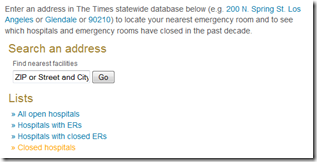
The Los Angeles Times has put together a site whereby you can look up and see what services are available and where. Use the link below to go to the site for complete listings and see what is available and where.  

California's dwindling emergency rooms

This is what the format looks like with links to the full data bases and easy enough to search or view the entire data base. 

image

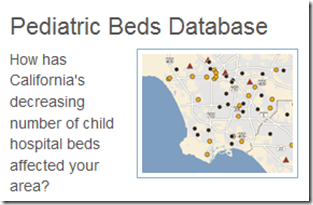
Also on the same page, see the number of pediatric beds available. 

image

On another page, the Times listed all the hospitals closed in the last 10 years in California, quite a few and we still have doctors and hospitals with some of the lowest compensation packages in the country to boot.  The most recent on the list being Century City, take a look and see why this hospital had to close, no money and on the outskirts of Beverly Hills.  We also certainly don’t have a shortage of healthcare lawsuits either disputing contracts and payments, even some hospitals suing others.   BD

Closed California hospitals

Hospital ER in 1998 ER in 2007
Alta Hospital District Closed in 2001 Yes No
Anaheim Memorial Medical Center West Closed in 2001 Yes No
Bay Harbor Hospital Closed in 2000 Yes No
Bellwood General Hospital Closed in 2003 Yes No
Bloss Memorial District Hospital Closed in 1998 No No
Brea Community Hospital Closed in 2005 Yes No
Calexico Hospital Closed in 1998 Yes No
Central Valley Orthopedic & Spine Institute Closed in 2004 No No
Century City Doctors Hospital (Los Angeles) Closed in 2008 Yes Yes
Chowchilla District Memorial Hospital Closed in 2002 Yes No
Del Puerto Hospital Closed in 1998 No No
Doctors Medical Center - Pinole Campus Closed in 2000 Yes No
Dos Palos Memorial Hospital (Dos Palos) Closed in 2003 Yes No
Elastar Community Hospital Closed in 2004 Yes No
Friendly Hills Regional Medical Center Closed in 1998 No No
Granada Hills Community Hospital Closed in 2003 Yes No
Hoopa Community Hospital & Medical Center Closed in 2000 No No
Indian Valley Hospital (Greenville) Closed in 2005 Yes No
Kaiser Permanente El Cajon Medical Center Closed in 2000 No No
Kaiser Permanente San Francisco Medical Center and Offices - French Campus Closed in 2000 No No
Lakewood Regional Medical Center - Clark Avenue Closed in 1998 No No
Lassen Community Hospital Inc Closed in 2003 Yes No
Lindsay District Hospital Closed in 2000 Yes No
Los Angeles County High Desert Hospital Closed in 2003 No No
Los Medanos Community Healthcare District Closed in 1998 Yes No
Martin Luther King Jr.-Harbor Hospital (Los Angeles) Closed in 2007 Yes No
Memorial Hospital at Exeter Closed in 2001 Yes No
Mercy American River Hospital Closed in 2000 Yes No
Mercy Westside Hospital Closed in 2003 Yes No
Mission Bay Hospital Closed in 2000 Yes No
Monrovia Community Hospital (Monrovia) Closed in 2005 Yes No
North Hollywood Medical Center Closed in 1998 No No
Northridge Hospital Medical Center - Sherman Way Campus Closed in 2004 Yes No
Novato Community Hospital (NOVATO) Closed in 2001 Yes No
Orange County Community Hospital - Buena Park Closed in 2003 No No
Orthopaedic Hospital Closed in 2005 Yes No
Pacific Coast Hospital Closed in 2000 No No
Pacifica Hospital Closed in 1998 Yes No
Riverside General Hospital University Medical Center Closed in 1998 No No
Robert F. Kennedy Medical Center Closed in 2004 Yes No
SHC Specialty Hospital Closed in 1998 No No
Saint Louise Mental Health Center Closed in 1999 Yes No
Saint Louise Regional Hospital (Gilroy) Closed in 1999 No Yes
San Bernardino County Medical Center Closed in 1999 Yes No
San Jose Medical Center Closed in 2004 Yes No
San Luis Obispo General Hospital Closed in 2003 Yes No
Santa Ana Hospital Medical Center Inc Closed in 2003 No No
Santa Teresita Hospital Closed in 2004 Yes No
Scripps Hospital - East County Closed in 2000 Yes No
South Bay Medical Center Closed in 1998 No No
South Valley Hospital Closed in 1999 Yes No
St. Francis Medical Center - Santa Barbara Closed in 2003 Yes No
St. Luke Medical Center Closed in 2002 Yes No
The Heart Hospital, Inc. Closed in 2000 No No
Thompson Memorial Medical Center Closed in 1998 No No
Tuolumne General Medical Facility Closed in 2007 Yes No
UCSF Medical Center at Mount Zion (San Francisco) Closed in 2000 Yes No
Valley Childrens Hospital & Guidance Clinic Closed in 1998 No No
Valley Community Hospital Closed in 1999 Yes No
Washington Hospital - Culver City Closed in 1999 Yes No
Westside Hospital Closed in 1998 Yes No

Emergency room physicians say the closures have led to long waits, diverted ambulances and, in the most extreme cases, patient deaths. The closures also mean that patients in need of emergency care may need to travel farther, delaying access to treatment.

Emergency Rooms - California Hospitals - Data Desk - Los Angeles Times

Related News:

ER doctors in Orange County sue state over low Medi-Cal payments – California

Hospitals Put Patients' Debt Up for Auction
California and Balance Billing
The battle of the medical bills where nobody but the insurers win
California sues Prime Healthcare over balance-billing practices

Scripps Health hit with class action suit over balance billing

Desperate Hospitals – Updated November 21, 2008
A hopeful prognosis - Desperate "California" Hospitals

Wisconsin Health Information Exchange RHIO connected with Amalga from Microsoft

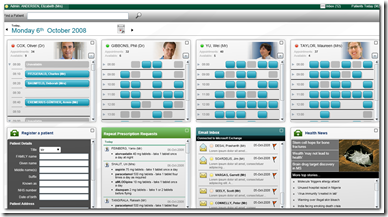
Microsoft Amalga has been chosen to the software used to imageconnect the network of hospitals.  Each hospital was an “island” and had their own system and were speaking their own language.  Amalga brings it all together and translates the data.  The ER rooms are able to have access to see what tests have been done and if they have a primary care physician.  The physicians were able to pick up and understand the system quickly. 

Hospitals are able to see that the patient was treated or consulted at another hospital for the same problem as an example a couple days prior and see what had been done at that point instead of having to start from scratch with all the information.  Amalga is also it’s own hospital system, but there are various modules that can be integrated and put in to place, such as in this story, where Amalga is bringing many systems together under one format.  Watch the video a the website to learn more.

Humana has stepped in for their part to help advise patients where it might be best to get care, in other words perhaps not always going to the emergency room when a visit to a local physician, clinic, etc. might be better as we all know the ER rooms are over crowded as ever and perhaps a bit of business intelligence on where to direct patients will help direct patients to other care that maybe don’t need to be seen at the ER. 

“The technology platform for the WHIE ED Linking project will be the Amalga system supplied by Microsoft Corporation. The innovative Amalga software has won accolades for its ability to integrate data from multiple health care systems and to present information to clinicians in a useful manner. Amalga's unique architecture delivers sub-second responses to diverse queries directed at massive amounts of data. The WHIE implementation will lead the nation in the application of this software platform to address the complex needs of a regional health information exchange system.”

Big steps and worthwhile to get all the hospitals connected and credible information available in the ER.  BD

Press Release below:

MILWAUKEE – January 29, 2009 ¾ Humana Inc. (NYSE: HUM) has begun working with the Wisconsin Health Information Exchange (WHIE) to ensure that clinicians have access to the most comprehensive community-wide data available for emergency department patients. image

As part of their on-going emergency care initiatives, beginning in December 2008, the Humana Inc. plans entered into a pilot program with the WHIE, the first health information exchange in Wisconsin. Health information exchanges, such as WHIE, use information technology to provide secure authorized access to clinical data, improving communication among clinicians, care coordination and reducing unnecessary duplication of services. 

“I have seen the positive impact of a physician having a patient’s historical view – it reduces the chance the patient will have unnecessary or redundant tests and results in steps that positively influence the patient’s cost of care delivery,” said Dr. Albert Tzeel, Humana’s regional medical market officer. “For these reasons, I’m proud Humana is taking steps to aid WHIE in this initiative.”

In this program, Humana recognizes the value of applying health information exchange technology, and has agreed to provide a WHIE-administered incentive to providers for utilization of the WHIE.
image“We are excited to see an insurer like Humana involved with WHIE and look forward to working with Humana on these initiatives. WHIE now has more than one year of patient history data online, with 13 hospitals contributing to the exchange and five emergency departments using WHIE as a standard in patient care,” said Kim Pemble, chairman of the board and executive director of WHIE. “2009 will bring continued growth for WHIE, building on this new relationship with Humana and an ongoing relationship with Milwaukee Health Care Partnership.”

Additionally, as part of a complementary emergency department program, in August of 2008, Humana initiated a pilot program to help members potentially seeking emergency department care. All members in the pilot program who may need emergency services at some point have received information on self-management strategies and on urgent care as a possible alternative to emergency department use.

In addition, members with two visits within a one-year period receive an age specific self-care education book promoting options for urgent and emergent care. Also, as a further service to members, those individuals with three or more emergency department visits within a one-year period receive a referral to a Humana personal nurse to help address questions on chronic conditions and potentially a referral into one of Humana’s clinical programs. 

These programs seek to improve utilization by directing patients with conditions more appropriate for a primary care physician or urgent care centers away from busy emergency departments. Examples include sore throat and flu symptoms, which for a typical patient with no other diagnosed illness are easily addressed in non-emergent settings.

“Emergency departments are intended for life-threatening situations. When a visit to the emergency department occurs for less urgent symptoms, healthcare expenses rise, time delays increase and overcrowded emergency departments get busier yet,” said Larry Rambo, regional CEO for Humana. “We understand the importance of working to reduce healthcare costs while maintaining the highest level of care for patients in Wisconsin.” 

“The agreement between the WHIE and Humana is an exciting endorsement of the power of information technology to drive improvement in the healthcare system. With this collaboration, one of the country’s largest health-benefits companies is incenting the re-use of information, which is critical to improving the quality of care and containing costs,” said Peter Neupert, corporate vice president, Microsoft Health Solutions Group. “We are pleased to provide the WHIE with affordable, high-value technology that powers the efficient aggregation and sharing of health data, helping physicians make optimal, timely decisions for patients while driving greater efficiency in the delivery of care across Wisconsin.”

About WHIE

WHIE is the Wisconsin Health Information Exchange, a not-for-profit organization formed to improve the quality, safety efficiency and accessibility of health care and public health by enabling collaboration and information sharing across multiple health care facilities. The WHIE ED Linking Project is being pursued in collaboration with the Milwaukee Health Care Partnership, WI Department of Health Services, and participating health care providers across the greater Milwaukee area. WHIE’s technical business partner is Microsoft Health Solutions Group, with WHIE powered by Amalga.

After establishing its initial membership and pursuing pilot studies in 2005 and 2006, WHIE launched the ED Linking Project in 2007, with clinical use beginning in 2008. As of December 1, 2008 WHIE had 13 hospitals across four delivery networks contributing data to the exchange, and five emergency departments using the exchange in regular patient care. In 2009, WHIE plans to expand the types of data (e.g. lab results, pharmacy information, imaging results) available to participants and also plans to expand the number of participating organizations. More information is available at www.whie.org.

About Humana

Humana Inc., headquartered in Louisville, Kentucky, is one of the nation’s largest publicly traded health and supplemental benefits companies, with approximately 11.7 million medical members. Humana is a full-service benefits solutions company, offering a wide array of health and supplementary benefit plans for employer groups, government programs and individuals.

Over its 48-year history, Humana has consistently seized opportunities to meet changing customer needs. Today, the company is a leader in consumer engagement, providing guidance that leads to lower costs and a better health plan experience throughout its diversified customer portfolio. More information about Humana is available at www.humana.com.

Related Reading:

President-Elect Urges Electronic Medical Records – comments by Dr. Bill Crounse of Microsoft
There’s No Good Reason to Delay Data Liquidity and Information Sharing in Healthcare..
Microsoft Interview on Fox following the Senate Health IT Testimonies
Investing in Health IT: US Senate Testimonies

Lawmakers Consider Adding Health IT to Stimulus Package – We Need some Congressional Algorithms
Education not Fear is Needed with Medical Health Records
Bringing Providers, Health Care Executives and Administrators into the 21st Century
Interoperability Advice for the New Administration – AHIC