Hospital Admissions – Who Decides is A big Question

Sometimes you can’t win for losing as this video shows what happened in Texas, the ER docs were instructed to bring up admissions if they could on marginal cases, so they did, and the reward was getting fired when the business intelligence software said some were not necessary, so this is a double edge sword we have going here and who’s going to be the Monday morning quarterbacks?  BD 

He describes the case of a woman with a probable case of lung cancer who needed a comprehensive evaluation. She was on Medicaid, the government health insurance for the poor, which meant she’d have a hard time finding specialists to treat her as an outpatient. So Pines admitted her to the hospital, even though she wasn’t acutely ill.

“She was not sick enough to need a hospital bed,” he writes. “But I believe admitting her was the right decision.”

Health Blog Questions of the Day: Who should decide when hospital admissions are necessary? Are there any instances where public insurance shouldn’t pay for a hospital admission?

An ER Doc Grapples With ‘Unnecessary’ Hospital Admissions - Health Blog – WSJ

Related Reading:

Closing the Chemotherapy/Outpatient Clinic In Las Vegas and nowhere to go – University Medical Center
Consolidation in Health Insurance Carriers – Who will be the king of risk management?
Desperate Hospitals – March 2009 Update
Desperate Hospitals – February 2009 Update
Desperate Hospitals – Updated November 21, 2008

Desperate Hospitals – September 2008

Desperate Hospitals - Hawaii- What is happening to our Hospital System?
Desperate Hospitals - August 29 (Continued)
More Desperate Hospitals - Miami, FL and Cape Cod, MA
Desperate Hospitals - Century City Doctors Hospital (Los Angeles) begins shutting down, others file Chapter 11 to reorganize

Senator Christopher Dodd of Connecticut Has Prostate Cancer – Using Recess to Have Surgery

What is very disturbing about all of this too is Rush Limbaugh blasting him about where he’s going to have surgery and attacks him.  Listen to the imageaudio below and hear how mean and cold he is.  This is ridiculous relating this to insurance (which we know is a problem) and our broken system.  Rush in my book has just about washed himself up.  Years ago this type of talk used to be entertaining but by today’s standards it is annoying and rude, and so very reminiscent of how discussions were in the 70s, so I guess Rush appears to also be stuck in the 70s, along with many members of Congress and other government officials, I don’t quite understand why it continues to fill the airwaves with this archaic type of rude opinions and lack of professionalism. 

I didn’t know Rush had surgery to help restore his hearing either until reading here, but perhaps that could be part of the issue too, can’t hear himself and what he sounds like?   Again, poor taste and time to take stabs. 

On the other side of the coin it is in an early stage and with prostate cancer that is a good prognosis in most cases and he more than likely will have a successful return.  Check out below in the related reading section to see what the Mayo Clinic is doing for prostate cancer too.  BD 

(CNN) -- Sen. Christopher Dodd announced Friday that he has an early form of prostate cancer, but he said the prognosis is good and he is going to be fine.

"I'm very confident that we're going to come out of this well," the senator from Connecticut said in a news conference in Hartford with his wife, Jackie Clegg Dodd.

Dodd, 65, said he was diagnosed in June after an annual physical and had decided Thursday night to undergo surgery after the Senate adjourns for its recess next week.

"I'm running for re-election," he said, referring to next year. "Now I'll be a little leaner, and a little meaner, but I'm running."

Dodd, who drew criticism in Connecticut when he moved his family to Iowa while he ran unsuccessfully for president last year, is facing a Senate ethics committee investigation over favorable mortgage rates he received under the Countrywide VIP program.

Dodd says he has prostate cancer - CNN.com

Related Reading:

President Obama Gets Some Hands On Experience with the DaVinci Surgical Robot

Rush Limbaugh – It’s All the Healthy People Driving up the Cost of Healthcare

Limbaugh Worrying about his Medical Records

Mayo Clinic - Reducing Tumors with Hormone Therapies Before Surgery for Prostate Cancer

Saxagliptin aka Onglyza Approved by FDA – Diabetes Medication For Diabetes 2

It appears 2 drug makers are collaborating and as stated below will give Merck some competition in this new class of drugs which is using the action ofimage hormones to increase the body’s usage of sugar.   Diabetes treatments are getting a lot attention and are coming in different shapes and sizes, like the one from Mannkind waiting FDA approval for one that you inhale.  BD

Mannkind Submits Afresa –Inhaled Insulin Device/Drug to the FDA

The FDA just approved saxagliptin, a diabetes medicine that will be co-marketed by Bristol-Myers Squibb and AstraZeneca. The drug, which will be sold under the brand name Onglyza, is in a relatively new class, called DPP-4 inhibitors, that can be taken along with older diabetes drugs.

“DPP-4 inhibitors are a class of compounds that work by affecting the action of natural hormones in the body called incretins. Incretins decrease elevated blood sugar levels (glucose) by increasing the body's utilization of sugar, mainly through increasing insulin production in the pancreas, and by reducing the liver's production of glucose.”

Until now, Merck’s Januvia has been the only drug in the class on the market in this country. But in late 2006, when Januvia was approved by the FDA, you wouldn’t have guessed that Merck would have the market to itself for so long. That it has is a sign of the tough safety scrutiny the FDA has given to many new drugs in recent years

Saxagliptin (Onglyza) Approved for Diabetes Approved by FDA - Health Blog - WSJ

Doctor Self-Referrals – Physician Owned CT Scanners Questioned Again

Here goes the same question again, are they being over used.  Well this time I’m going to speak out a bit from some personal experience where I worked with a physician’s practice, writing software that connected to the information from the CT scanner, which involved a bit of my time on premise so I was also an observer of what occurred in this office, they had a CT scanner on premise and it was a practice of 3 family/internists.  image

Did I see abuse here, not in my opinion, but did I see convenience for the patient, yes.  The number of patients that came through the office that had scans were actually small.  The practice was also intelligent enough to offer “retail scans” too, so in other words if a patient, on their own with no insurance coverage here, wanted to have a full body scan, heart scan, virtual colonoscopy, etc. they could.  Now as far as I know there’s no law against wanting to have one and paying for it on your own account.  If a practice is smart, they make the availability known to the patient, and if a scan is required, it can be done immediately.  I saw many patients that appreciated that fact and they were happy with the quick diagnosis. 

One other item too, the scans for diagnosis are specified they are for that purpose, and thus there is a separation between a retail patient and one for diagnosis. What I did while I was there was to create some additional business intelligence so the physicians could stay on top of those patients who had a high calcium score, in other words those at risk for heart disease and made it easy for automated letters to go out and remind those patients to come back for a check up, and we are not talking marginal here, we are talking over 300 or more on the score.  One more thought to keep in mind, does one know the expense of keeping one of these units up?  Well think about that side of the coin if you will as it is not cheap and actually when the repair and maintenance bills came in I occasionally used to hear some mutterings to the effect of “why did I get this machine”, so again, this is looking a the other side of the coin. 

Again there’s always someone along the line that will abuse this, but from what I saw as an example I don’t think abuse is the case with most, it’s convenience and not having to wait until a hospital facility can do it a couple weeks or days down the road, and all the controversy over this notion is ludicrous.  Now should there be occasional audits, sure, to make sure everyone is on track and if all is going the way it should, there’s nothing to worry about.  Remember even when the CT scanner is on premise, insurance coverage still have to be verified.  BD 

In August 2005, doctors at Urological Associates, a medical practice on the Iowa-Illinois border, ordered nine CT scans for patients covered by Wellmark Blue Cross and Blue Shield insurance. In September that year, they ordered eight. But then the numbers rose steeply. The urologists ordered 35 scans in October, 41 in November and 55 in December. Within seven months, they were ordering scans at a rate that had climbed more than 700 percent.

A lawyer for the Iowa urology practice defended its medical decisions. "The standard of care for a certain category of patients may require a CT scan and the practice may have decided to purchase a CT scan as a result," Victor Moldovan said in an e-mail. "Any assertion that there is some wrongdoing simply because of an increase in scans is unfounded." The urology practice, he added, "understands its obligations very well and complies with all applicable standards."

Physicians, medical associations and imaging-device manufacturers argue that allowing doctors to own and operate scanners increases patient convenience and allows quicker diagnoses.

"It is important for legislators not to take tools out of the hands of doctors," said Jim York, an orthopedic surgeon and president of the Maryland Patient Care and Access Coalition, a group fighting to allow physicians to operate their own scanners.

"Just because doctors have CT scanners in their office does not mean they are abusing the system," Siegel said. "Is everyone a Bernie Madoff or a crooked politician? Most doctors are dedicated to providing outstanding patient care. They don't think, 'A CT scan is coming and I am going to make money.' They think, 'A patient needs a blood test or a scan, and I am doing it for him.' "

Doctor Self-Referrals Part of Health-Care Cost Trend - washingtonpost.com

Health Issues on Vacation, Call Your Insurer and Have Information with You in a Personal Health Record

This is a good bit of advice from a post in the New York Times about what to think about when you go on vacation as he stated even at Disneyland you might have a fall or in his instance his toe. 

The only one item that I would elaborate on here and think about changing to fit me would be to have all my information in a personal health record in case I end up in an ER outside of home.  Keeping a list in your wallet is good too, but what if you lose you wallet?  A PHR as I have always said is your back up system for your health records and any ER physician appreciates any information they can get their hands on.  Google Health and Microsoft HealthVault are 2 free PHRs that get the job done for you and when you don’t even have to enter the data with labs or most medications as e-prescribing and connecting to retail drug stores can do it for you, a nice set of credible medical records.  The ER doctor will love you for this. 

Here’s a link to over 180 Posts dedicated to both Google Health and Microsoft HealthVault for more information on this blog.  BD

JUST one hour into the start of my recent Disneyland vacation, I tripped on a tree root by the hotel pool and jammed my toe. The pain image was intense. My husband kindly looked up nearby orthopedists on the Internet and suggested I go see one. Instead I called the number on the back of my insurance card (yes, I’m frugal) and was transferred to a nurse who said, based on my symptoms, my toe was probably not broken, and that ice and ibuprofen might be enough.

BRING YOUR INSURANCE I.D. Duh, you might be thinking. But go on — check your wallet now, to prevent a scramble later. (Can’t find it? See if you can print one out from your insurer’s Web site.) And make sure you’re also carrying information about your prescription drug plan and dental policy.

HAVE A LIST OF YOUR MEDS. Ideally, you should bring all your bottles with you, that way if you end up in the E.R. and are unable to speak, a doctor can make sure he’s not giving you a medication that would adversely interact with something you are already taking. But at the very least, bring along a written list of the medications you take and keep it in your wallet.

“Telling an E.R. doctor that you take a little white pill for high blood pressure is not helpful,” says Dr. Jay Morris a former emergency room doctor who is now a vice president for the insurer UnitedHealthcare. “There are hundreds of pills.”

If you end up in the E.R. or even a clinic, try to bring a friend or relative. You may need an advocate to pester the nurses for extra meds or a better bed and to make phone calls should you need the attention of a specialist, Dr. Morris said. Your advocate can also call your insurer to find out if you need preapproval for any procedures.

Patient Money - For Health Problems on Vacation, Call Your Insurer First - NYTimes.com

2 new Moms in Northern California Die from Swine Flu

We are not out of the woods yet and the H1N1 virus is still being watched with pregnant women being identified as a big risk.  Also in the news recently pages at the Senate could have Swine flu, so maybe recess at this time is a good thing.  BD

US Senate – 5 Pages May have Contracted Swine Fluimage

Swine-flu virus has claimed the lives of two Bay Area women who recently gave birth, adding to the growing body of evidence that pregnancy puts women at increased risk of flu-related hospitalization and death.

News of the deaths comes as the federal Centers for Disease Control and Prevention recommends that pregnant women be among the first to receive a vaccine, when it's available. The CDC also urges that anti-viral drugs like Tamiflu or Relenza be quickly administered to pregnant women with suspected influenza.

Pregnancy changes both the lung capacity and immunology of women, making it harder for them to fend off respiratory infections.

2 new moms in Bay Area die from swine flu; concern raised about risk for pregnant women - San Jose Mercury News

Related Reading:

Dr. Oz Talks About Healthcare Reform with a “Clinical” and “Smart Patient” View
First Case of Pigs with Swine Flu Reported in Canada
FDA approves use of Quest Diagnostics H1N1 flu test – Getting Ready for Flu Season
Wimbledon tournament – 28 Staff Members told to say home – Swine Flu

Hospital News – California and Pennsylvania Money Issues

In California hospitals need to retrofitted to meet earthquake standards by the years 2013 and 1015 and most surveyed felt they were not going to be able to meet the deadline, which could in time force more closures.  In Pennsylvania more hospitals are sliding into the red, big jump of over 20% with an erosion retaining staff and health IT initiatives being put on hold.  Also worth noting is the situation in Arizona where the capitol buildings mayimage need to be sold and leased back as funds are running out.  BD   

Arizona May Sell Government Buildings Including the State House, Senate, and a Hospital

A majority of California hospitals won't be able to meet state-mandated deadlines for seismic retrofitting because of the nation's credit crunch and their own deteriorating revenues, according to a report issued Thursday by the California Hospital Association.

Under state law, the state could force hospitals to close if they fail to meet the deadlines. About a third of the state's 430 hospitals responded to the survey.

Pennsylvania’s general acute-care hospitals are continuing to struggle with the ongoing recession, according to the Hospital & Healthsystem Association of Pennsylvania trade group.

The survey also found the percentage of hospitals with a negative total margin increased from 31 percent to 55 percent over the same period.

“With more than half of Pennsylvania’s hospitals experiencing [losses], up from one-third just a year ago, we are seeing an erosion of hospitals’ ability to retain staff, invest in health-care technology, and make capital improvements — severely affecting hospitals’ core mission to provide care for patients 24 hours a day, seven days a week.”

Related Reading:

Desperate Hospitals Update – April 2009
Desperate Hospitals – March 2009 Update
Desperate Hospitals – February 2009 Update
Desperate Hospitals – Updated November 21, 2008

Desperate Hospitals – September 2008

Desperate Hospitals - Hawaii- What is happening to our Hospital System?
Desperate Hospitals - August 29 (Continued)
More Desperate Hospitals - Miami, FL and Cape Cod, MA
A hopeful prognosis - Desperate "California" Hospitals
Desperate Hospitals - Century City Doctors Hospital (Los Angeles) begins shutting down, others file Chapter 11 to reorganize

Customer Asset Protection Company (CAPCO) Reinsurance Firm – Can They Handle the Lehman Bankruptcy and Pay Claims?

New York is now investigating if the company sold policies without the assets to cover, sound somewhat like short selling without the funds to back imageit doesn’t it?  The hedge funds are looking at CAPCO for information and probably some money too when it comes to settling the Lehman bankruptcy, and the company has never had a claim, until now.  Interesting too how the company moved from New York to Vermont to get out of the spotlight and scrutiny of the state of New York. 

What is starting to worry individuals too is that when you call, according to the New York times, you get a recording that you have reached a non working number at Morgan Stanley, so who and what is running the place?  It’s credit rating was reduced to junk in December and no longer exists. 

There are pension funds, endowments and medical funds all tied in here, so what happens if CAPCO files bankruptcy, another “Madoff” saga that continues?   From the website, here’s the listing they provide of their accounts with some very familiar names. 

image

In a similar reinsurance news story, AIG is back in the news:

“Nothing is wrong with spreading risks to other companies, a practice known as reinsurance, when it is carried out with unrelated, solvent companies. It can also be acceptable in small amounts between related companies. But A.I.G.’s companies have reinsured each other to such a large extent, experts say, that now billions of dollars worth of risks may have ended up at related companies that lack the means to cover them.

Mr. Gober is a consultant for a lawsuit on behalf of A.I.G. policyholders, filed in California Superior Court in Los Angeles. The lawsuit seeks a court order requiring all A.I.G. subsidiaries doing business in California to put enough money to cover their obligations into a secure account controlled by the state treasurer.”

The hunt is on to determine if assets are really there and available from several angles it appears and the age of transparency is bringing many things to light today, some expected and maybe some not expected.  BD 

Next to a Chinese restaurant in Burlington, Vt., lurks a quiet guardian of Wall Street — an obscure insurance company that is supposed to protect big-money investors in the event of a catastrophic failure of a major brokerage firm.

A failure, for instance, like the one that brought down Lehman Brothers nearly 11 months ago. Now, after years in the shadows, the insurer, the Customer Asset Protection Company, could finally be put to the test, and questions are starting to swirl.

The worry is that the company, which has never paid out a claim, might be unable to cope with the Lehman bankruptcy.

By some industry estimates reviewed by the insurance department, Capco could face nearly $11 billion in claims but has only about $150 million with which to meet them.

The Insurer Capco, a Pillar of Lehman, Begins to Look Flimsy - NYTimes.com

Nearly 30% of Insured Are Already Covered by Government Healthcare Plans in the US

This is an interesting ongoing Gallup pole, so getting close to 1/3 of the population with a government plan of some sort and this includes Medicare, Medicaid and Military coverage, so it appears we have one big chunk already working through a government program.  Employer based insurance is still the leader in all categories. 

 image

When you look at the percentages by age, after 65, the percentage grows phenomenally.  More on the poll can be found here as Gallup states that they poll 7 days a week and no less than 1000 individuals a day.  BD

image

WASHINGTON, D.C. -- The Gallup-Healthways Well-Being Index reveals that currently 29.0% of adult Americans who have health insurance get their coverage through the government, a percentage which has increased since early 2008. More than half of insured Americans (56.5%) rely on an employer-based program and another 13.3% of the insured obtain their healthcare coverage through some other means, which includes purchasing it privately for themselves.

Nearly 30% of Insured Have Government Plans, Up From ’08

Burning Medical Records Found Near Shopping Center – Paper Records Bon Fire in Kentucky

It appears we still have a problem with shredders and perhaps the time it takes, and still stories like this one, medical records found in a small bon fire near a shopping center, but at least the report stated that most were burnt beyond recognition so that’s good news for the patients in one respect, but on the other hand, their records are gone.  Maybe the answer is to install “public shredders” for easy access.  BD 

The investigation continues into why hundreds of medical records were found dumped and burning in Jessamine County.

The records were found burning last week near the Brannon Crossing Shopping Center.

Jessamine County officials handed over bags of charred records to an investigator with the Kentucky Board of Medical Licensure. So far, the board will only confirm that it is investigating the improper disposal of the records, but will not confirm where the records came from.  The board calls the case an open investigation. They estimate between 500 and 1,000 records were recovered, but said most were burned beyond recognition.

Investigation Continues Into Burnt Medical Records - LEX18 - Lexington, KY - News, Weather, Sports -

Strong Perfume Evacuates Office, Sends 30 to the Hospital and Paramedics to the Scene

Allergies must be among us, or at least they were at the Bank of America, but how does one confuse carbon monoxide with perfume unless it is one of those new blends that is supposed to smell that way (grin).  Employees complained of having chest pains and headaches and the ones that did not go to the hospital were treated on the scene.  Hazmat did their part and investigated the incident.  image

The fire department stated the complaints originated from two employees who reported feeling dizzy after someone sprayed on some perfume, so there was the culprit, and I am really curious as to which brand it was as now the brand could potentially be considered hazardous!  BD 

Thirty people were transported to a hospital Wednesday after what was initially believed to be a carbon monoxide leak, but later determined to be strong perfume inside a Bank of America office.

The Fort Worth Fire Department responded to the incident in the 5400 block of North Beach Street at about 12:55 p.m. and evacuated the building as hazmat crews conducted an investigation.

"When the two employees reported their illness to a supervisor, an announcement was made over the building’s PA system saying that anyone feeling these symptoms should exit the building to an outside location," Worley said in an e-mail.

Worley said a large number of people, even from other floors, came outside, but many continued working with no ill effect.

"Perfume" Evacuates Office, Sends 30 to Hospital | NBC Dallas-Fort Worth

FDA Approves Hypertension Drug (with Conditions) that You Inhale - Tyvaso

This is more than just a drug, it is a drug and a delivery system technically.  More and more I seem to be seeing more drugs steering towards an inhalable formula.  This is not the first one as there are others on the market.  The first one that everyone seems to remember was the “huge” giant inhaler which is no longer available from Pfizer, it looked like a bong, but things are smaller and better now.image

One drug for migraines that is an inhalable recently met its trial goals and then there is Afresa from Mankind that has been submitted to the FDA for inhaled insulin. 

The artist rendering below gives an idea as to what the delivery system devices looks like and the company with their FDA approval will be making some changes on that portion. Will it end up in a blue tooth inhaler?  The subsidiary of United Therapeutics, Lung RX will be releasing the product in September. 

The Smart Inhaler with Blue Tooth and Wireless Capabilities

In other related news today, a Swine Flu vaccine that you inhale is also on its way to market.  BD 

BANGALORE, July 30 (Reuters) - United Therapeutics Corp (UTHR.O) said U.S. health regulators approved its inhaled drug to treat pulmonary hypertension, sending its shares up as much as 13 percent.

The Food and Drug Administration approved Tyvaso inhalation solution for the treatment of pulmonary arterial hypertension (PAH) using the Tyvaso inhalation system, the company said.

image

Even though the drug, Tyvaso, had faced a couple of delays on its way to approval, analysts were expecting a regulatory nod by Thursday's action date as it was mostly the drug's delivery device that had faced a close scrutiny than the drug itself.

The company has agreed to post-marketing commitments to modify certain aspects of the inhalation system, perform a usability analysis and collect pharmacokinetic data, which shows the body's reaction to a drug, to verify expected dosing with the modified device.

"It is positive that the company got the drug approved and they can make the modifications while the drug is on the market," Collins Stewart analyst Salveen Kochnover said.

She sees about $2.5 million in Tyvaso sales in the fourth quarter and about $51 million for the next year.

UPDATE 2-United Therapeutics lung drug gets FDA nod, shares rise | Industries | Healthcare | Reuters

Related Reading:

More Inhaled Drugs on the Way – Levadex for Migraines Met Trial Goals
Mannkind Submits Afresa –Inhaled Insulin Device/Drug to the FDA
The Smart Inhaler with Blue Tooth and Wireless Capabilities

Quest Diagnostics and Health IT – Interview with Rohit Nayak, Vice President of Sales, Clinical Information Solutions Group, MedPlus

Last week I had the opportunity to speak with Rohit Nayak, Vice President of Sales, Clinical Information Solutions group at MedPlus. MedPlus is the health information technology subsidiary of Quest Diagnostics and you may already be a bit familiar with the MedPlus name as they have marketed an e-prescribing solution now for a few years. image

I was anxious myself to have the chance to be updated on what is happening with Health IT at Quest for a couple reasons, first being the recent news events on some of the solutions they have provided, and secondly due to my own exposure a number of years ago when I was still writing code and had written a code interchange with Quest in writing my own EMR. It is amazing how far along we have come since my work, which now is in mothballs as technology is way beyond the simple code I wrote years ago when everything was still contained at the doctor’s office and web based applications were far and few between and everyone was afraid to trust them. One comment I have to add though is that the code worked and if I was able to do it, there’s plenty of opportunity for more and a side note here too, Rohit remembers the old Quest interface I worked with so he has quite an extensive background on the development to where they are today.

imageAlso in the news this week was the announcement of the MedPlus HIE solution going live in New York City from the New York Clinical Information Exchange (NYCLIX).

“The New York Clinical Information Exchange (NYCLIX), Inc., consists of 11 hospitals (eight of which are in Manhattan), the Visiting Nurse Service of New York, a federally qualified health center and a faculty practice organization, encompassing about 840,000 emergency room visits, 470,000 discharges, 6.8 million outpatient visits and 5.9 million home visits annually. Incorporated in 2005, the not-for-profit group has received federal and state grants to create its health information exchange.”

image

First of all Rohit and I began discussing Care360, which was pretty much the first step in Health IT with Quest and has been around for a number of years. For those reading here who are not familiar with Care360, it is a web based solution that gives the physician’s office the ability to enter lab requests electronically and secondary, get the results and this means a lot for consumers as they can go to any Quest Patient Service Center to have their labs done, and you don’t need to worry about losing that slip of paper with the order from the physician as it is paperless.

Rohit stated that the the big focus of their technology today is dedicated to adding value the physician’s office, and to do this it requires building the framework of a patient chart. When lab results are returned, there’s a pretty good chance that treatment of some type may result if they are out of normal tolerances. Quest is the largest lab in the US to provide this service. In addition to entering and receiving lab reports, the system also has the ability to allow physicians to securely communicate with one another, as an example a family practice physician with a specialist. If results come back that would determine the need to follow up with a physician beyond the family practice, and the specialist is “in network” or in other words also a subscriber of Care360, lab results can be forwarded and communication between the 2 physicians is allowed for collaboration.image

If a physician is away from the office or medical facility and has an internet connection, no problem, just log on to the Care360 Physician Portal. The use of Care360 eliminates the dependency of having to rely on a fax machine, which sometimes the information is not always clear or having to sit on the phone to wait and get results. Easy for patients too, they can set up a personal account and make and confirm appointments online with Quest Diagnostics and find a listing of insurance coverage by state.
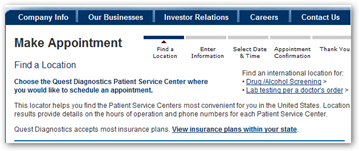
image

Also as information, Quest has a Patient Assistance program for those who do not have insurance and you can find additional information here and they are green, well we mean besides the color. image
Rohit also discussed the role played by Quest Diagnostics in the dialog and discussions ongoing relative to Meaningful Use”. There are several objectives here, but number one is probably the most important since we are all patients at some point in time. Over 140,000 physicians,representing about 70,000 practices are currently using Care360 in the US. This is number one on the list relating to “Meaningful Use”:

“Meaningful use “as seen through the patient’s eyes” should specifically inform objectives and measures.”

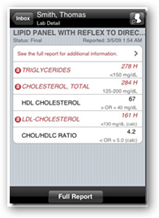
In addition, Rohit also told me that the Care360 solution connects to other labs across the country as well as radiology vendors and other 3rd party vendors; more on this a bit later. Not too long ago I had a post on the Medical Quack speaking about using an iPhone application from Quest to get patient lab reports. You can read more at the link below. Since April of 2009, the software has been downloaded over 6500 times Rohit stated.

Quest Care360 – Access Patient Lab Results and Medication History from your iPhone

This availability will become even more valuable with Care360 eprescribing, more on this a few paragraphs down.

image

Next we talked about MedPlus's ChartMaxx solution. Again, for me going backwards in time I remember in the early days when ChartMaxx was pretty much a document manager and the framework for this application has also grown and changed tremendously.

In addition, later this year MedPlus will release the next version of Care360 which will provide capabilities to enable a Physician to create a Electronic version of a patient’s medical record. This EHR offering will also enable physicians to take advantage of economic stimulus incentives available as part of the 2009 American Recovery & Reinvestment Act (ARRA). You can request additional information from the website.

Care 360 integrates with a number of EMR desktop and web software programs as well, some Rohit stated are real time while others are not, and I would perhaps guess too that has a lot to do with the interface written from the EMR software and it’s capabilities. Quest has one common data base for patients for both labs and eprescribing so this eliminates double input with patient demographics.

image

Next we moved on to discuss prescription history. Labs and medications/prescriptions are compiled together in a single view, and this makes sense as the labs are already in place if the patient has had any diagnostic testing at a Quest facility.

As mentioned above with the lab reports having the ability to be shared, the same can be said for the e-prescribing portion of Care360 too. MedPlus became part of Quest Diagnostics in 2001 Rohit stated and is now the Health IT division of the company. I do remember that myself and have to keep reminding myself. Later this year, prescribing medications/prescriptions will follow the same path as the labs and will be available for integration with personal health records too.

We briefly discussed the free NEPSI e-prescribing plan, of which Quest is a member. Rohit said that yes they have integrated with companies such as Allscripts and Quest was one of the founding members when the association was started to allow physicians a free web based imageapplication to encourage eprescribing.

You can also find eligibility information integrated in the system, depending on who the payers and other potential 3rd parties are in the application.

The next item we discussed was the Centergy Clinical Portal.. This is the connecting product that was mentioned at the top of this page with the connected hospitals and doctors in Manhattan HIE. Rohit stated when you think about all the patients that at some point in time that have had a test done through a Quest Diagnostics center, well that’s a lot of people, and more importantly too a lot of gathered data that is useful to clinicians and hospitals alike. The aggregation software provides a physician centric view with a single sign on so clinicians are not spending a lot of time gaining access, but yet everything is secure. Bringing lab tests and results to the table is a great use of information that exists today through aggregation and saves time and money without having the same tests repeated in some instances and again begins building a framework for a medical record.
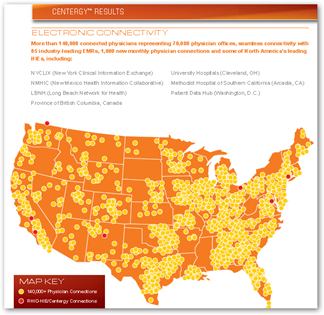
image

He stated that when a patient arrives and the search for information begins with Centergy Clinical Portal, edge servers are being utilized to create an image of all the information available and found on the all connected doctors/hospital systems. The information is brought together and a new record at that facility is created, and the information is seen through a “viewer”. Centergy Clinical Portal is leveraging meta data layers to bring all of this together. The software will bring together the Care360 information along with the information; ChartMaxx data as well as information from other 3rd party HIT vendors. Again, stay tuned for some major changes and application benefits coming later this year.
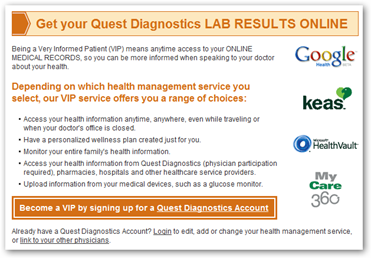
image

Now that we have touched on what is available for healthcare professionals, I asked what about the patient, is Quest addressing this part of the solution too? In the recent past I have written about both Google Health and Microsoft HealthVault connections. Rohit took a little additional time here to elaborate on how the PHR (personal health records)work with the Quest system.


Rohit stated the patient needs to be set up with their physician first of all to secure a “pin” number. It is one extra step that is required, but due to privacy and security it is the extra step that is taken to ensure the records are yours. With all the information we hear today about security, it’s really not a problem to go through the motions for this one time set up.

The first step he said is for the consumer to establish an account with Quest Diagnostics and that you can do pretty much like any other type of business online with entering all your information. At the end you will be asked if you want to be able to have your labs (and prescriptions coming later this year) shared with your PHR (personal health record). Quest of course uses a secure connection for this process to protect the data.

The consumer portal for Quest can be found here.

The one nice benefit of having physicians that use e-prescribing is the fact that it all goes to one place by provider. Retailers are also very helpful with their capabilities to share with PHRs, but if you use more than one drug store your information comes from 2 different vendors, with e-prescribing 2 or more doctors, all one share with the PHR and it is linked to the physician so every prescription that goes through the eprescribing process is there.

Rohit again stated the connections and use for the “wired patients” will accelerate and this may also have a positive effect on driving provider/physician participation in the long run.

As you can see from the writing above, this is not only a clinical move but a patient move as well. Myself, I consider the PHR my personal back up for my medical information when needed.

One last item worth a mention too is that Quest Diagnostics is the largest lab in the world and is involved in the testing and participation of clinical trials, to include Pharmacogenomics, in other words working with DNA or genomic based lab tests.

image

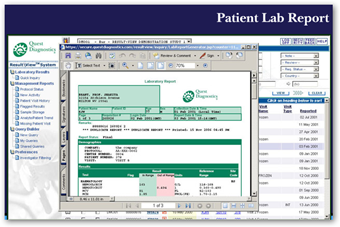
They also offer their web based software Result/View for investigators and others involved in the process.
image

I want to thank Rohit for taking a few minutes out to go through the offerings and services of Quest Diagnostics and hopefully some of the information gained here will help inform others as to the direction and services they offer and help explain where we are headed with Health IT. In conducting the interview I continued my ongoing education by learning about new and additional services that are available that contribute to the quality of the healthcare we receive today, and Quest Diagnostics is certainly is busy doing their share.

Related Reading:

Quest Diagnostics and Microsoft HealthVault – Connect to get your Lab Results in your PHR

Quest Diagnostics and Google Empower Patients and Physicians to Share Diagnostic Test Results Online
Quest Diagnostics/MedPlus Centergy(TM) Offers New Technology Benefits – HIE and RHIO
Quest Care360 – Access Patient Lab Results and Medication History from your iPhone
Health IT company declares victory in NHIN trial to send and receive patient medical record summary

NEPSI – Free E-Prescribing Solutions with Microsoft HealthVault and Google Health

Quest Diagnostics Joins National ePrescribing Patient Safety Initiative (NEPSI)

Statewide Health Information Exchange System to Launch in 23 Orange County ERs

The Medical Caduceus Has Taken On A Strange New Look

We all know the symbol and recently an anonymous group proposed that we consider the image below to reflect our current situation here in the US with the healthcare debate and reform in progress.  (grin). 

Use this link for the history if you want to know more with how the symbol originated.    

image 

Ok, this is a little humor and we can all certainly use it today.  BD

Surgery, the past, today and the future – Robotics

If you not seen this video, it is well worth the watch as Catherine Mohr walks us through surgery of days past, where it was done as a public imageexposition without anesthesia to where we are today and discussed the DaVinci Robot and the next plateau with only having one incision at some point instead of multiple small incisions.  Why is all surgery not done this way, cost is one item. 

Setting up the robot for each procedure takes time and currently required several small incisions, but still for the patient a much easier recovery and less blood loss. 

The next generation will have a camera and three instruments all together and this is where the next generation of robotic surgery is headed.  BD

image image


Surgeon and inventor Catherine Mohr tours the history of surgery (and its pre-painkiller, pre-antiseptic past), then demos some of the newest tools for surgery through tiny incisions, performed using nimble robot hands. Fascinating -- but not for the squeamish.

Catherine Mohr: Surgery's past, present and robotic future | Video on TED.com

Related TED Posts:

The Marrow Miner – A Better Way to Harvest Bone Marrow

Regenerative Medicine – Material and Cell Based Regeneration of the Human Body

Excessive Incentives and Rules – Where Did the Wisdom Go in HealthCare?

The Sneaky Moves of the anti-social smartphone users – Renny Gleeson

Cigna profit grows but based on Non Health Care Entities

Life Insurance and International Sales were the 2 areas that showed substantial profit increases and domestic membership is projected to continue to fall.  They are also alive in the online patient visit areas for compensation for physicians which has been in the news of late.  BDimage

Medical insurers Aetna, Cigna agree to pay for online doctor visits

NEW YORK, July 30 (Reuters) - Insurer Cigna Corp (CI.N) posted a higher-than-expected quarterly profit on Thursday, helped by growth in its disability and life, and international segments, while earnings at its main healthcare unit only dipped slightly.

Its shares rose 5.8 percent as the large U.S. health insurer nudged up its full-year profit forecast. Cigna stood by its expectation for 2009 healthcare earnings even as it sees a steeper decline in year-end health plan enrollment.

UPDATE 4-Cigna profit beats as non-health units shine | Industries | Healthcare | Reuters

Related Reading:

Cigna to Offer Quicken Health Expense Tracker, United HealthCare in Beta – Easily Identify Balance Billings?

Here Come the Health Coaches - Aetna Locks Contract with Bank of America for Health Insurance for 3 Years – Cigna Lines Up 3 Major Employers

Cigna and Aetna face lawsuit – AMA joining the the cause on payment issues

CIGNA Rolls out New Suite of Health Plans for Individuals and Small Employer Groups

CIGNA Reaches across Borders to Improve Health Care

Health Net and Humana File Protests over Military Healthcare Awards to UnitedHealthcare and Aetna

The battle between insurers begins and who may end up being the losers, the consumers as it takes money to pay the lawyers to facilitate the legal battles and of course there’s the time in court.  One the additional legal costs start accruing, will the 80% target of premium money being spent on imageactual healthcare still be attainable?  That is somewhat shocking to know that 20% or so in round numbers goes for administrative and other types of expenditures other than healthcare.  Reports and numbers do vary a bit on what actual percentage amounts are and in California some insurers have been taken to task legally on this battle ground.  A few weeks ago, Wendell Potter gave us a look behind the scenes as a retired health care executive and explained how the business works.  BD 

Wendell Potter Speaks on PBS with Bill Moyer on Health Insurance Reform – The Industry Did Not Keep Their Word (Video Previews)

Health Net Inc. filed a second protest Tuesday over the loss of a lucrative military health care contract, suggesting the company intends a vigorous fight to keep the business.

Health Net filed a protest July 20 alleging Aetna had an unfair advantage in the bidding process because the Defense Department posted Health Net’s bid price on the Internet.

Humanas Inc. has filed a protest of its loss of a contract to UnitedHealth Group Inc. for the southern region. And UnitedHealth, despite its win in the south, has filed a protest regarding the western regional contract, which will remain with TriWest Healthcare Alliance Corp.

TriWest subcontracts the California Tricare business to Blue Shield of California.

Health Net files second protest over Defense contract - Los Angeles Business from bizjournals:

Related Reading:

WellPoint (Blue Cross) and Aetna Profits Sink – UnitedHealthCare Profits Doubled
Aetna and United HealthCare Secure Military Contracts with Tri-Care

UnitedHealth Receives $21.8B military health care contract With DOD Tri-Care – Aetna Gains Northern Region

UnitedHealthCare Buys a Portion of Health Net in the Northeast

Goldman Sachs – Healthcare Reform Bets, Hedges, and Analysis, Not About Healthcare But All About Money

US Senate – 5 Pages May have Contracted Swine Flu

Recess might be coming at a good time, and perhaps our next session could see a Congress wearing masks when deliberating.  If nothing else is drills imagedown the importance too of getting healthcare reform done and not dragging it out longer than needed.  Recently in the news Quest Labs also now has a test approved by the FDA to see if one does in fact have the flu.  BD 

A day after the Senate sergeant at arms announced that five Senate pages may have contracted the H1N1 virus, the House Sergeant at Arms, David Cohen, on Wednesday evening sent out an e-mail urging caution. 

Cohen wrote that the Office of the Attending Physician "has identified individuals with symptoms of influenza, and quite possibly, the H1N1 virus, within the Senate Page Program. The Office of the Attending Physician is closely monitoring the situation and if it changes, you will be informed."
He warned that experts expect a "strong return" of the virus in the fall and "practicing preparedness across the House community, prior to the outbreak of this infectious disease, can help mitigate its effects and facilitate a better overall response once an outbreak has occurred."

The Sleuth - Capitol Hill Swine Flu Scare Continues

Related Reading:

Dr. Oz Talks About Healthcare Reform with a “Clinical” and “Smart Patient” View

First Case of Pigs with Swine Flu Reported in Canada

FDA approves use of Quest Diagnostics H1N1 flu test – Getting Ready for Flu Season

Wimbledon tournament – 28 Staff Members told to say home – Swine Flu

Arizona May Sell Government Buildings Including the State House, Senate, and a Hospital

Financials in Arizona have not improved much and included in the potential sale is a hospital.   The state is not alone as California and Connecticut and a fewimage other states are considering the same.  I grew up in Arizona and spent a few years in the 70s working in the Capitol building and there are some very interesting memories from that time.  In other areas of the state, things are still a little tough as well with the football team, the Cardinals taking over the concessions at the stadium as Arizona Sports and Tourism Authority is strapped for cash and are relying on the team to help bring more events to the stadium which has also hosted a Super Bowl in the past. 

Reflecting back, there are some interesting memories from my time working at the Capitol, times when we have pressing issues going on, like a car dealer bringing his bull in through the front doors to take a picture of it standing on the State Seal, which is something that was all done by hand with mosaic stone many years back, or taking time out at lunch to breeze out the front door and see what Caesar Chavez and his group were doing camped out on the front lawn.

imageWe are seeing times improving a bit but when I see items as such that include having to sell health care facilities, it makes me thing we are not anywhere near being out of the water yet.  Are we going to start seeing owners names on the buildings, like “Staples Capitol”, I hope not an perhaps that was an exaggeration on my part.  The state legislators becoming tenants is almost a scary thought too.  BD 

Call it a sign of desperate times: Legislators are considering selling the House and Senate buildings where they've conducted state business for more than 50 years. 

Dozens of other state properties also may be sold as the state government faces its worst financial crisis in a generation, if not ever. The plan isn't to liquidate state assets, though.

Instead, officials hope to sell the properties and then lease them back over several years before assuming ownership again. The complex financial transaction would allow government services to continue without interruption while giving the state a fast infusion of as much as $735 million, according to Capitol projections.

Desperate state may sell Capitol buildings, others

Connected Care – Webcam Remote Visits Explained by UnitedHealthCare

Here’s a look at the mobile units on video.  This is a remote visit with the physician.  The technology is great and helpful, but one question that pops to mind though, where do the funds come from exactly as there have been big questions on how much of premium payments are applied to claims and healthcare, so is this healthcare or technology?  What happens if your carrier is Blue Cross or Aetna, will they be subletting space for availability on the network where actual facilities house the remote consultation areas. 

The TeleHealth Bus Tour Gets Started in Tennessee – Connected Care Mobile Clinic

UnitedHealth To Spend Tens of Million of Dollars with Cisco to Build Nationwide Telehealth Network

The price of a couple of hundred dollars is not inexpensive as was stated below in the article, but perhaps that is for using a mobile facility, where as if you were at home you could log on to your own computer for a visit for a cheaper rate?   United began recruiting doctors a couple months ago for those who want to earn extra money and see patients via their remote services.  Again, the same question is swimming around in my head, is this a health insurance/healthcare company or a technology company?  The technology is nice but with the history of the recent past with the company with the slew of lawsuits etc, will the services actually help create better healthcare or is it the sole mission to save money only?  BD 

UnitedHealthcare is setting up both stationary facilities along with mobile units that will travel the country and set up shop in areas to help rural populations. The goal is for 25 to 30 stationary sites in six regions by next year, along with three to five mobile facilities that will be strategically placed in areas to help rural populations.

Instead of a thousand dollar Emergency Room visit, the telehealth network would cost a couple hundred dollars. According to UnitedHealthcare, it can also enhance your care.

New Virtual Health Care in Rural Areas

Related Reading:

United Health Care Says Cheaper Efficient Doctors and Reducing Hospital Visits by the Elderly Would Help Reduce the Cost of Healthcare

Aetna and UnitedHealthCare to offer WhiteGlove House Call service to customers in Texas

State of Washington Awards Contract to Ingenix (Subsidiary of UnitedHealthCare)

UnitedHealth Creates Personal Health Records With Online Health Venture

WellPoint (Blue Cross) and Aetna Profits Sink – UnitedHealthCare Profits Doubled

Aetna and United HealthCare Secure Military Contracts with Tri-Care

Health insurer accused of overcharging millions – United Health Care/Oxford Insurance 50 Million Fine

Algorithms, Formulas and Investigations leads to AARP suspending sales of some health plans