
92648

Microsoft Tags in Healthcare – Comments and Demonstration at “Microsoft Connected Conference” with Surface

Now the big job is to get an open ear from the FDA too so all device companies, drug companies could maintain a synchronized data base and this could even go up into a cloud depending on design.  Just think the FDA having an automated update system with alerts so they too could know in real time when recalls or additional safety information was added.  A Microsoft Tag was even used on the Surface Demonstration at the Microsoft Connected Conference with logging in.  Here’s a screenshot below, he puts down his card with his Microsoft Tag on the table and he’s logged in.  Embed of the full video below. 

 image

Whether you have a Smartphone, a BlackBerry, IPhone or an Android, this is probably the easiest and simplest application for phones to use once you install it.

Open program, aim phone and shoot.  In case you missed the first post, there’s the link below and there’s also a link to Microsoft.Gov who ran post as well.

Microsoft Tags – Microsoft MSDN Posts Ideas from the Medical Quack About Use in Healthcare!

It’s that easy and would simple for consumers as well as for those on the Health IT side. 

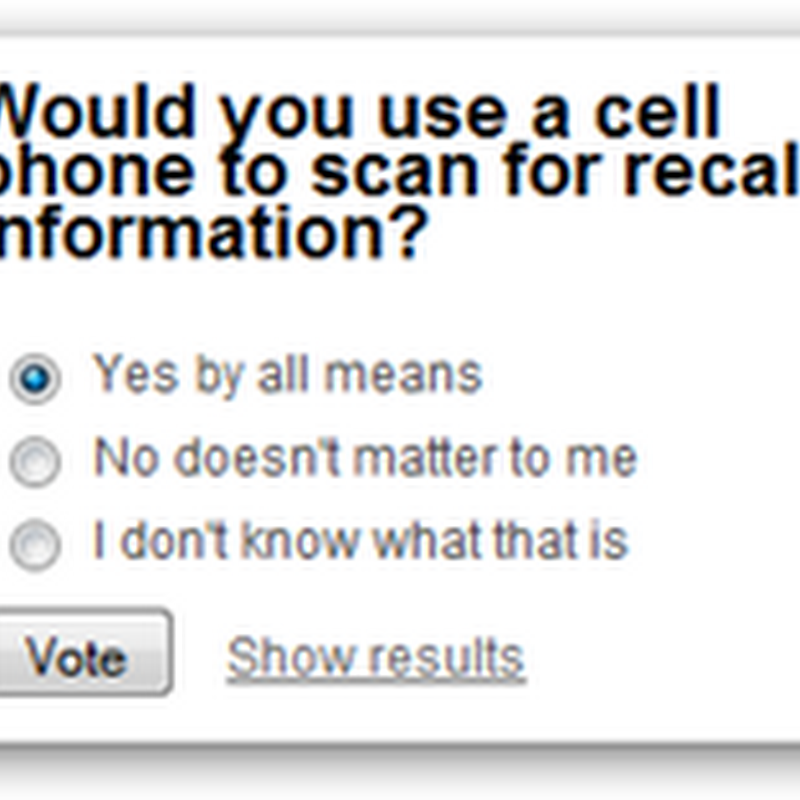
You can read the first comment below from a Mom who had 7 products from J and J who said she sure could have used it to scan the products to check for recalls.  As mentioned below too I have had some readers from the biotech industry reading up on the Tags. 

image

image

This comment talks about how great they work on an IPhone and sees as an enhancement at the hospital.

image

image

This IT person says, yes, combine with RFID at the hospital as they already work with bar coding.

image

image

About halfway through the video you can see where the Microsoft Tag is used to log him in on Surface.  This has really moved along since I played with Surface and the original demo of HealthVault. 

I made up a couple of my own tags on the blog and these two work, one opens up the blog on a mobile browser and the other opens up a simple text document I made up. 

image

One other item to note these can be an avenue to get information in to your PHR with your phone with HealthVault too, so that becomes easier if consumers already use the program for other functions, again so darn easy to use, a no brainer.   Something this simple to use will stand to enhance consumers with the use of Health IT too so we get more “participants” all the way around.  BD 

http://blogs.technet.com/neupertonhealth/

Octomom Sporting New Advertising “Don’t Let Your Dog or Cat Become an Octomom – Spay and Neuter”

I had to post this one, saw it on Twitter earlier and it was too much to pass up.  She’s getting paid for this and this is being done to endorse the People for the Ethical Treatment of Animals.  You can visit their website here for more information. 

I hope this works for the sake of the animals and it is cute and different attention getter too.  BD 

image

The sign, which measures 3 feet by 4 feet, reads, "Don't let your dog or cat become an 'Octomom.' Always spay or neuter. PETA." Alongside the text is an image of a cat nursing a litter of young kittens. In exchange for the advertising placement, Suleman will receive a $5,000 payment from PETA and a month's supply of vegan hot dogs and Boca burgers. Suleman has said that she typically spends $1,000 each month on groceries.

Nadya Suleman, the 34-year-old mother of 14 whose delivery of eight babies conceived through in vitro fertilization last year earned her the nickname "Octomom," has made good on her promise to People for the Ethical Treatment of Animals by unveiling a sign promoting animal birth control in her front yard.

'Octomom' Nadya Suleman unveils spay and neuter sign for PETA on her front lawn | L.A. Unleashed | Los Angeles Times

Ortho-McNeill Pleads Guilty to Illegal Promotion of Topamax – $6.14M Fine And $75.37M For Payment of Civil Allegations

The fine appears small compared to also having to pay $75.37 million to resolve civil allegations related to the false medical claims that were generated due to off label imageillegally promoted use.  

The ‘Doctor For A Day Program” is listed as an area where the promotions occurred as well as sales efforts.  No more physicians accompanying pharma sales representatives you can almost bet.  The drug Topamax was approved by the FDA for epilepsy and not for psychiatric conditions.  Again, doctors can use off label prescribing but it cannot be promoted by a company for conditions other than what the FDA has approved.  BD

Press Release:

Ortho-McNeil Pharmaceutical, LLC Pleads Guilty to Illegal Promotion of Topamax and is Sentenced to Criminal Fine of $6.14 Million

BOSTON—Ortho-McNeil Pharmaceutical LLC, a subsidiary of Johnson & Johnson, pled guilty today in U.S. District Court in Boston to one count of misdemeanor violation of the Food, Drug & Cosmetic Act for illegally promoting its epilepsy drug Topamax for uses that were not approved by the FDA. The company was also sentenced at today’s hearing.

U.S. Attorney Carmen M. Ortiz and Tony West, Assistant Attorney General for the Civil Division of the Department of Justice announced today that Ortho-McNeil was sentenced by U.S. Magistrate-Judge Robert B. Collings to pay a criminal fine of $6.14 million. 

At the plea hearing, the prosecutor told the court that had the case proceeded to trial, the government’s evidence would have proven that Ortho-McNeil used a promotional program called the “Doctor for a Day Program” as a tool to promote its epilepsy drug, Topamax, for uses which had never been approved by the U.S. Food & Drug Administration (FDA). Through the “Doctor for a Day Program,” Ortho-McNeil paid outside physicians to accompany sales representatives on sales calls, including to psychiatrists. On these sales calls, through the Doctor for a Day, Ortho-McNeil promoted Topamax to psychiatrists, including some in Massachusetts, for psychiatric uses. However, Ortho-McNeil had never applied to the FDA for any approval for Topamax to treat any psychiatric disorders and there was no data from any well-controlled clinical trial to demonstrate that Topamax was safe and effective to treat any psychiatric conditions.

“This case should send a strong reminder that the off-label promotion of pharmaceuticals is illegal, whether it is done directly by company employees, or through programs such as the ‘Doctor For A Day Program,’” said U.S. Attorney Carmen M. Ortiz. “We will remain vigilant in our enforcement of these laws regardless of what form the conduct takes,” Ortiz concluded.

An affiliate of Ortho-McNeil called Ortho-McNeil-Janssen Pharmaceuticals Inc. will also pay $75.37 million to resolve civil allegations under the False Claims Act that it illegally promoted Topamax and caused false claims to be submitted to government health care programs for a variety of psychiatric uses that were not medically accepted indications and therefore not covered by those programs. Also as part of the settlement, Ortho-McNeil-Janssen Pharmaceuticals entered into a corporate integrity agreement with the Office of Inspector General of the Department of Health and Human Services.

The criminal case was prosecuted by Assistant U.S. Attorneys Jeremy Sternberg and Susan Winkler of the U.S. Attorney’s Office for the District of Massachusetts and Jill Furman of the Justice Department’s Office of Consumer Litigation. It was investigated by the U.S. Department of Veterans Affairs, Office of Inspector General; Boston Resident Agency, Criminal Investigations Division; the U.S. FDA’s Office of Criminal Investigations, Boston Resident Office; and the FBI’s Boston Field Office.

The civil investigation and settlement was handled by Assistant U.S. Attorney Zachary A. Cunha of the U.S. Attorney’s Office in Massachusetts and Trial Attorney Colin M. Huntley of the Commercial Litigation Branch of the Justice Department’s Civil Division. The Corporate Integrity Agreement was negotiated by the Office of Inspector General for the Department of Health and Human Services. Assistance was provided by the National Association of Medicaid Fraud Control Units and the offices of various state Attorneys General. 

Federal Bureau of Investigation - The Boston Division: Department of Justice Press Release

Red Flags Rule Lawsuit Filed Against the FTC – A Need for Algorithmically Centric Laws so We Have Working Examples, Visuals and Tier Levels Established for Areas of Enforcement and Compliance

Obviously this is not a “one size fits all” law here as practices, hospitals and facilities come in different sizes and flavors today.  What may be normal and standard imageoperating procedure for a large facility, works a hardship on a small office.  One of these days we might get to that understanding and have some “meaningful implementations” with healthcare along with meaningful use.  

Are We Ever Going to Get Some Algorithm Centric Laws Passed for Healthcare!

If you have laws with some digital capabilities added in besides all the huge amounts of text, interpretation sure would be a lot easier and maybe would cut down on some law suits and save some money. 

The entire purpose of the law is not bad, but just not specific enough to accommodate all who fit into different categories here.  The other side of the coin borders on ethics practices too with doctors and patients with the area we call “trust”.  Lawyers are exempt so it does bring up a good question here, why not doctors, or have is the billing and reimbursement side of the healthcare business so strong now that ethics with human trust are out the door? 

In the normal course of business, practices certainly are going to get their information and facts as they will want to bill for reimbursement,  but again I look at the compliance side with the data portions here and this could put a financial strain on some practices and doctors with an additional identity as a “creditor”.  BD   

Medical and osteopathic associations today sued the Federal Trade Commission for covering them under the Red Flags Rule, which will require them to start verifying their patients' true identities before they agree to treat them. Enforcement begins June 1.

The lawsuit seeks to prevent the FTC from defining physicians as "creditors" whenever they do not require payment in full at the time they provide care, and later bill them, according to the brief filed by the American Medical Association and the American Osteopathic Association and the Medical Society of the District of Columbia, the District Court where the case was filed.

The physician groups say that the rule requires them to set up identity theft prevention and detection programs, which aren't necessary, and said the FTC was "arbitrary and capricious" in extending the application of the law to them. Also, the extension of the Red Flag Rule to doctors would do nothing to improve care, the physician groups say.

Mills says that healthcare providers are already bound by the Health Insurance Portability and Accountability Act, which requires patient information be kept confidential, and several other rules. "So why implement another unfunded mandate to keep medical information secure when it is already confidential?" Mills asks.

The AMA and several other health provider groups petitioned the FTC in March for a similar exemption, but were not successful.

According to the lawsuit, complying with the Red Flags Rule "imposes significant burdens on physicians, particularly sole practitioners, and those practicing in small groups."

Lawsuit: Red Flags Rule Violates Doctor/Patient Relationship

New Zealand Healthcare Companies Looking for New Markets with US Investors – 90% of Their GPs Use Electronic Medical Records

New Zealand is a highly motivated Health IT country.  Back in September I posted about one of their companies who has partnered with a US company in Dallas that is imageworking on a external power supply for all your devices.  Have you ever thought of your body as a wireless platform, well neither have I, but there’s work in progress here across the continents. 

Implantable Devices Getting Wireless External Power Supplies – Bionic Man/Woman

I communicate with a physician, Dr. Graham Chiu in New Zealand who recently was featured in a Brunei newspaper with his lecture on “How to Make the Most of Electronic Medical Records”.  We met though another medical records site a few years ago when I was still tinkering around with writing my EMR and thus so have compared some notes along the way. 

Back a few years ago I don’t think either one of us had been able to predict in just a matter of a few short years on how medical records would evolve to where we are today.  Here’s a few lines from the article mentioned above:

Dr Chiu, a rheumatologist consultant from New Zealand, said that if a country wants to invest in the EMR, the first and foremost thing to do is develop an IT infrastructure.
"You need to have basic IT support systems and professional IT personnel who can help. You need to get your physicians to know how to use it too," he said.

Other setbacks include needing a computer literate person to use the EMR because they cannot use it if they do not have the skills. "There is a high requirement for strong technical support. If you don't have support, then the systems won't work and you need back up."
Security considerations also need to be considered as putting data into EMR can be open to people hacking into the database, he added.”

Over a year ago I wrote about Graham using some of the formatting of the Microsoft Common User Interface.  He’s not even writing in a Microsoft language, but yet has worked at using the same screen formatting, again with everything in the same place which can really be helpful for physicians working are more than one facility and using more than one EHR system.image

Common User Interface – EHR Development Work in Progress

“Recently I posted about the Common User Interface from Microsoft and I spoke with a developer in New Zealand, Synapse, who has done some integration work with the interface.  Graham Chiu of Synapse, is a physician as well as a developer so  he is one busy person and nice to see a physician to be able to find the time for software development.” 

New Zealand seeks 'medical tourists'

We have also recently talked about New Zealand and their efforts with medical tourism too and Graham said the hospital was very good place and where he was born.  The long and short of all of this is that there are other countries and very smart companies and people looking to attract US investors on what they feel they can bring to market to improve healthcare. 

Arizona Man Travels to New Zealand for Shoulder Surgery – Cost was 1/6 of US Customary Charges

The group of companies making their way here to the US shows how we need to keep up on our front as well as the global economy is affecting how healthcare technology is used.  You can see here Dr. Halamka from Harvard is on the panel in Boston taking a look at what technologies they have to offer who is a perfect panel expert as he gets out there hands on beyond a proof of concept in almost everything he does.  BD 

BOSTON – Nine healthcare information technology companies from New Zealand are taking a tour of the United States, in hopes of finding new markets for their products and getting a piece of the American healthcare reform pie.

The companies, chosen from 104 that participated in the New Zealand Trade & Enterprise Agency’s year-long “Focus on Health Challenge,” are visiting imageSan Francisco, New York, Washington D.C. and Boston this month. They were selected by a seven-member international panel that included Harvard Medical School’s John Halamka and Jay Srini of Lifewire and SCS Ventures.

“New Zealand has the agility, as a small country, to expedite innovation in a way that larger countries, with multiple rules, regulations and bureaucratic processes, have difficulty doing,” Srini says on the New Zealand Trade & Enterprise Web site.

The companies currently touring the United States are:

  • Airway, which has developed a high-fidelity, virtual reality bronchoscopy simulator designed to teach doctors safe airway management in difficult patients;
  • B2P, a developer of products that enable the quick identification of bacterial contamination at all stages of the supply chain;
  • Comprehensive Health, which has developed GASP (Giving Asthma Support to Patients), a Web-based clinical assessment and decision support tool for asthma management.
  • Emendo, whose CapPlan software solutions are designed to help hospitals plan, monitor and manage unscheduled emergency patients as well as scheduled elective patients;
  • INR Online, which offers an online platform that enables patients to manage their own Warfarin treatment plan from home, while still under close medical supervision;
  • Matakina Technology, a developer of breast image analysis software;
  • Mesynthes, whose Endoform Infection Control is a proprietary, ready-to-use tissue substitute for wound care and soft tissue reconstruction;
  • Pictor, which has developed diagnostic technology for testing blood and other biological samples for a number of disease and infectious agents; and
  • SIMTICS, which has developed a PC-based learning environment designed to integrate a virtual reality simulator with text, 3D interactive anatomy and high-definition video from experts.

New Zealand healthcare companies tour U.S. in search of investors, customers | Healthcare Finance News

Using Health IT Standards for Accurate Queries and Processes Within Electronic Records(Video)

Dr. Halamka makes a great point here on structured data and the challenges of the analytics portion of the puzzle.  Not too long ago I posed about mapping ICD codes to SNOMED and we had some what of the same ridiculous conclusion drawn which we all know is not really good here.

Mapping ICD Codes to SNOMED A Daunting Project – Men Who Smoked While Pregnant

In his example here we have the person using alcohol every day, listen to what he has to say and how the queries run, especially when looking at unstructured data, in other words freehand notes that every doctor adds to a chart.  This is where the human bridge comes in to add “human” sense and accuracy to the algorithms so we get quality information to work with.  Click on the image to link to the video and listen to the example he makes here and you will understand why we need to do this.  BD 

image

In this video from the national HIT conference in Boston, Dr. John Halamka -- CIO of Boston's Beth Israel Deaconess Medical Center; chair of the U.S. Healthcare Information Technology Standards Panel, or HITSP; and co-chair of the HIT Standards Committee -- participates in a roundtable discussion about developing effective health IT standards and policies.

Using health IT standards to address EHR data challenges

Abbott Pays $3.7 Billion for Indian Pharmaceutical Company – Primal Healthcare Does Generics and Outsourcing

As this article states, this will give Abbott 7% of the market share in India.  We are seeing more big pharma moves in the area of purchasing or investing in generic drug companies.  The development of drugs outside the US is different and not as stringent in some areas, thus we are starting to see more companies flourish imageoutside of the US.  The company like many others is not restricted to just manufacturing in India though as they have presences in other countries as well.

As mentioned in previous posts, portfolios are changing quite a bit today and no exception here either as the company also makes glass and invests in real estate, which might come in handy when looking for the next place to build a factory as an example.  BD 

NEW DELHI — Abbott Laboratories said Friday that it would purchase the Indian drug maker Piramal Healthcare for $3.7 billion, increasing its presence in the fast-growing emerging markets and its portfolio of low-priced drugs.

Piramal, based in Mumbai, makes generic and branded drugs in nine plants in India, Britain and Canada, and has the largest sales force in India with more than 6,000 representatives. The company’s net profit increased 52 percent in the last fiscal year, to 4.8 billion rupees ($103 million).

Abbott said Friday that it would pay $2.12 billion in cash upfront for Piramal, and then $400 million annually over the next four years. The deal will add immediately to Abbott’s earnings, executives said.

The pharmaceutical business in emerging markets is profoundly different from the West. Consumers in emerging markets often pay directly for their prescriptions, rather than relying on insurance or government care, and generic drugs are the biggest sellers.

Piramal is part of a conglomerate that also makes glass and invests in real estate. The drug company, which is nearly 50 percent owned by the conglomerate’s founding family, has done 15 acquisitions since 1988, including a deal for the British division of Rhodia and Pfizer’s manufacturing facility in northeast England.

Abbott Buys Indian Drug Maker for $3.7 Billion - NYTimes.com

How Big Are Private Equity Investments in Healthcare – Large Enough to Create a “Non-Profit” Trade Association To Talk About How to “Profit”

This is moving pretty rapidly in healthcare with private equity.  I just posted about a related story a couple days ago, HealthcareofToday, a big grouping of investors adding a medical tourism company to their group.  With such investors too, we get layers, in other words this company is a subsidiary of company B who is a subsidiary of company A, imageso tracking who owns who and where they invest gets a bit complicated. 

SK3 Group, Inc. (A HealthcareofToday Company) Acquires Premiere Medical Travel

Everybody wants you to be aware of your cost today, medically speaking and even form HHS Secretary Mike Leavitt has joined such a company that is in the employer and analytical side of the business with insurance. 

Former HHS Secretary Mike Leavitt Joins Board of Healthcare Financial Services Company

We have the Medical Banking Project that is another group collaborating on the cost, investing and other financial areas of healthcare and again how we make money at doing all of this.  Lobbyists too are encouraged to join this group.

HIMSS acquires Medical Banking Project – Business Intelligence and Banking Algorithms?

This is interesting that it is considered a “non profit” organization when you can almost bet everyone involved who may join is doing so to learn how or is already “making a profit”. 

This could in fact be a new coined paradigm here, “non-profit” place where the “for profits” gather to talk about how to make more money from healthcare and compare those portfolios.  BD 

CHICAGO – A group of private equity firms active in the healthcare industry have formed a non-profit trade association whose purpose is to support the "reputation, knowledge and relationships" of the healthcare private equity community.

The Healthcare Private Equity Association's approximately 40 member firms represent more than $300 billion of capital under management and more than 300 healthcare-focused investment professionals.

As the first sector-focused trade association in private equity, HCPEA anticipates it will represent one of the largest groups of privately-held healthcare businesses in the United States. Its members' approximately 500 healthcare portfolio companies have more than $200 billion of combined revenue and more than 750,000 employees.

Private equity firms establish first healthcare-focused trade association | Healthcare Finance News

Emergency Care Billing Provisions for Health Insurance Take Effect September 23rd – Out Of Network Charges No Longer Subject to Reduced Rates

In the case of an emergency, you may not have time to consult and see what hospital is in network, depending on what the emergency is.  This has been a huge on going battle for years, and especially felt big time in California, lawsuits over this issue too, and a study showed that one of of every six claims for emergency imagedepartment care was denied by 2 large HMOs in California. 

A life saving event at the ER should not force people into bankruptcy and yet it has happened time and time again.  Prime Healthcare was one such example which lead this investigation all over the place.  Patients were receiving balance due bills and basically they just wanted their charges paid, but a lot of folks caught in the middle of all of this and hopefully this is one situation that will go away too. 

California sues Prime Healthcare over balance-billing practices

“Dr. Reddy states Kaiser should pay the bills, not the patient. "We really don't want the patients to pay us," Reddy said. "Patients are the only messengers to the health plans. They should call and say, 'We paid you dearly, how come you don't pay for my emergency care?'

Prime Healthcare almost has no contracts in place at their hospitals but do provide emergency services at their ER Rooms.  When your life is threatened and you need immediate care, the last thing on anyone’s mind is “are they in network”.   In New York there are also related battles going on in regards to being notified by the hospital or the reimbursement will be cut in half and this may go beyond emergency treatment too, but again just more unrest in how we get care sometimes.

United Healthcare to Hospitals – Notify Within 24 Hours of Patient Admittance or Reimbursement Will Be Cut in Half

Perhaps as some of the new provisions of healthcare reform go into place we might begin to see some standardization of charges become more transparent too.  BD

When Kelly Arellanes fell off a horse and suffered a severe head injury in rural Arkansas, medics said she would need to be airlifted immediately to the nearest hospital — 50 miles away in Fort Smith. There, emergency surgery saved her life — but at a cost.

The hospital wasn't in her insurance network, so she and her husband ended up with $20,000 in out-of-pocket expenses that they wouldn't have incurred at their network hospitals 150 miles away in Little Rock.

If the new health law had already been enacted, Arellanes wouldn’t have had such a big emergency bill. Under the law, insurance companies must extend several new protections to patients who receive emergency care. One of the biggest guarantees: insurance companies can no longer pay less for emergency care at “out of network” hospitals — the hospitals with which they don’t have prior financial arrangements.

The new law also bars health plans from requiring prior authorization for emergency services. And it mandates that plans follow the "prudent layperson" rule. For example, if a person goes to the ER with chest pain, but ends up being diagnosed with indigestion, the claim has to be covered because going to the hospital under those circumstances made sense.

Kelly, now 50, has gone through intense rehabilitation and needs tests and checkups every few months. Without her salary and battered by the bills from the emergency room and continuing medical costs, the family burned through their savings, retirement accounts, investments and their daughter's college fund. With medical debts of more than $100,000, they filed for bankruptcy in 2005.

Patients saved from huge ER bills by new law - Health care- msnbc.com

Home Health Monitoring May Significantly Improve Blood Pressure Control - Kaiser Permanente Study

The findings were announced today at this year’s American Heart Association Forum on Quality of Care and Outcomes Research in Cardiovascular Disease and Stroke imagethat patients were more than 50% likely to have their blood pressure control tactics in place.   Some of this is common sense, in the fact that if we “see” and look at the information, we learn.  

The process here made it easy for the patients too without taking additional time for data input, which we all love to hate sometimes with the busy schedules we all have today.  When you make it simple, easy and automated for review, people tend to take an interest, especially if they have any bouts of not feeling well, etc. I know tend to want to do the same, take a look and see what is going on and blood pressure is something we all pretty much look at today and is one of the first items conducted in a visit to the doctor’s office, so this way we can be one step ahead and take a look before rolling up our shirt sleeves at the doctor’s office.

This also shows how the HealthVault PHR was the software vehicle used to collect the information and the interaction between the system at Kaiser Permanente to import the data for analysis for the study results – data working together and patient medications were adjusted according to what was perhaps working and what needed another look, in other words too much, too little, a different medication, and so on.  BD 

Press Release:image

Friday, May 21, 2010, DENVER and REDMOND -- The use of at-home blood pressure monitors and web-based reporting tools that connect clinicians and patients via the Internet appears to significantly improve patients’ ability to manage their high blood pressure to healthy levels, according to research from Kaiser Permanente.

The study, led by Kaiser Permanente Colorado in collaboration with the American Heart Association and Microsoft Corp., involved 348 patients with uncontrolled hypertension, ages 18-85 years. The initial study data was presented today by Kaiser Permanente Colorado researchers at the American Heart Association’s 11th Scientific Forum on Quality of Care and Outcomes Research in Cardiovascular Disease and Stroke.

"Kaiser Permanente Colorado’s Institute for Health Research is committed to studying innovative ways to make care more patient-centered in order to improve quality,” said lead author David Magid, MD, Kaiser Permanente senior scientist. “While more research is necessary, our study suggests that using technology to engage individuals in their care at home may be a better way to help patients achieve a healthy blood pressure.”

As many as 73 million Americans have high blood pressure (hypertension), a leading predictor of heart disease. According to the American Heart Association, approximately 69 percent of people who have a first attack and 77 percent who have a first stroke suffer from elevated blood pressure levels. The participants were randomized to a usual care group or a home monitoring group. All patients had their blood pressure measured in the medical office at the start of the six-month study. The usual care group was managed in a typical model that involved checking blood pressure during office visits.

The home monitoring group used an at-home blood pressure device that uploaded data to the patient’s account in Microsoft HealthVault, a security enhanced, imageWeb-based data storage platform. At the time of entering the study, the participants opted into a Kaiser Permanente application that automatically transferred the home blood pressure readings to Kaiser Permanente’s electronic disease registry.

Kaiser Permanente’s clinical pharmacists used the computerized registry to monitor readings and consulted with patients to adjust their antihypertensive medications based on proven protocols. Connected to HealthVault, patients were able to manage their data using Heart360, a free online tool provided by the American Heart Association.

At the start of the study, the average systolic blood pressure was 149 mm Hg in the home monitoring group and 145 mm Hg in the usual care group. At six months, patients in the home monitoring group were 50 percent more likely to have their blood pressure controlled to healthy levels compared to the usual care group. Similarly, a significantly greater decrease in systolic blood pressure at six months occurred in the home monitoring group (-21 mm Hg) versus the usual care group (-9 mm Hg).

Health experts have long known that the current approach to managing hypertension has its shortcomings. Patients often don’t comply with in-person visits and when they do, the measurements can be inconsistent or inaccurate. In light of these shortcomings, the American Heart Association recently began recommending home monitoring. However, prior research conducted by Dr. Magid found that when patients used home monitoring, but were required to write down and call-in results, blood pressure goals only slightly improved. This latest study provides an additional layer of automation and convenience by directly feeding the readings from the home blood pressure cuff to the patient’s care team via sophisticated health-IT tools.image

“While the in-person doctor-patient relationship will always be a cornerstone of care, one day the use of coordinated, secure health information technologies based at home or work could complement visits in a medical office,” noted coauthor Kari Olson, PharmD, a clinical pharmacy specialist at Kaiser Permanente Colorado.

"Engaging patients with tools that make health management more accessible is a critical step in addressing the alarming growth of chronic diseases and associated increase in costs,” said Peter Neupert, corporate vice president of the Health Solutions Group at Microsoft. "The preliminary results of this clinical trial are significant and demonstrate how cost-effective and flexible technology solutions can encourage patients to be active partners in their health and help decrease their risk for life-threatening, acute care incidents."

This Kaiser Permanente Colorado research is part of a larger effort at Kaiser Permanente to study remote monitoring and connected telehealth to deliver health care at a distance outside of the traditional health care facilities.

About Microsoft HealthVault

Microsoft HealthVault is a personal health application platform designed to put consumers in control of their health information. HealthVault provides a privacy- and security-enhanced foundation on which a broad ecosystem of providers can build innovative health and wellness solutions such as personal health records, disease management, fitness, weight loss and other Web applications. HealthVault can be used to collect and store health information that would otherwise reside in disparate systems and transfer the information between a variety of providers’ health services and systems. It enables the reuse and free flow of interoperable and transportable personal health information.

More information is available at http://www.healthvault.com.

About Microsoft

Founded in 1975, Microsoft (Nasdaq “MSFT”) is the worldwide leader in software, services and solutions

that help people and businesses realize their full potential.

About Kaiser Permanente

Kaiser Permanente is committed to helping shape the future of health care. We are recognized as one of

America's leading health care providers and not-for-profit health plans. Founded in 1945, our mission is to provide high-quality, affordable health care services and to improve the health of our members and the communities we serve. We currently serve 8.6 million members in nine states and the District of Columbia.

Care for members and patients is focused on their total health and guided by their personal physicians, specialists and team of caregivers. Our expert and caring medical teams are empowered and supported by industry-leading technology advances and tools for health promotion, disease prevention, state-of-the art care delivery and world-class chronic disease management. Kaiser Permanente is dedicated to care  innovations, clinical research, health education and the support of community health. For more information, go to: www.kp.org/newscenter.

http://www.kaiserpermanente.org

Big Companies are Finding Out With Employer-Sponsored Insurance It Just Might Be Cheaper to Pay The Fines

As healthcare reform evolves, we are seeing some interesting changes occurring as everyone takes a first, second, and third look at how they are functioning and the cost.  There’s also the internal cost of monitoring the benefit area here too, and with large companies this may involved an entire department that is dedicated to imagethe administration, legalities and so on of employer insurance.  We have also seen a ton of benefits and other incentives offered through the employers too, all of which are not bad, but there are some that leave a lot of questions and some skirt around some real privacy issues too.  

This is not to say that all employers will stop sponsoring health insurance as I think each will look at their own scenarios and perhaps there could be a reduction in where insurance is offered, based on wages, etc. paid to employees too.  In some areas with marketing and incentives it has created perhaps some not so happy areas with technology playing it’s role and here lies one more area for the benefit department to be on top of what is legal, what can be done, etc.  With the passage of GINA, healthcare assessments were thrown a left hook too as a patient’s past family history can no longer be included as the ruling stood to discriminate over a person’s genetic background and when analytics enter the picture, possibly some of this information could be seen as interference or not abiding by all areas of the law. 

GINA Begins November 21st – Medical Histories And Financial Benefits Not Allowed

Under the rules, group health plans, in seeking information for wellness programs, cannot attach a request for family medical history to any penalty or, as is far more common, any benefit.  I have some acquaintances that are happy about the possibility of not having the administrative headache with running their small businesses.  Long and short of all of it is that the process has evolved into an administrative nightmare that nobody likes and it takes time to review all the contracts and look for different options too to make sure they are making a good selection(s).   While we talk about the small employers here, as mentioned in this article there could be some big ones bailing too. 

The whole process of what employee benefit packages were set out to be years ago has evolved way beyond the initial design and with current technologies and economics today perhaps there’s a change in the air.  BD 

Millions of American workers could discover that they no longer have employer-provided health insurance as ObamaCare is phased in. That's because employers are quickly discovering that it may be cheaper to pay fines to the government than to insure workers.

AT&T, Caterpillar, John Deere and Verizon have all made internal calculations, according the House Energy and Commerce Committee, to determine how much could be saved by a) dropping their employer-provided insurance, b) paying a fine of $2,000 per employee, and c) leaving their employees with the option of buying highly-subsidized insurance in the newly created health-insurance exchange.

If this same worker goes to the health-insurance exchange, however, the federal government will pay almost all the premiums, plus reimburse the employee for most out-of-pocket costs. All told, the CBO estimates the total subsidy would be about $19,400—almost $17,000 more than the subsidy for employer-provided insurance.

In general, anyone with a family income of $80,000 or less will get a bigger subsidy in the exchange than the tax subsidy available at work.

John C. Goodman: Goodbye, Employer-Sponsored Insurance - WSJ.com

Ingenix (UnitedHealthCare Subsidiary) Creates Desktop Software for Employers to Analyze Employee Benefit Use To Help Cut Costs – More Analytics and Algorithms To Save That Buck

Are you tired of analytical software yet?  Here’s one more software tool aimed at the employer to help manage their employee benefits as relates to health insurance and what the employees are opting for or what services they could using that are cheaper, like encouraging employees to use generic drugs.  In addition, the press release states there are some modules built in here that go into preventive care.  image When we get all done reading this post, let’s have some fruitful “meaningful use” chat (grin). 

It states there’s a 90 day time to go live which is less than normal data integration.  The product is web based, thus all the data connections to various plans and insurers with employee information, carrier information, etc. has to be connected.  Ingenix industry benchmark information will be provided for full algorithmic comparisons.  The “what if” scenario is there to create to measure risk management and cost assessments.  This is one big aggregation of data program and perhaps in time they may be adding other information in as far as what device companies make cheaper devices too.  Having worked with data it’s just the path that data aggregation takes and with the news yesterday of the acquisition below, I might not be off base here. 

UnitedHealth subsidiary (Ingenix Subsidiary I3) Acquires ChinaGate – Working to Sell Chinese Products Globally

A couple months ago there was the purchase of QualityMetric so you can explain to your employee what their care is economically a risk for you. 

Ingenix (Subsidiary of United Health Care) Buys QualityMetric – More Algorithmic Formulas To Choose From To Identify Future Risk and Cost

QualityMetrics also wants the patient to understand the economic benefit of your score too.  Did I say that correctly, is this about healthcare or the economics of your care?  Granted like every survey and information gathering system there’s good information attained, but how it is used and analyzed for profits is where the problem lies.  Along with all of this there’s a section whereby the algorithmic processes are used to “predict” medical expenses, we don’t want any more surprises here, right?   Don’t forget the company has other areas whereby they make money selling your medication records for underwriting or other purposes. 

Health Insurance Underwriting Practices With Prescription Data – How Does This Work

With all your medication records for sale, perhaps they are being purchased by clinical trial companies as in the link below, with the connection of the I3 division.

i3 An Ingenix Company (United Health Care) Partners With Acurian For Business Intelligence With Clinical Trials Marketing for Investigators

Almost a year ago Ingenix bought this company that collects overpaid medical claims from providers and returns them to insurers. 

UnitedHealth Ingenix's acquiring AIM Healthcare Services in Tennessee

This week their analytics folks determined there’s a risk for seniors who are prescribed some antipsychotics for developing diabetes.  This was their own in house study but in time could there be restrictions on what will be covered in this area for seniors as I have seen things like that happen with using a published report of algorithms to justify decision processes, like what was done on the Oncology study. 

Atypical Antipsychotics Increases Risk of Diabetes Among the Elderly – Study from UnitedHealthcare Analytics

Come to think of it, will these be some of the patients identified on the claim mining project to identify those patients where United has Pay for Performance Benefits available for the Walgreens pharmacies and the YMCA that was announced a couple weeks ago for identifying patients who have the “potential” of developing diabetes?  

UnitedHealthCare To Use Data Mining Algorithms On Claim Data To Look For Those At “Risk” of Developing Diabetes – Walgreens and the YMCA Benefit With Pay for Performance Dollars to Promote and Supply The Tools

If you have read this far, it might be enough to make your head spin with analytics and it appears just to inquire within their own benefit structure you are somewhat cornered into buying something that analyzes all the data they analyze. Remember those pharmacists will be working the employee end of this with the list of those patients who appear to have a “risk” of developing diabetes and probably in time the employers will know who they are too.  If that doesn’t work then they will “sick” the wellness coach out there to “drive” you to better health too “as all the statistics will show” that you are in fact the “evil twin” here with issues.

I still somewhat like the atmospheres of a nice friendly doctor’s office myself without being analyzed to death and not having to worry about a pharmacist trying to “tackle me” with information every time I visit the pharmacy, but all the statistics and pay for performance will lead in that direction as folks will obsess with analytical data as most in every day positions don’t have enough common sense on how to handle some of the decision making processes in front of them on the screen

Decisions will be made though if there is a dollar savings, whether or not this may or may not be the right decision it will be the one made as human nature has taught us to “use those numbers and algorithms” on the screen and you are validated as you have saved money. 

When I see analytics to this degree it makes me think of the need to certify payers with a copy of their algorithms, file them and store a working digital copy so we can see up front what is being done. 

We take the time to certify EHR medical record software to be accurate and ethical, so why not start certifying the algorithms and software used by the payers, a missing link with “machine gun” business intelligence with the payers while the rest of us run around with swords and daggers, so what’s up with that?

My Algorithm Didn’t Do That, Did It? Is There a “Department of Algorithms” in Our Future?

There are also 3rd parties using the same software provided by Ingenix for claim and business intelligence payment processing.  Trizetto is owned by a private equity firm in the UK so all the profits go over there.  CareMore a Medicare Part D company is a good example here in southern California that works with Trizetto and some of the intelligence supplied by Ingenix.   image

TriZetto Group, Owned by Apax Partners-London Based Private Equity Firm, Rolls Out Payer Based PHR

A couple months ago United bought another wellness company that specializes in using biometric monitoring.

UnitedHealth Buys Another Wellness Company – Biometric Monitoring For Data With Employer Contracts

In addition Ingenix provides analytical services to Red Brick who provides employee incentive health care benefits for employees with or without biometric monitoring and Target stores was one of their first contracts.  Biometrics depending on how a system is implemented can have you answering text messages and jumping around perhaps at times where it may not be possible or just flat out a good time while on the job, but your statistics will show how much moving around you have done with those accelerators and devices that report data and you may be called to answer to that as an employee. 

Behavioral Underwriting With Biometric Employee Screenings – Red Brick Secures 3 More Clients

That is just a short summary of some of what I have recently posted here so no wonder they want you to buy one more software program to incorporate all of this and chances are that some of the prior company purchases may have technology incorporated into the TrendView software. If nothing else this post may have presented a summary of some of the many entities the company is entrenched with and an idea of where the money comes from, and I didn’t by any means get them all. 

One final item worth mentioning here too is don’t forget to file for your 15 years of underpayments that occurred by the use of a skewed data base from who else, Ingenix and now employers can further drill down on their healthcare expenses that many are having a hard time paying for today with yet even more analytics.  BD

AMA Has Online Assistance and Forms For Filing Claims For UnitedHealthCare/Ingenix

(BUSINESS WIRE) -- Ingenix is launching Ingenix(R) TrendView(TM), an affordable, easy-to-use desktop solution designed to help companies better understand and manage a critical expense category -- employee medical costs. Ingenix TrendView provides graphical views of consolidated employee benefits usage, enables scenario modeling, and uncovers opportunities for reducing medical costs and improving employee health.

With health care spending projected to grow 6.1 percent annually over the next decade, according to the Centers for Medicare & Medicaid Services, employers face intense pressure to control their medical costs while offering competitive health benefits that will attract and retain the best talent.

Ingenix TrendView is a low-cost, flexible online tool that helps companies address these challenges by converting employee health claims data from multiple sources -- including multiple health plans serving their employees -- into easy-to-understand visual reports. Employers can use these reports to answer a variety of cost-management questions, such as where they might reduce prescription costs by promoting the use of generic versions of brand-name drugs most commonly prescribed to their employees or how they can minimize employee absenteeism through increased use of preventive care.

Employers can also use Ingenix TrendView to perform simple "what if" scenarios to see how changes to their health benefit plans could affect overall medical costs.

"TrendView is revolutionary in its intuitive, visual approach to delivering actionable insights," said Tina Brown-Stevenson, executive vice president, health care innovation and information at Ingenix. "TrendView is simple to install, requires less than two hours of training and gives employers access to accurate, understandable information."

Ingenix TrendView is ideally suited for companies with 2,000 to 10,000 employees that offer multiple health plans, and for health plan management brokers and consultants serving mid-size employers. Because Ingenix TrendView is Web-based, employers need only a PC and an Internet browser to use it.

New Ingenix TrendView Helps Employers Manage Medical Costs - MarketWatch

Biosimilar Drugs – Approval and Process Appears Cloudy On the Biologic License Applications With HealthCare Reform Law and The New “Pathway”

With healthcare reform the purpose of the new pathway was to get drugs out to consumers faster, but in reading here it appears that some biotech companies are imagegoing to continue on with the same methods they have been using for the standard BLA application.  Timing and patent expiration enter into the picture for sure here.

I’m sure we have not heard the last of this one either as there are longer times for the drug to be exclusive and as long as the options are there, it looks like some are staying with the original filing plan.  The laws have been created and now how the FDA will interpret, well, this is maybe another complicated issue that has been tossed onto their already over flowing plate.  To say the least, this is going to be an interesting watch to see how it works and how many pharmaceutical companies actually take advantage of the new “pathway” and if it is cost effective for them to do so. 

Time will tell if we as consumers see the reality of less expensive drugs with biosimilars getting into the hands of our doctors any sooner.  BD 

But boy does it sound like an uphill climb from here. We were struck by the case made by Bob Dormer, a founding partner of the DC law firm Hyman Phelps & McNamara, who argues that--all things considered--sponsors are better off just filing a conventional BLA than bothering with the new "pathway" for biosimilars created by the health care reform law.
Dormer offered the following points:

  • You can file a BLA at any time (rather than waiting at least four years to file the new, abbreviated BLA--and at least 12 years total for the innovator's data exclusivity to expire before marketing is allowed).
  • A BLA filing is secret, preserving possible competitive advantages. An ABLA must be disclosed to the innovator.
  • You can get to court on patent issues quicker, without going through the cumbersome-looking administrative process set up for ABLAs.
  • The data requirements probably won't be very different--and, for the time being at least, the BLA requirements are more predictable.
  • Last but not least, you are entitled to 12 years of exclusivity on approval.
      Dormer's not the only one who feels this way. As we noted in "The Pink Sheet," Novartis' Sandoz division says it will focus on the BLA route, given the drawbacks it perceives with the new pathway; Teva has also opted to file a BLA for one of its biosimilar projects, and says it may do the same in other cases while it waits and sees what FDA comes up with.
      That may be the key point: how will FDA translate the legislation into a regulatory pathway? As the WLF panelists agreed, there are far more questions than answers at this point.
  • The IN VIVO Blog: Follow-On Biologics: Is There a Pathway?

    Man Received Kidney Transplant That Was Infected With Cancer – He Too Developed Cancer

    This by all counts is depressing all the way around to receive a “life saving” organ only to find out that the organ had not undergone sufficient screening and then come down with cancer after the transplant.  Getting a transplant with the hope of a better or longer life is stressful enough. image

    Some cancers are supposed to be safe for transplant but there’s still a lot more to be said and researched on that side of the coin.   The risk associated is small but if the alternative were death, I think most of us would take our chances.  

    What Liew, 37, and his doctors didn't know then was that his new kidney had come with an undiagnosed cancer from its original owner, one that would cause him to die seven months later of uterine cancer.

    The New York City man's autopsy revealed widespread tumors in his lungs, bladder, kidneys and prostate, all consistent with the kind of uterine cancer cells found post-mortem in the donor.

    Kimberly Liew is now suing the doctors at the NYU Medical Center who performed the transplant, claiming that they didn't properly screen the organ, failed to recognize and treat Liew's cancer, and withheld information concerning the donor's cancer from the couple, according to court.

    Although the organ had been cleared for use by the New York Organ Donor Network before the transplant, results from the donor's autopsy later revealed that she suffered from an undiagnosed uterine cancer that had spread to the right ovary and lungs, court papers say.

    Although surgeons can have as many as 20 hours for kidney transplants to organize the transplant and screen the donor for eligibility, the window is fewer than 10 hours for livers and fewer than six for hearts.

    If cancer in a donor went undiagnosed in life, it can be hard to screen for it after the donor has died.

    Uterine Cancer From Kidney Donor Kills New York Man - ABC News

    Congress Members Getting I Pads – Its About Time for Some Technology in Congress

    Has Hell frozen over here?  For those who appear not to be announcing retirement, we have some that are finally looking at an update on the way they handle business…hmmm…maybe like the rest of us have been doing from some time now.  Don’t get too excited here, there’s only 4 so far according to this video. 

    image

    As you can see the project of going wireless is going to take around 3 years for the House!  (yikes) Why so long.  What is funny is the talk about the representatives from California and the one in my area is a big surfer and I don’t mean the internet so I wouldn’t see this one jumping on the bandwagon too soon as our town halls are phone calls out of the 70s in this part of Orange County. 

    House of Representatives Going Wireless – Slated to Take 3 Years And Could Have Some Real Healthcare Management Benefits for Members

    A couple weeks ago though during the Goldman Sachs hearing, I didn’t see anything but big stacks of paper, so the effort to move in this direction and become “participants” is good.  How many will actually use them for as working tools and not just entertainment will remain to be seen and I hope we hear more about this.   Multi tasking will no doubt be in the picture in no time at all.  BD 

    image

    Dr Oz on Friday May 21st – TV Show Focuses on Doctors Who Have Battled Cancer

    The Dr. Oz show is always full of good information we can use anywhere and this show will get personal and upfront with physicians who have battled cancer themselves.  Might be one to tune in and watch.

    Dr. Oz Visits Jimmy Kimmel and Discusses Nutrition, Obesity, Size and Gives a Few Impromptu Exams (Videos)

    As a small side note, if you missed Dr. Oz a couple weeks ago as he was making the rounds in Los Angeles, check out the videos above with Jimmy Kimmel, only Dr. Oz could pull this off and make his point, good humor and information at the same time.  He is also a big fan of electronic medical records and you can read more at the link below.  BD 

    Dr. Oz (as seen on Oprah) Discusses How Electronic Medical Records Improve Care – New York Presbyterian moves forward from pilot program

    image

    Dr. Mehmet Oz is joined by three doctors – Dr. Dara Richardson Heron, Dr. Elizabeth Tanzi and Dr. David Servan-Schreiber – all who have battled cancer and we’re on the show to discuss what we can do to take measures to resist cancer growth in our bodies.

    The show discusses a variety of cancers including breast, skin, brain, mouth and ovarian and here are several tips that were given to take preventative measures and to better your lifestyle:

    • Eat more vegetables; should make up 80% of what you eat
    • Reduce your sugar intake significantly
    • Eat more fatty fish
    • Drink at least 3 cups of green tea a day to sustain defenses against cancer
    • Cut down on red meat
    • Use more turmeric in your foods

    UK Supermarket Chain to Sell Cancer Drugs at Cost – Iressa, Glivec Sutent and More

    This is an extension of US retail chain Wal-Mart in the US – ASDA is owned by Wal-Mart.  The chain is calling for others to follow in their footsteps.  These are treatments that extend lives of cancer victims and are not always available from the NHS. 

    A representative from the company realizes like we have in the US, patients are going into extreme debt to pay for some of these essential drugs and they feel they imageare taking a step in the right direction to make them affordable and the program stands to save consumers hundreds if not thousands of dollars to be able to have affordable access.  Even at the “cost” price the drugs are still costly but any attempt to help make drugs available is certainly welcome.  BD  

    British supermarket chain Asda said on Thursday that it is to sell cancer drugs at cost-price and called on its peers who make massive profits on the treatments to follow suit.

    "The crippling cost of paying privately for cancer treatment has forced many people to spend their savings or even re-mortgage their house to pay for these essential drugs," said John Evans, superintendent pharmacist at Asda.

    "We are the first retailer to recognize this injustice and to do something about it and we are calling on other retailers to follow our lead.

    "It's a small step in the right direction but our permanent 'not for profit' price on cancer treatment drugs makes them more accessible and can save people hundreds if not thousands of pounds."

    Asda said the lung cancer drug Iressa will be sold by the chain for 2,167.71 pounds (2,508 euros, 3,102 dollars) for a pack of 30. Some leading pharmacies are selling the same item for more than 3,250 pounds, it claimed.

    Asda will also sell at cost price the leukaemia drug Glivec, Nexavar for kidney and liver cancer, as well as Sutent for kidney and stomach tumors.

    British supermarket says to sell cancer drugs at cost