Big Pharma Exploring and Moving Data to the Cloud – IT Execs Talk about How It is Being Done

 Amazon, Google and Microsoft are the 3 big players for now in the Cloud market.   For the purpose of this post, we are talking about external clouds.  There is also the internal cloud which is a virtual machine configuration.   The FDA already trusts secure external servers for e-mail communication of clinical trial data, and recently were testing their own internal or private cloud.  image

FDA Testing the Clouds – Disaster Recovery With a Private Cloud

Some of the very interesting comments from the IT Heads from the Pharma companies listed below are really stated best from Lilly, when you look at what they were dealing with.  Scientists were having to wait their turn in line as capacity hit, so scientists were submitting and having to wait until the computing power was available.  Not only this issue, but the cost savings was huge, and to set up local servers and power, it would have taken 12 weeks to set up.  Basically the process is harnessing the power of the internet instead of the local data warehouses and server. 

Also referenced in this article is Michael Naimoli, Industry Solutions Director for Microsoft’s U.S. Health & Life Sciences Group and a former biopharmaceutical scientist who recently sat down and discussed where Microsoft is today and the future of Life Sciences and the Cloud.   

If you want to see what an external cloud looks like, you can read a bit more here and see.  This is the same thing we do with our PHRs, they are stored in the clouds(grin).  BD

Pfizer, Eli Lilly & Co., Johnson & Johnson, and Genentech are among the drugmakers that are piloting into an emerging area of IT services called cloud computing, in which large, consumer-oriented computing firms offer time on their huge and dispersed infrastructures on a pay-as-you-go basis. These drug companies are among the first to gauge the cost- and time-saving pros and the potential management and security cons in this largely uncharted territory.

The concept of cloud computing, based on technologies that already support e-mail and search services, has burst onto the IT scene during the past year. Success stories have already been logged across a range of industries and government organizations, including the White House, which used Google cloud services to handle the questions sent to President Barack Obama during his March 26 town hall meeting. The White House was able to field a peak of 700 e-mail hits per second from 92,934 people submitting 104,073 questions and casting 3,605,984 votes in the 48 hours leading up to the meeting.

And Lilly has demonstrated the viability of cloud computing in pharmaceutical R&D, according to Dave Powers, the firm's associate information consultant for discovery IT. "We were recently able to launch a 64-machine cluster computer working on bioinformatics sequence information, complete the work, and shut it down in 20 minutes," he says, describing a project the firm executed using Amazon's Elastic Compute Cloud (EC2) service. "It cost $6.40. To do that internally—to go from nothing to getting a 64-machine cluster installed and qualified—is a 12-week process."

The result is that for days at a time our clusters are at 100% of capacity. This means there are actually scientists who have work to be done that is literally sitting in a queue." Although exact cost savings are difficult to calculate, they are clearly significant, according to Powers and Kaczorek, as are the time savings.

“Pfizer is beginning to employ cloud computing in other research operations, but there are some downsides, Day says, one being that users must come up with their own programming to coordinate with cloud service providers. Pfizer is working with the BioTeam, a consulting firm, on connecting its work to the cloud. Lilly is using software and services from two suppliers, Cycle Computing and imageRightScale, to access Amazon's network and manage the transfer of data onto and off of the cloud.

Merck, though, has not taken the plunge. The company has amassed a computer center at Seattle-based Rosetta, which it acquired in 2001, with about 10,000 processors and an elaborate Internet-based architecture allowing researchers working on thousands of projects anywhere at Merck to access data from storage. But that situation is about to change.

In the coming months, Merck will be handing the Rosetta computer cluster, and a majority of the data therein, to a nonprofit bioinformatics database called Sage Bionetwork being formed by Schadt and Stephen Friend, senior vice president and oncology franchise head at Merck Research Laboratories. The drug firm, which will have open access to Sage, will consolidate research computing at its new Center of Excellence for Molecular Profiling & Research Informatics, in Boston. Meanwhile, Sage will pursue partnerships with other public and private research centers in order to expand the database. Sage, as it develops, may well incorporate cloud computing, according to Schadt.

In addition to cost and time savings, Mike Naimoli, director of Microsoft's life sciences business in the U.S., says cloud computing may also enable data sharing among drugmakers and contract research organizations and other partners. The company introduced its Azure Services Platform for cloud computing last year.

image

"It is one thing to get the data up there, another to interact and work with it," he says. "That is done through applications hosted on Azure. Microsoft won't build those applications. We provide a framework and fabric that can host the user's applications. Anything users can do locally and adapt to the Internet can run on the cloud."


The New Computing Pioneers | Cover Story | Chemical & Engineering News

Hat Tip:  Fierce Biotech IT

Related Reading:

FDA's Sentinel Initiative Information Revealed – Business Intelligence

Microsoft Seeking Database Customers to Test Synchronizing SQL Server with the Cloud

Genomic analysis in the Amazon Clouds…

Beth Israel Deaconess Medical Center – Using an Internal Cloud for Virtualized Electronic Health Records for Private Physician Groups

This is a Cloud? What a Portable Data Center Looks like…

Grants.Gov website is getting overloaded with traffic – Move to the “Cloud”?

Genentech Embraces Cloud Computing subscription service from Google

Homeland Security Working on a Device that Can Capture Vitals from up to 40 Feet Away – Is the Future of an Emergency Room at the Hospital Too?

Vital signs would come from the carotid artery, the head, chest, abdomen, even a foot.  The technology being used for a device is Laser Doppler Vibrometry.   The device would be connected to a camera and coordinate with algorithms to converts those data points into measurements imageemergency medical responders, so where do I think something like this would end up?  The emergency room might be one of the first places to think about, just imagine everyone’s vitals as soon as you walk in the door!

They hope to have proto-types out for testing this fall.  Again, it is for emergency responses, but what is the ER Room considered to be?  They could end up being a testing ground for the device.  I guess we might need to pair this up with the mind reading technology they are testing and we can get the full package.

Technology that Detects Threats by Reading Your Mind

From a prior post:

When the sensors identify something suspicious they transmit warning data to analysts, who determine whether or not to deter passengers for further questioning. Micro-facial scanning is the next step, yes it scans your face and muscle movement.

It will read your body temperature, heart rate and respiration.  The lab is mobile and can be set up anywhere like a stadium, shopping mall, etc.  Ok do we have privacy issues here, I think so.  If this is programmed to look for terrorists based on an algorithms and settings, what else could it look for?  Programmers know this as the basic code has been written, so it’s just a matter of some new SQL statements to query other factors, and maybe a little hardware update.  image

So, can you see this showing up at hospitals some day?  Scary thought overall.  It was tested in the DC area on just regular “Joes” who had no idea it was there.  

This type of technology has also intrigued DARPA as well.  BD

DARPA working on telepathic communication for soldiers – Must Have Been Talking to Homeland Security

Because time is the most precious resource in a crisis, every second shaved can be a life-saver. With this in mind, the Science and Technology Directorate (S&T) is trying to make a revolutionary leap forward in triage. Why not 30 seconds per person? And why not from far away?

In partnership with the Technical Support Working Group (TSWG), Boeing and Washington University’s School of Medicine, Tech Solutions is developing the Standoff Patient Triage Tool (SPTT), a device that classic Star Trek fans will recognize for its resemblance to the medical diagnostic tool known as the tricorder.

Like the tricorder, SPTT takes key physiological readings necessary to any diagnosis —pulse, body temperature, respiration—from an injured person at a far distance. It’s triage at twenty paces.

When connected to a camera, the vibrometer can measure the velocity and displacement of vibrating objects. An algorithm then converts those data points into measurements emergency medical responders can use in their rapid assessment of a patient’s critical medical conditions.

DHS | Science and Technology (S&T) Snapshots

Related Reading:

DARPA working on telepathic communication for soldiers – Must Have Been Talking to Homeland Security

Technology that Detects Threats by Reading Your Mind

Britain will make foreigners carry RFID identity cards to include health information

Reader Comment: American Cancer Society Circle of Sharing Tool Is a Good Thing

Yesterday I posted about the American Cancer Society Circle of Sharing Tool and had a reader post the comment below, which I think is well worth imagetaking a look at.  There are multitudes of social networks on the web where patients can and are encouraged to share their medical information, information on how they are battling cancer and other diseases, etc. and I warn all to be careful where you post this information or use an alias.  There are others out on the web who mine this information daily on an automated query process, so be careful by all means so you are not putting something out there that could work against you later, we have all heard the stories of people finding information about you on My Space, potential employers check it all the time.

My words of wisdom on this with social networks:  “what goes on the internet, stays on the internet”.  Even if you remove something you posted, it

image

only takes a second for someone else to read, cache it, and repost. 

American Cancer Society Circle of Sharing Tool Unveiled – Microsoft HealthVault

The collaboration with HealthVault appears to be the “private” solution for this issue in the fact that “you” control who and where you share your information, and you can stop sharing it at any time.  As we are all entangled with information overflow, this will help you possibly keep a handle on who gets to see your personal information that you believe might offer value to someone else in the same or similar plight. 

On a related note, one of the HealthVault Partners is also working with Microsoft to create a direct to clinical application, in other words to enable importing information from HealthVault to perhaps an EMR or EHR that might be a tool for software companies in that business to investigate. 

The comment below is from a reader who uses HealthVault and wished it had been around a few years ago when a member of their family was fighting cancer.  In the next few days the ASCO convention will have more additional news released on with the war against cancer too, so be on the lookout.  BD 

“This is so outstanding! I wish it had been around while we were helping my father with his cancer fight. This is good for the patient, as well as for the patient's family and friends. Circle of Sharing is sure to help so many patients and their families. I use MS HealthVault for myself and my family, and this is just another reason why I am happy with my decision. Kudos to the group that developed Circle of Sharing. I have to go share the news with some friends who are currently dealing with cancer.”

The Medical Quack: American Cancer Society Circle of Sharing Tool Unveiled – Microsoft HealthVault

Tenet Announces Joint Venture with MED3OOO – Focus on Electronic Medical Records and Business Intelligence

If you work with a Tenet Hospital, it looks like some possible changes and upgrades could be on the horizon.  Many of the ones I am familiar with haveimage used systems from McKesson, but that’s only a few that I am acquainted with locally.

With the joint venture it appears there may be a handful of options with bringing in the technology of MED3000, which offers an EMR, data warehousing and business intelligence software.  Some facilities also work with Perot Systems for some of their data support as well. 

image

From the Website:

“MED3OOO is national healthcare management and technology company devoted to making health care a better place for physicians to practice and patient to receive care. At MED3OOO, we provide solutions to physician groups, provider networks, and EMS ambulance organizations to allow them to reach their highest levels of operational, financial and clinical outcomes.

MED3OOO empowers physicians, hospital, and health system clients to improve outcomes and results through our advanced knowledge, operations and technology resources.

MED3OOO is focused on performance.  Our systems, services and people are dedicated to increasing revenue, growing medical practices, and ensuring the highest level of cost efficiency.  MED3OOO allows physicians and managers to focus on management, growth, and medicine, while we handle billing and information systems headaches.  Our success in improving practice performance has been achieved through the unique combination of practice management and information technology resource experts working together for the benefit of our clients.

At MED3OOO, we bridge the gap between operational knowledge and technology to help group practices, provider networks and emergency medical services advance. We are focused on the provision of Evidence-Based Management and Evidence-Based Medicine to produce and document improved outcomes to better manage costs and care.”

image

As with every other healthcare vendor, there’s a Stimulus page if you need help in that area.  With the constant changing of both marketing and strategic partners, it may not always be clear on the exact services being offered, but it appears that Allscripts and InteGreat are two solid partners in the group and the mission statement is here. 

 image

 In related Tenet news, Tenet Healthcare Corp. (THC) began a tender offer to purchase as much as $1 billion of senior notes that mature in 2014, part of its efforts to improve its financial flexibility.

As mentioned, MED3000 is a subsidiary of Tenet, so logic would tell me that there could be a large amount of support from Tenet in this direction which could lead to additional cost and care Health IT initiatives coming to a Tenet facility near you soon.  BD 

Tenet Healthcare Corporation (NYSE: THC) today announced the creation of MED3OOO Practice Resources, LLC, a joint venture between MED3OOO, Inc. and a subsidiary of Tenet, which is a 20 percent minority owner. Founded in 1995, MED3OOO, Inc. is a national leader in providing advanced healthcare management and technology to physicians and physician networks. 

The new joint venture will initially focus on providing services to physician practices in the 12 states where Tenet operates, including the majority of employed physicians at Tenet hospitals. MED3OOO Practice Resources will provide health information technology (including practice management systems, electronic health records and personal health records) and management services (including revenue cycle management, group purchasing and comprehensive practice and data management).

Tenet Announces Joint Venture with MED3OOO, Inc.

Related Reading:

Tenet Squeezes a Profit -Admissions Are Down

How Hospitals Go To War – Tenet and HCA – It’s a Hedge War with Insurers

Tenet Healthcare Posts 33 Million 4th Quarter Loss – Charge on Sale of USC Hospitals

Tenet Takes A Hit – Even After selling several hospitals this year
Tenet subsidiary announces closing of Irvine Regional Hospital – Orange County, CA
Tenet Completes Sale of Tarzana Hospital to Providence Health & Services - California
Tenet not renewing lease for Community Hospital – Los Gatos
Providence Health to buy Tarzana Regional Medical Center from Tenet – Prime Healthcare buys the Encino branch
Tenet Sells North Ridge Medical Center for $20M - Florida
Prime Healthcare to acquire three hospitals from Tenet Healthcare - California
Kaiser Permanente members targeted in hospital billing dispute
Tenet Healthcare to sell USC University Hospital

Merck Issues Statement on Singulair Patent Challenge from Teva

image

 Teva has certainly been busy with a number of legal challenges of late, yesterday one filed against Amgen too.  The challenge of intellectual property in the pharmaceutical business is certainly heating up.  Teva produces generic drugs for the most part and states their efforts are coming forth to keep pharmaceuticals affordable.   Merck releases their statement on the issue below.

Teva Suing Amgen Over Intellectual Property Infringement – Sensipar for Kidney Disease

Merck and Teva Go to Court over Singulair Going Generic

“Reexamination is an administrative procedure within the PTO that can be initiated by any person. Essentially, if a potential new issue of invalidity is raised, the PTO will examine this issue and determine whether it should take any further action regarding the current claims of the patent. In the event that the PTO decides further action is warranted, it may amend or revoke the claims in the patent.image

The reexamination is under the direction of the PTO and we cannot speculate how long it will take.  According to the PTO website, the average time it takes the PTO to decide ex parte reexaminations is roughly 24 months.  The PTO's decision can be appealed to the Court of Appeals for the Federal Circuit before it becomes final.

Merck firmly believes that the SINGULAIR patent is valid and enforceable. We do not believe that the reexamination will affect the litigation currently pending in the U.S. between Merck and Teva.”

Merck News Item

Related Reading:
Healthcare Patents – How Long and How Much is Becoming a Challenging Question

Push For Electronic Medical Records Must Slow Down - Howard Schmidt, Former White House Security Czar Advises for Secure Applications

This is in fact a good question, are we rushing to get the money available and perhaps pushing matters a bit to fast.  I post enough security breach imagestories on here that somewhat encourages me to agree with the basis of this.  Having written a bit of code myself, I know what happens when the pressure is on to meet client demands, code that is maybe not ready for prime time.  The focus from a developer is to keep the customer happy with functionality as this is what sells software, but then again there is the security issue and the 2 must go hand in hand.  Speaking only for me, I would address and create the functionality first, and then go back and look for security loopholes that were maybe missed or overlooked.  Ask anyone who writes and we all face this as nobody gets it perfect out of the shoot the first time.  That is why we have “beta” testers to find what the coders missed or did not foresee from their side of being the creator.

This happens all the time as the creator or programmers don’t really know how everything, even with a multitude of testing internally, until it is released for the outside world and customers to start working with it as there are so many variables that come up, things that a group misses as the different areas of focus from a creator and end user differ, not a bad thing, it’s just the way it is and has been for years, and not much will change there either, as it still humans writing code.  The good thing though is once software has gone through some extreme data testing, it gets better.

Today there are many additional variables to work with, Web 2.0 and all the areas need to come together, so now it really is a team effort all the way around.  As with anything in life, when things are rushed, and we are all still human, the margin for errors rises, so thus, this is a good area to ponder, are we perhaps moving a little too fast in some of these areas?  The comparison made on the creation of Vista used is a good analogy, sure it was delayed, but we are better off waiting to have a good product rather than one with too many bugs. 

So again, in the pursuit of creating a medical records system in the US that talks and communicates, are we maybe moving a tad bit to fast in some areas and maybe not addressing security at the highest levels?   BD   

Among the many new provisions the American Recovery and Reinvestment Act (ARRA), is federal funding for electronic medical records. Known as HITECH, the law gives incentives to healthcare organizations to digitize personal health information before 2020. Lost in the rush, however, are the details.

"I look forward to medical records going electronic," said Howard Schmidt, the former White House cybersecurity czar, "but I have a tremendous amount of concern about building a really, really good healthcare infrastructure … and then securing it later." Schmidt spoke with PCWorld at RSA 2009.

Schmidt recalled how people faulted Microsoft, where he worked in the late 1990s, for delaying Windows Vista many times. "We would criticize [Microsoft] if they shipped [Vista] and it had more problems than it does now. So we have to remember that having a timetable is nice," but he cautioned that any timetable should also have some built-in limits and safeguards. That currently isn't the case with HITECH, which awards the bulk of its financial incentives within the first few years.

Push For Electronic Medical Records Must Slow Down, For Security's Sake - Business Center - PC World

Related Reading:
Aetna Web Site Data Breach – Employees and Former Employees Affected

If You Take the Time to Encrypt Medical Information – Don’t Tape the Passwords on the Container or Flash Drive – NHS Security Breach

Update: Hacker demands $10 million – Back Ups Missing too

Hackers breach UC Berkeley Data Base System

The Hackers Could Possibly push the move for PHRs – Medical Records Hacked in Virginia Department of Health Professions computers

Hospital MRI and Other Medical Devices Infected with Conficker Virus – FDA Required 90 Day Notice before Windows Update Patch Could be Applied
Malware attack - Department of Defense

Security tightened over data loss – Flash Drives Can be One of HealthCare’s Biggest Nightmares

Healthcare Workers Sharing Music and they could also be sharing Medical Records and Files

Medical records turn up online – MRecord transcription services

Teva Suing Amgen Over Intellectual Property Infringement – Sensipar for Kidney Disease

Teva wants to sell a generic version of the product and claims Amgen is using it’s patented technology to create Sensipar and now it wants Amgen to pay and halt production.  This is unusual to somewhat see the tables turned here, usually it is the named brand going after a generic. 

This case could end up with some interesting results if Amgen were ordered to stop making the medication, and of course Teva would have to be approved by the FDA to fill the bill by that time I would guess.  In the meantime, perhaps they could reach a financial agreement out of court. 

Teva is also busy bringing Merck to court too over patent issues, a little different in the fact that the legality is being questioned, but one more legal case. 

Merck and Teva Go to Court over Singulair Going Generic

More information on Teva in the related reading below.  BD

And now a word from the Teva Marketing Department:

Teva Pharmaceutical Industries Ltd., the world's largest generic-drug maker, claims in a lawsuit that biotechnology company Amgen Inc. is using its patented invention to make the kidney disease treatment Sensipar. Teva, which is seeking U.S. Food and Drug Administration approval to sell a generic version of the medicine, filed the complaint yesterday in federal court in Philadelphia. It seeks a court order to halt use of its invention, plus cash compensation.

Teva's patent covers a process to prepare cinacalcet, a type of compound used to treat certain complications suffered by people who have kidney disease and are undergoing dialysis. TEVA (Nasdaq) closed at $44.28, down 42 cents.

Teva claims Amgen uses patented invention - The Globe and Mail

Related Reading:

Sun and Teva Announces Approval and Launch of Generic Topamax Tablets

Generic biotech drugs discussed in Congress – Bio Similars

Here Come the Bio Similar Drugs – Bill in Congress to allow Follow Me Provisions for the FDA

Merck Purchases Insmed – Biosimilar Biotech Drug Company

A new source of generic Wellbutrin available soon

Teva Pharmaceutical raided in European Union antitrust probe

Teva mulling $7.5B deal for Barr – Generic Pharmas on the move

Need an RFID System at the Hospital – Plug it in to the Electrical Outlets

The system can co-exist without interrupting other Wi-Fi services, so it appears that “dead zones” would not be an issue.  They also have devices imagethat can be worn and sterilized too.  One the device is plugged in, ensuring you have a live plug too, it immediately becomes a node.  RFID technology is good for keeping track of those 13k stents.  BD  

Awarepoint’s Active RFID technologies and real-time location systems (RTLSs) include its real-time awareness platform, firmware, RFID tags, sensors, and bridges.

Awarepoint’s technologies collect raw sensor data and transform that data into high-value positioning information that can be used to add location awareness to a variety of healthcare and business applications.

Awarepoint Real-time Awareness Solutions are used to map, monitor and measure the status and location of high-value assets, and to provide critical data needed to improve workflows and processes associated with these assets.

Our patented asset and location tracking technology is a proven solution to improve hospital process management. For hospital administrators, Awarepoint’s rapid-impact implementation and fully managed service model supports healthcare business processes, reduces costs and increases revenue, while requiring no maintenance upkeep of hardware or software.

 image

With Awarepoint, hospitals now have effective tools to improve patient safety, patient flow and operational efficiency while preventing theft, reducing equipment rental costs and increasing equipment utilization.

http://www.awarepoint.com/solutions.html

Related Reading:

Long Beach Memorial Medical Center Integrates RFID Automatic Tracking System With Epic Documentation Software

Deaconess hospital in Spokane Will No Longer Serve as Major Trauma Center

Down in Orange County here, I am starting to see some of the same or similar with hospitals, the signs out front are changing.  I recently drove by a hospital owned by Prime Health Care and the sign out front listed the hospital name and underneath, it stated “limited emergency care”.  Prime Healthcare owns a number of hospitals.  Most of the hospitals would no longer be in business if not for the purchase, and on the other hand, Prime does not sign contracts with insurance companies, they just bill them.  The downside to this of course is the balance billing situation we have here in California.  If you want to see where they are in California, use the link below to find out.  BD

Where are the Emergency Rooms in California - How Many hospitals have closed in the last 10 Years

SPOKANE, Wash. -- Deaconess Medical Center in Spokane will stop serving as a major trauma hospital this year but keep its emergency room open for less serious injuries.

The change will leave Providence Sacred Heart Medical Center as the only center in Spokane for people critically wounded in violent crashes, accidents and crimes.  The Spokesman-Review reports both hospital currently share the Level II trauma center designation under a 14-year joint operating agreement.

Deaconess hospital to give up Spokane trauma care

Related Reading:

ER doctors in Orange County sue state over low Medi-Cal payments – California

Hospitals Put Patients' Debt Up for Auction

California and Balance Billing
The battle of the medical bills where nobody but the insurers win
California sues Prime Healthcare over balance-billing practices

Microsoft HealthVault Device Logo Requirements 1.20 Available for Device Vendors

If you have purchased a blood pressure or glucose device, you may have already seen the sticker on the devices, depending on what device you bought.  Devices will need certified drivers to work and the old 1.0 certification is up in June.  BD

Microsoft has released the latest set of requirements associated with its HealthVault Device Logo Program. By no means are the Redmond company's logo initiatives limited to the Windows platform. The HealthVault Device Logo Program is an illustrative example of this, evolved up to version 1.20 with the latest installment provided by the company. Works with Microsoft HealthVault Device Logo Program v1.20 went live on the Download Center on May 26, 2009, and is now up for grabs for all users with a genuine copy of Windows. 


A member of the HealthVault device team enumerated some of the changes delivered by version 1.20: “There have been several packaging requirements added so the user has proper guidance on how to create a HealthVault account, download HealthVault Connection Center, Install the driver, Setup the device, Take a measurement, and upload the data to HealthVault. If the device ships with non-HealthVault software, it must not create a conflict with the HealthVault experience.”

image

Microsoft HealthVault Device Logo Requirements 1.20 Available - For download - Softpedia

Those Who Just Take What the Payers Offer May be Missing Out – Money Left on the Table

This is an issue close to my own heart, as years ago and still even today it’s difficult for me to hopefully get the point across of how important business intelligence software is to mine and drill down to find where you may have been short changed and how to better manage what you have.  Years ago I told many physicians that those who run and use the software (the payers) will take your money and win this game as you are operating imagelike a PC with no anti virus protection, something one could understand.

When you are out there in the field trying to create solutions you see all kinds of things, like the “floating patients” on capitation lists when the EOB would arrive for one simple example.  The only way to say on top is to have the queries run against what you have been provided.  If you don’t, then again there’s money maybe being left on the table.  The payers have created the algorithms, which are complicated that run the payment business.  This makes me once more again refer to a post I made over a year ago:

 The 2 New Hot Words in Healthcare: Algorithms and Whistleblowers

Those 2 items are generating money, maybe not fundamentally correct in all areas, but it is what it is.  Some of these folks have some VC divisions to fund too.  Holding back on electronic records is one issue, but at least on the money side, don’t hold back on business intelligence software, even if it is very basic and simple in concept for a small practice.  BD

BlueCross BlueShield Create New Venture Capital Organization
What does CRM have in Common with EHR/EMRs
Using Business Intelligence to Bring out the Value of EHRs
Business Intelligence Provides Support for Difficult Times – Hospitals

When hospitals and clinics get into disputes with payers regarding underpayment of claims, data can be a very powerful weapon, some financial managers have discovered. Armed with detailed information gathered using contract management systems, some providers are reaping multi-million dollar rewards.

"If you do not have this kind of software to get down to the nitty gritty of a claim getting paid right, payers will run over you all day long," says Brian Marx, director of billing at Radiology Associates of Hollywood (Fla.). "Those who just take what the payers are paying them are missing out."

The 10 hospitals in the Washington-Montana region of Providence Health System reaped an extra $8.3 million in payments last year as a result of its data-backed appeals of underpayments, says Matt Blackmore, manager of contract compliance for the region.

"As long as you let payers get away with short-paying you, they'll continue to do it," says Tim Goodson, managed care director at Plano (Texas) Orthopedic, an 11-physician group practice. "The squeaky wheel gets the grease. If you never send in a grievance and let them know you're watching them, the problems will continue."

Providers load claims payment data from remittance advice into the application as well as the detailed terms of health plan contracts and later updates. Using data mining, the application then offers a comparison of anticipated payments based on the contract vs. actual payment, flagging for providers those claims that appear to have been underpaid.

The business intelligence functions of the software take into account extremely complex payment rules as well as bundled charges to pinpoint anticipated payments for a service provided.   "A lot of practices are just happy to get paid," Goodson adds, stressing that even the smallest clinics can appeal underpayments if they have the right data. "It's amazing how much money is left on the table."

Fighting for Every Dime

Related Reading:

Medical Quack on Fox News this Week - Business Intelligence at the NHS (Video)

Microsoft Business Intelligence in Healthcare – The NHS Solution

Insurance Rescission case to go to Court – Business Intelligence Practices Used to Analyze and Deny Claims and Coverage at Bay
Will Greed lead to Meltdown of the Health System?
Senators Holding Closed Door Sessions Discussing 3 health-insurance plans – Why Are the Doors Closed?
Sutter Hospitals and Ingenix working together on Business Intelligence Software
Is This a Case for a New Law – Illegal Algorithms? How Do You Sleep at Night Rockefeller asked the CEO of United Health Care

Stand Up to Cancer Grants Go to 2 Arizona Doctors and Their Teams to Turn Science Into Cures for Cancer

I have covered a few posts from the Translational Genomics Research Institute (TGen) which is where the grant money is going.  Joshua LaBaer formerly from Harvard heads up the bioscience lab at TGEN.  BD 

PHOENIX (AP) - Two prominent cancer doctors and their team are getting an $18 million grant from a nonprofit group created by scientists and members of the entertainment industry.image

The grant is the largest going to five research teams from the nonprofit Stand Up to Cancer. The goal is to quickly turn scientific discoveries into better care and cures for cancer patients.

The five teams will focus on breast, ovarian, cervical, uterine, brain, lung, rectal, prostate and colon cancers.

The team headed by Dr. Daniel Von Hoff, the physician in chief of the Translational Genomics Research Institute, or TGen, in Phoenix, and Dr. Craig B. Thompson, the director of the University of Pennsylvania's Abramson Cancer Center, will focus on new approaches to treating pancreatic cancer, 1 of the deadliest forms of the disease.

Arizona cancer doctor to get $18 million grant - KSWT: Local News, Weather, Sports Yuma, AZ El Centro Imperial Valley, CA |

Related Reading:

A Progress Report on Stand Up To Cancer
Cancer Research Blog Carnival - Stand Up To Cancer - A Combination of Bloggers Addressing Cancer and Cancer Research
Stand Up To Cancer - Friday September 5, 2008 - 8:00 EST

Contributions for Stand up To Cancer – Tyra Banks Website Adds Support

Cancer Research Blog Carnival - Stand Up To Cancer - A Combination of Bloggers Addressing Cancer and Cancer Research

Harvard director to lead ASU bioscience lab – Shopping for leaders at the “smart” store
Stimulus Bill To Compare Effectiveness of Medical Treatments – But Let’s not Forget Science in the Process
Translational Medicine – Science 2.0

Isotope Update – Nuclear Radiation Treatments Could be Delayed As Other Plants Close Down for Scheduled Maintenance

No doubt there will be shortages if the reactor in Canada ends up being down for 8 months potentially.  It appears that France, Argentina and Belgium will be holding up the show with production as there are only 5 facilities in the world who manufacture the product.   If you are being scheduled for treatments, be aware there could be some delays as two other reactors are scheduled to be pulled off line for scheduled maintenance.  BD

Nuclear medicine specialists say the crunch for patients is coming after it was announced yesterday that the Canadian reactor responsible for one-third of the world's medical isotopes will be shut down for at least three months.

The 51-year-old NRU unit at Chalk River, Ont., will be offline though July when the reactor in the Netherlands, which produces another third of the world's supply, is scheduled to shut down for a month of maintenance.

image

But the South African reactor that is providing additional amounts of the material to make up for the shortage caused by the loss of the NRU will shut down next week for required maintenance.

Chalk River shutdown expected to last three months - The Globe and Mail

Related News:

Isotope Update: Plant Could be Down for Months – Nuclear Medicine Diagnostics Can Expect Delays

Isotope Factory Shut Down again in Canada – Surgeries and Procedures could Face Delays
Medical Isotopes - Will there be enough, treatment delays through October possible at US Hospitals
Rev. Jesse Jackson Touts Medical Isotope Technology
Canada set to order restart of isotope reactor

We Deny Fewer Claims than They Do – Is this Necessary?

Good news for Humana I guess, but when it comes down to the matter at hand, it makes no real difference unless it is YOUR claim, at least that is the way I tend to look at such matters with an industry that continues to struggle with transparency.  BD  image

Pays Claims Fastest with the Fewest Denials in the Health Care Industry LOUISVILLE, Ky.--(Business Wire)-- Humana (NYSE: HUM) has been named the easiest payer for medical providers to do business with in a review of 2008 claims payment data conducted by athenahealth, Inc. and Physician`s Practice magazine. The latest annual PayerView Rankings were released today. athenahealth, a provider of billing and electronic health record services to medical groups, and Physicians Practice, a respected medical journal, conduct the ranking annually as a way of grading insurance companies on their business dealings with physicians. Humana was also the top ranked payer in the inaugural PayerView Rankings in 2005.

Humana Named Top Payer in Annual PayerViewSM Ranking | Reuters

Aetna Web Site Data Breach – Employees and Former Employees Affected

Have you had any spam from Aetna lately?  The article states this is how the breach was identified with individuals complaining.  If you applied for a job with Aetna, might we worth taking a look into this too.  Everyone gets a year of free credit monitoring.  One item of notice is that the site was maintained by an outside vendor, outsourcing?  They are looking into the matter with a forensic investigator.  Today, you really need the services of an outside party too that scans networks by the second that search for this type of activity, but whether or not this was in use is not stated in the article.  i guess the good news here is that it was not highly sensitive patient files at risk.  BD

Insurance company Aetna has contacted 65,000 current and former employees whose Social Security numbers (SSNs) may have been compromised in a Web site data breach.

The job application Web site also held names, phone numbers, e-mail and mailing addresses for up to 450,000 applicants, Aetna spokeswoman Cynthia Michener said. SSNs for those people were not stored on the site, which was maintained by an external vendor.

The company found out about the breach earlier this month when people began receiving spam messages that appeared to come from Aetna and complained to the company, Michener said. The spam purported to be a response to a job inquiry and requested more personal information.

Aetna Contacts 65,000 After Web Site Data Breach - Business Center - PC World

American Cancer Society Circle of Sharing Tool Unveiled – Microsoft HealthVault

Built on Microsoft HealthVault, Circle Of Sharing will allow sharing of medical information and resources from the American Cancer Society with a trusted circle of caregivers, family, and friends .  This is once again a great idea as all the information is centralized in one location.  Myself, I haveimage my mother with her account and it is easy for both of us to access too.  I just happen to have an 84 year old Mom that likes to scan, so even her document entry is not a problem. 

With more medical devices now connecting and adding information, the HealthVault makes it a one stop gathering location for all data.  We could even begin to see devices that are specific to cancer treatment in the future connecting to add data, but again the big feature here is being in control, in other words you are in control by giving access with sharing.  There’s a linked   connection on this blog to get started with a HealthVault account on the right hand side under resources.

As the delivery methods of medications are evolving, so are the devices as I recently wrote about with inhalers for one example, so one day soon, all of this could be incorporated into the HealthVault and who knows we could see cancer treatments delivered in this fashion with inhalers or other types of devices that will be able to supply data, especially in healthcare with cancer treatments, tracking this type of information relative to evaluating how a treatment plan is working will be vital, not only to the patient, but offering such information to clinicians and those conducting clinical trials to evaluate and create real time information. 

Having timely information available in family and friends networks will also help all individuals involved in the education processes taking place and why and how certain treatments have been selected for various types of cancer.  It’s a step in the direction of educating all about treatments and the evolution of personalized medicine and it is shared with who the patient selects.  If you were receiving treatment as an example through the Mayo Clinic for a simple example they too are a HealthVault participant so you could already have one level already established and ready to go.  BD

From the website:

Circle Of Sharing™ works through Microsoft® HealthVault™, a Web tool that allows you to store personal health information for yourself and your family on the Internet. All personal information you enter into the Circle Of Sharing™ is stored in HealthVault™.

To get started, you'll need a HealthVault™ account and a Microsoft Live ID. If you don't have these already, you'll be able to create them on the following screens.

ORLANDO, Fla. — May 29, 2009 —The American Cancer Society today unveiled its Circle Of Sharing™ social web application designed to help cancer patients, their families, and their friends better coordinate support and cancer information as they move through treatment and beyond. Built on Microsoft HealthVault, a privacy and security enhanced platform designed to put individuals in control of their personal health information, Circle Of Sharing enables users to share reliable medical information and resources from the American Cancer Society with a trusted circle of caregivers, family, and friends for a more holistic approach to managing their disease. The Society, the leading voluntary cancer fighting organization and largest non-government funder of cancer research, made the announcement at the annual meeting of the American Society of Clinical Oncologists (ASCO) in Orlando, Florida.

image

“A cancer diagnosis can be very scary and may very well be the hardest thing patients and families have ever faced, and coordinating care and communications can be a real challenge,” said Terry A. Music, chief mission delivery officer at the American Cancer Society. “The American Cancer Society provides a variety of resources to help cancer patients get well, and The Circle Of Sharing tool will provide medical information, support and status updates through the security of HealthVault to help patients and their trusted circle through this challenging time. The Society and Microsoft HealthVault entered into this strategic collaboration to create and deliver a tool that lets people with cancer organize their health information and gain insight to help them make informed health decisions.”

image

The Circle Of Sharing promises to help cancer patients and their support networks better manage their disease and treatment plans. Patients can organize and access critical details about their diagnosis, medications, other treatments, and side effects all in one secure location, making it easier to keep track of this information and share it with healthcare providers as they move through the different phases of their treatment. 

In addition as people record the details of their health, the Circle Of Sharing tailors the articles they receive to match their situation.  Cancer patients receive reliable information from the American Cancer Society specific to their needs to help them manage their care and prepare for what lies ahead. Patients can then share any of this information with members of their circle to help them better understand what the patient is going through.  The tool also allows patients and loved ones to send messages to one another to better coordinate support and care. 

image

“Empowering patients by providing them with information and resources can support them in their fight against cancer,” said David L. Cerino, general manager of the Consumer Health Solutions Group at Microsoft. “We are proud to support the American Cancer Society’s vision of creating an online community that will allow cancer patients to securely connect their health records digitally and decide which data they want to share with loved ones and their health providers in order to best manage their care.”

image

Consumers can learn more about the Circle Of Sharing tool and create accounts at www.cancer.org/circleofsharing

Related Reading:

Washington and Oregon Health Banks – HealthVault and Google Health PHRs Provided

The Smart Inhaler with Blue Tooth and Wireless Capabilities
Personal Health Records – Who’s in the Know and Who has one?

Patients Want Access to all Their Medical Records Survey Says – How to Help the Patients on how to do this

Microsoft and Google Driving for the Same Outcome with Personal Health Records – Could DPHRs Be in the Picture

Quest Diagnostics and Microsoft HealthVault – Connect to get your Lab Results in your PHR

FDA Clears and Certifies MyGlucoHealth to Integrate with Electronic Health Records and Personal Health Records

TELUS in Canada licenses Microsoft HealthVault Personal Health Records

Mayo Clinic and Microsoft HealthVault Partner for Personal Health Records Solution

United Health Care Says Cheaper Efficient Doctors and Reducing Hospital Visits by the Elderly Would Help Reduce the Cost of Healthcare

It is nice to make statements to somehow convey helping but for some reason it’s the lack of transparency with the company that I think tends to give them a tarnished reputation.  Last I looked, Senator Rockefeller was still waiting to see if any of the federal employees were hit with the Ingenix overcharge situation and then the AMA and several states still have filed lawsuits in that area too. 

Basically all I interpret from reading this is just to cut back and not offer healthcare to a portion of our society, which anyone could do, so where’s a solution that could be viewed positively?  After what is currently happening I wonder how the company could effectively position themselves with a legitimate positive posture as there are very little offerings of transparency.  BD 

Is This a Case for a New Law – Illegal Algorithms? How Do You Sleep at Night Rockefeller asked the CEO of United Health Care

image

WASHINGTON - A major health insurer says the government can save big money on health care by sending patients to cheaper, more efficient doctors, reducing hospital visits by the elderly and cutting down on unnecessary care.

Those are among 15 suggestions made Wednesday by UnitedHealth Group Inc., a Minnesota-based health management company that said the proposals could save $540 billion over 10 years, mostly through savings for the government's Medicare insurance program for the elderly.

Some of the proposals could be cast as attempts to ration health care — one of the attack lines some conservatives have been using against emerging proposals from the Democratic-controlled Congress.

Like other groups with an interest in the outcome, UnitedHealth is trying to position itself as a constructive voice in the debate — and avoid becoming a target itself as lawmakers try to reshape the nation's $2.5 trillion health care system.

Health insurer suggests ways to save billions - Health care- msnbc.com

Related Reading:

I’m Stuck with United HealthCare – Would Welcome a Change to Try a Public Health Insurance Option

Insurance CEOs Get Rich While Denying Health Coverage to Children – As Noted in the Senate Hearings
Is This a Case for a New Law – Illegal Algorithms? How Do You Sleep at Night Rockefeller asked the CEO of United Health Care
The Ingenix Inquisition – Hearing Requested by Senator Rockefeller
Andrew Cuomo – You Have to Like This Guy – Healthcare Reform
Prescriptions risk score used to deny health insurance

e-Zassi Marries Innovation and Collaboration in the Medical Device Industry – Interview with Peter Von Dyck

I had the pleasure to speak with the guys over at e-Zassi recently. Bringing a medical device to market is very costly and time intensive process to properly vet. The e-Zassi team has a lot of experience bringing medical devices to market and they thought there must be a better way. So, these guys decided to assist fellow innovators and bring efficiency to the $40+ billon business of medical technology innovation.

If you are a device manufacturer looking to collaborate, this could be the place to cut the search time down for prospective partners, or if you are a software vendor looking to collaborate with a device company the same would hold true. Anyone who reads this blog often enough knows there’s plenty of software and device information floating around.

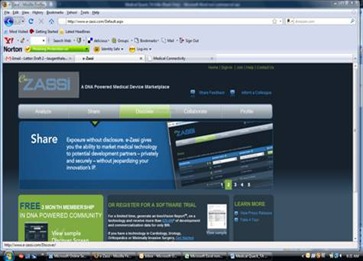
The company is led by CEO Peter Von Dyck, who has about 30 patents to his credit. His vision was a platform that would bring together the latest trends in business intelligence software, Web 2.0 tools, online business networks and B2B communities. The result, after a lot of hard work, is e-Zassi.

clip_image002

I recently sat down with the management team and viewed the system, and came away very impressed with what they had built. The solution brings together every industry sector in an online environment where innovators, academia, investors, doctors, lawyers can share and collaborate on new ideas and most importantly protect their intellectual property while doing so.

When logged on I tried some sample searching projects and the potential partner listing worked quickly. Again, this can save a lot of time versus doing a general browser search and the information is mined for you with your specified targets.

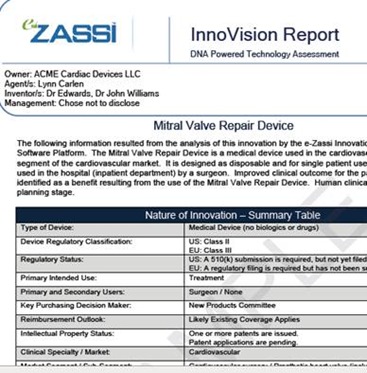
The Innovation Assessment Software especially caught my attention. It lets users calculate the essential clinical and regulatory costs of new technologies that are important when attracting grants, research and development capital -- and in developing strong IP protection. In a process that takes no more than an hour, this data is delivered in a 30 – 40 page InnoVIsion Report. Here is a snapshot of the report:

clip_image004

According to the e-Zassi, the data contained in this report, if generated manually, would cost more than $25,000, require the services of a consultant and take weeks to generate. Once generated, the user can choose either to share the report with other members of the community, or can use the software to manage and triage an inventory of new technologies.

I can see how this is a huge improvement in time and cost efficiencies for venture groups, tech transfer offices and medical device companies.

To see an actual report, click here.

The company has also built an exclusive community ONLY for participants in the global device community and provides an enhanced means to search and identify fellow members for collaboration.

The company has just announced a new promotion to build awareness in the software. For a limited time, software trials can be purchased for $99, along with a three month membership in the community.

__________________________________________________

I have worked with e-Zassi to develop a special Promotional Code just for readers of the The Medical Quack that can be used to get the $99 software trial at no cost. To take advantage of this special offer simply input the

Promotion Code: MedicalQuack, when prompted on the Registration page.

Please take time to visit the site; I think that you’ll be impressed and view the video for a quick summary of how it all works.

www.e-zassi.com