92648

Sanofi Uses Automated Calling System And Emails For Last Round of 1700 Layoffs–Fired by the HR Textbox

Algorithms can be programmed for many uses and this one seem so very impersonal with first a mass email effort that contained instructions to call in to a 800 number and a code.  An automated voice according to this article told those who were going to be laid of to “stop working immediately” with no opportunity to imageask even a question.  This gets pretty cold when the face to face notice is gone but now add on the voice too.  This is stressful and when handled this way it is upsetting as at least the employee might want to have an opportunity to say something. 

Often I refer to those who use email without voice contact as the “text box people” and in time they do forget how to to relate to others face to face.  I see more of this happening every day.  A friend of mine told me she was in an airport sitting in the same area with other travelers when one man was checking his email on his cell phone.  While on the return run from a business trip, he received an email via cell phone that he was fired and promptly bought everyone a drink on his last expenditure on his credit card.  I could see me doing that too as again without an opportunity to ask a question or talk to a human, the frustration and disappointments have to come out some way or another. 

As soon as the dirty work was done, an outsourced company representative showed up to take company car, so again this was pretty much automated leaves humans with a very empty feeling.  The company said there was no other way to handle the layoffs quickly and efficiently.  Technology is good and helpful but the way some folks interpret their methodologies these days leaves a lot to be desired.  I would not like it and I don’t think anyone else would if in the same shoes.  BD 

On Nov. 30, employees at Sanofi-Aventis pharmaceuticals, the world's fourth-biggest drugmaker, received an email from the company wishing them a happy Thanksgiving and telling them to check their email again at 5 a.m. on Tuesday, Dec. 2.

A.R., a Sanofi-Aventis sales representative in California who wished to remain anonymous, as her contract forbids publicly disparaging the company, said she and her coworkers each received one of the two mass emails the company sent out that Tuesday morning. Both emails contained a code, an 800-number and a call time, either 8:00 a.m. or 8:30 a.m. The employees who were instructed to call in at the earlier time were told they could keep their jobs, but the 1,700 employees who called in at 8:30 a.m. weren't so lucky: They were laid off by a voice on the other line that told them to stop working immediately, and had no opportunity for question or comment.

Sanofi-Aventis told its employees they would be paid through Dec. 31, and gave them a modest severance package. A.R., who had only been working at the company a year and a half, received 13 weeks of pay and benefits.

A.R. says a representative from an outside company hired by Sanofi-Aventis to repossess materials came by almost immediately after the layoffs to take back the company car she had been driving.

The automated call seems to have had a ripple effect in at least one employee's life. A.R. says she was so "shaken" by the whole process and is so worried about the possibility of finding employment in this economy that she can't sleep at all, and it's affecting her ability to perform in job interviews.

Drugmaker Lays Off 1,700 Via Conference Call Ahead Of Holidays

PolitiFact's Lie of the Year: 'A Government Takeover of Health Care'

I saw this last evening and thought it was good enough for a post on this healthcare blog and perhaps Wendell Potter may whole heartedly agree with this too.  The site imageis not saying whether or not they endorse healthcare but they are simply stating a government take over it is not true.  The phrase “A government takeover of healthcare” was used so frequently and some of the instances from the article are stated below and you can go to the website of PolitiFacts as they have quite a bit of additional documentation.

The White House Blog has also considered this big news and you can read their comments at the link below:

http://www.whitehouse.gov/blog/2010/12/17/lie-year-health-reform-a-government-takeover-health-care

image

If you read below you can see where it was stated 8 times in the GOP Pledge for America which we know was written by lobbyists who created the original pdf and I guess due to lacking some IT literacy with removing personal information the names of the likes of AIG, Pfizer, BP and more were shown as the authors.

The Properties of an Adobe pdf Document -the GOP on Lack of General Consumer IT Knowledge And Exposes the Input and Authors of the Content–Lobbyists

This is not an opinion but rather a post about the site created and substantiated from other sources and sites.  The article further says the the Democrats were not able to come up a phrase of their own to combat. The site looks at a number of items and you can sort and choose what you want to look up. This one on healthcare being the winner I guess was used so much in speeches and writing it was too numerous for them to even get a full count.

If you want to check any other statements by politicians or what’s in the imagenews this might be a site to check back with and one worth a bookmark.  BD

In the spring of 2009, a Republican strategist settled on a brilliant and powerful attack line for President Barack Obama's ambitious plan to overhaul America's health insurance system. Frank Luntz, a consultant famous for his phraseology, urged GOP leaders to call it a "government takeover."
"Takeovers are like coups," Luntz wrote in a 28-page memo. "They both lead to dictators and a loss of freedom."

By selecting "government takeover' as Lie of the Year, PolitiFact is not making a judgment on whether the health care law is good policy.
The phrase is simply not true.

"If you're going to tell the truth about something as complicated as health care and health care reform, you probably need at least four sentences," said Maggie Mahar, author of Money-Driven Medicine: The Real Reason Health Care Costs So Much. "You can"t do it in four words."
Mahar said the GOP simplification distorted the truth about the plan. "Doctors will not be working for the government. Hospitals will not be owned by the government," she said. "That's what a government takeover of health care would mean, and that's not at all what we"re doing."

PolitiFact sought to count how often the phrase was used in 2010 but found an accurate tally was unfeasible because it had been repeated so frequently in so many places. It was used hundreds of times during the debate over the bill and then revived during the fall campaign. A few numbers:
The phrase appears more than 90 times on Boehner's website, GOPLeader.gov.

It was mentioned eight times in the 48-page Republican campaign platform "A Pledge to America" as part of their plan to "repeal and replace the government takeover of health care."
• The Republican National Committee's website mentions a government takeover of health care more than 200 times.

image

By March of this year, when Obama signed the bill into law, 53 percent of respondents in a Bloomberg poll said they agreed that "the current proposal to overhaul health care amounts to a government takeover.”

image

FactCheck.org, an independent fact-checking group run by the University of Pennsylvania, has debunked it several times, calling it one of the "whoppers" about health care and saying the reform plan is neither "government-run" nor a "government takeover."

In 2010 alone, "government takeover” was mentioned 28 times in the Washington Post, 77 times in Politico and 79 times on CNN. A review of TV transcripts showed "government takeover" was primarily used as a catchy sound bite, not for discussions of policy details.

PolitiFact | PolitiFact's Lie of the Year: 'A government takeover of health care'

Best Buy To Rollout Health and Fitness Products At 600 Stores

It looks like we have a bit of everything here from treadmills to glucose readers to weights.  If you happened to read the news this week their sales numbers were down a bit so what’s the answer, healthcare products.  If you are buying a device, according to the video they will help you connect your computer to the device.  Back in July the Geek Squad in some stores were supplying both hardware and software tech help for Cardiac Science. 

Cardiac Science Partners with Best Buy Geek Squad And/Or IT Experts For Sales, Tech Support and Consulting To Include Medical Record and Device Connectivity

In addition last year they ran a survey to see if consumers would feel comfortable and buy healthcare products at the stores so the answer must have been a solid yes to roll out the products.  BD

A 30-foot-long in-store health and fitness presentation area enables imageconsumers to sample many of these devices before they buy. On display are state-of-the-art heart rate monitoring watches, pedometers, special MP3 players, earbuds, headphones, yoga mats, scales, blood pressure monitors and other products from leading manufacturers such as Gaiam, GoFit, H2O Audio, MIO, Polar, Sportline and Yurbuds. image

Consumers interested in health and fitness products will have access to trained Best Buy Blue Shirts to help them better understand how technology can support their personal wellness. Whether helping to download exercise data to a home computer or creating a customized home gym complete with a treadmill, TV and surround sound, Best Buy’s Blue Shirts are equipped to assist consumers with product demonstrations and in-store interactive tools to show how the technological devices can help maximize their workout routines, track their results and create an environment to stay motivated.

Best Buy Announces Nationwide Rollout Catered to Health and Fitness Products | EON: Enhanced Online News

Oracle Announces Cloud Office 1.0 to Compete with Microsoft and Google

Cloud Office will be integrated with Open Office, which I think you may remember from the Sun days before Oracle acquired them.  It will be a professional product sold to business users and can be hosted by telcos and ISPs.  Open Office still imageexists on it’s own but as I understand the professional version with the cloud will have a strong resemblance.  BD 

This is pretty interesting: Oracle just announced Cloud Office which, surprise surprise, is an office suite based in the cloud, like Google Docs and Microsoft's Docs.com and Office 365.

image

The suite is based on OpenOffice.org, the open source office suite which Oracle owns. It's part of those assets, like Java, that Oracle acquired from SUN and that many people wondered what, if anything, Oracle would do with, because it's not directly related to Oracle's core business of enterprise databases.

Oracle Cloud Office

Prospect Medical Holdings Acquisition by Private Equity Firm in California Complete

The acquisition was first announced back in August of this year.  This is one more private equity group seeing an opportunity to generate enough revenue to turn imagearound and sell in some point in time.  I think healthcare investments today contain a bit of risk as there are ethics questions that go along that other industries do not have, it’s complicated and hopefully we don’t see services at the IPAs or hospitals they own.  We have seen that with some other investments here in southern California.  BD 

Private Equity Firm Buys Prospect Medical–Southern California HMO/Hospital Management Firm

image

Prospect Medical Holdings, Inc. (Nasdaq: PZZ) ("Prospect" or the "Company") today announced that, at the special meeting of stockholders held today, its stockholders approved the adoption of the merger agreement among the Company and entities affiliated with Leonard Green & Partners, L.P., a private equity fund. The merger agreement was first announced by Prospect on August 16, 2010. Approximately 67.6% of the Prospect shares entitled to vote at the special meeting was voted in favor of adoption of the merger agreement. Following the special meeting, the merger was completed.

Pursuant to the merger agreement, each outstanding share of Prospect common stock immediately prior to the completion of the merger has been converted into the right to receive $8.50 in cash per share, without interest and less any applicable withholding taxes, except for shares held by stockholders who perfect appraisal rights in accordance with Delaware law and except for shares held by Ivy Holdings (including shares contributed to Ivy Holdings immediately prior to the merger by certain Prospect stockholders), any subsidiary of Ivy Holdings, Prospect or any subsidiary of Prospect. Prospect will distribute shortly to Prospect stockholders of record transmittal letters with instructions regarding delivery of their shares to the paying agent in exchange for payment of the cash merger consideration. Stockholders who held shares through a bank or broker will not have to take any action to exchange their shares, which will be handled with the paying agent by the bank or broker.

With the closing of the merger, Prospect common stock will no longer trade on the Nasdaq Global Market following today's close and will be delisted.

About Prospect

Prospect owns and operates five community-based hospitals in the greater Los Angeles area, and manages the provision of healthcare services to HMO enrollees in southern California, through its network of specialist and primary care physicians. Prospect's website can be found at www.prospectmedicalholdings.com.

About Leonard Green & Partners, L.P.

Leonard Green & Partners is one of the nation's leading private equity firms with approximately $9 billion in equity commitments under management, was founded in 1989, and has invested in 52 companies with an aggregate value in excess of $44 billion. The firm's investments are focused primarily on North American companies in a range of industries including retail, consumer products, distribution, media, business services and healthcare. Additional information is available at www.leonardgreen.com.

Prospect Medical - Investor Relations - News Release

Partnering For Cures Conference Unveils Prototype Model for Accelerating Cancer Research Using Microsoft HealthVault/Amalga and Data from Nat’l Cancer Institute

HealthVault and Amalga are very commonly used together with Microsoft solutions and the first time this was introduced on a large scale was at Scripps in San Diego and Steve Shihadeh from Microsoft and I had nice chat about it.  With using HealthVault this captures the ability to analyze patient provided data and Amalga will de-identify all the relevant personal information. 

Steve Shihadeh, VP Microsoft Health Solutions Group – The Amalga Software Solution for Aggregating Hospital Information (Interview)

Over the at Life Sciences side Amalga and other solutions from Microsoft also come into play with working with Microsoft and other technologies all gathered together in the sandboxes.  It’s about a year old but you can read further on that topic below relative to the science side of Microsoft and healthcare. 

A Deep Dive into Microsoft Life Sciences Today and in the Future – Interview with Michael Naimoli

Amalga has many current hospitals and healthcare groups across the US utilizing the powerful data aggregating software and it’s very user friendly and is connecting hospitals together to share patient records in the ER.  BD 

This week at the Partnering for Cures conference in NYC, the National Cancer imageInstitute (NCI) and Microsoft presented a prototype which showcases the potential for technology to accelerate cancer research and improve clinical care.  It is hoped that the prototype can help the more than 9 million Americans with cancer who are not currently a part of formalized research help future generations get to more effective treatments more quickly.

The prototype uses Microsoft HealthVault and the Patient Outcomes Data Service (PODS) created by NIC to collect provider and patient-generated data on cancer diagnoses, treatments and outcomes. This could include data from those 9 million people who are not currently represented widely in research.

Using Microsoft Amalga, this data can be made anonymous and aggregated with similar data available in research databases to give a more comprehensive view and enable a more complete analysis of cancer treatment efficacy.

Providers and patients can not only contribute their own information to a more effective treatments, but can view trended data from across similar patient populations, enabling shared decision-making around diagnoses and treatment plans.  This connected approach could also be applied to other disease areas like Parkinson’s, Multiple Sclerosis, etc., creating closer connections and valuable feedback loops across providers, patients and researchers.

If you want to sign up for a HealthVault PHR for your own use, there's always a link here at the Medical Quack and additional information on PHRs with over 300 posts with all kinds of information with a lot of HealthVault coverage. 

Medicare Federal Investigators Getting Algorithms to Analyze And Find Fraud-Good Move as Contractors Efforts Are Weak With Risking Loss Of Transaction Revenue

This is a good deal if in fact it is available for use for the government and not outsourced to contractors as when you read the news, they are not making any waves when handling claims for Medicare in finding fraud as fraudulent claims as well as legitimate claims all add up to transaction fees, the most imageexpensive and profit making area of healthcare today.  The government is really on their own with the FBI and other agencies on catching fraud as to turn in Provider ABC that has ton of claim where many are algorithmically determined to be potential fraud cuts off the transaction money, conflict of interest you might say. 

Medicare Contractor Gets Deal to Monitor Physician Incentive Payments–Same Folks Earlier This Week Admonished For Not Doing Enough for Fraud Prevention?

I mentioned too last year to look at who gets the anti fraud contracts, insurance interests or companies.  They will of course keep their own exposure down but when charging the government for algorithmic transaction fees they want all of those they can get, thus not much gets done.  When you have companies that are using extreme business intelligence algorithms for profit, kind of like what Ingenix does with their fraud prevention and they have another imagedivision that makes profits from transactions, well this is kind of like beating a dead horse and they are good at their formulas if you remember the underpayments that went on for 15 years and all the short pays.  It only took 15 years to catch up with them with playing technology against those who did not have the IT resources to do a check and balance as was finally proven by Cuomo from New York.   This kind of activity in healthcare data systems with claims has been going on for years.  Again they will do fraud prevention very well on their own commercial claims, but when contracted to process for the government, keep those transactions coming in. 

Medicare Fraud Prevention Has Cases Falling Through the Cracks–Looks Who’s Getting the Contracts And Check Out the Algorithms For Their Profitable Business Models

This could be interesting in another way too as they can keep a closer eye on the Medicare contractors as well.  BD 

Federal investigators will begin using sophisticated computerized analysis, much the way credit card companies and banks do, to fight increasingly clever and organized attempts to defraud the nation's health care system, officials said during a visit to Boston today.

Called predictive modeling, the modern tools will allow Medicare officials to spot providers who may be committing fraud in nearly real-time, and before the federal health insurance program for the elderly pays them for their services, said Health and Human Service Secretary Kathleen Sebelius in an interview. Sebelius and other federal health care officials are at UMass Boston today Thursday for a conference on preventing medical fraud.

The agency said it is soliciting proposals from companies to provide predictive modeling for the Medicare program, after testing the method in two pilot programs. Now, Sebelius said, the Centers for Medicare and Medicaid Services generally must track down potential violators after they've been paid, sometimes millions of dollars, and try to recover the
money.

Medicare sharpening tools to detect fraud - White Coat Notes - Boston.com

Life Technologies Debuts Ion Torrent Machine-Cheap Genes at $500 for Single Sequence

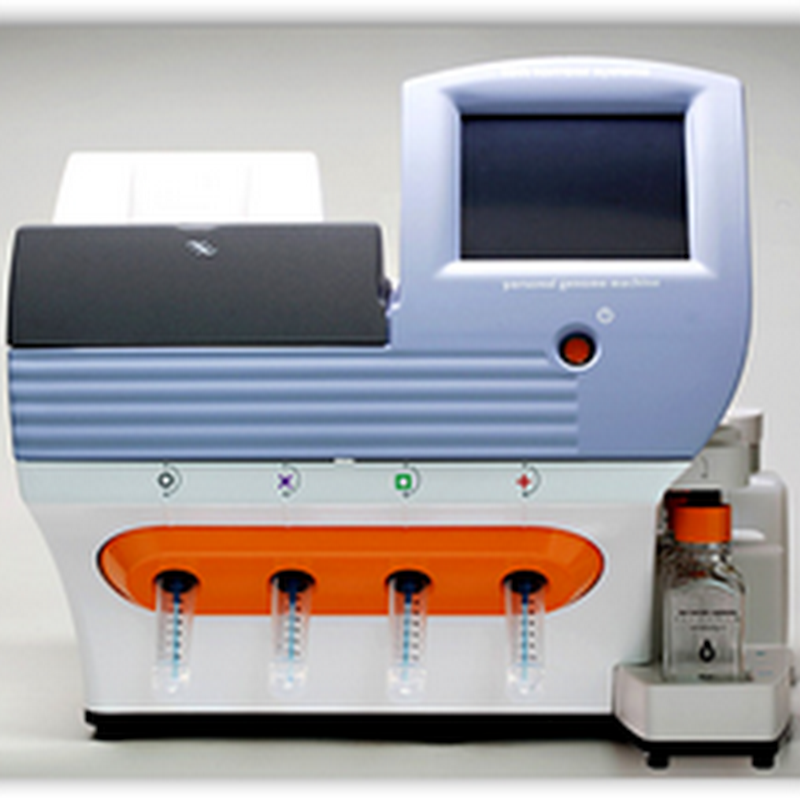
The machine is said to sell for less than 100k, which compared to other products that do the same on the market, a bargain by price.  This is actually a new type of imagemachine based on semi conductor technology and is referred to as a desktop sequencing machine, well I guess it sits there like a printer? 

It may not be the key element to do a full sequence according to this article but there’s lot of other areas to research and speed is also another area to where the technology is slated to excel.  No scanning, cameras or lights required.  BD 

Ion Torrent Chemistry

Life Technologies turned heads four months ago with a bold acquisition of one of the hot startups in the field of faster/cheaper gene sequencing, and now it says the new product is ready for prime time.

The Carlsbad, CA-based company (NASDAQ: LIFE) said today it has started selling what it calls the Ion Personal Genome Machine, the first commercial sequencing machine based on semiconductor technology. The instrument is being shipped to “select sites in North America, Europe and Asia Pacific,” the company says. As promised, the machine’s sticker price is $49,500, about one-tenth the price of today’s most powerful gene sequencing tools.image

Founder Jonathan Rothberg unveiled a prototype machine this spring that is meant to fuse the principles taught by DNA pioneer James Watson with those of computing legend Gordon Moore. By using semiconductor technology to read the individual chemical units of DNA, instead of using traditional fluorescent tags and cameras, Ion Torrent created a desktop sequencing machine that was said to cost about one-tenth the cost of existing instruments—and could perform a single sequencing “run” for about $500 in a couple hours.

Life Technologies Debuts Ion Torrent Machine, Next Big Bet on Fast, Cheap Sequencing | Xconomy

Aetna Drops Albany Medical Center Over Rate Request From Doctors

As the article states here the doctors proposed a rate increase and received a letter cancelling the contract.  One patient comments below on the fact that his imagepremiums went up 15% and he can’t go to the major trauma center hospital in his area and that it is becoming more difficult to find a doctor that takes Aetna in his area.  We all know that Aetna has had a big focus on employer insurance and last year they said themselves that they would be purging non profitable members.  BD

Dec. 16--ALBANY -- Aetna Insurance is dropping the Capital Region's trauma hospital from its network because the company says Albany Medical Center's doctors want too much money.

About 24,000 Aetna customers in the area will be affected by the decision, which will go into effect on Feb. 5.

David Porter , an Aetna member, said he is upset that his wife, Melissa, will have to find new doctors -- and said it is even more galling because Aetna's premium went up this year.

"You raise my premium 15 percent and tell me I can't go to the major hospital in the area?" said Porter, who lives in Earlton and is a heavy machine operator at the LaFarge cement plant. "It's a real hassle to find a doctor that accepts Aetna Insurance."

Insurance News - Aetna To Cut Albany Med Over Rates

In Massachusetts Report from Attorney General States 43 Cents on Each Dollar from Professional Fund Raisers Goes to Charity

This is good to know as I think it is something that we all ponder at times when we donate money to causes.  It just seems a little lopsided as I think we would wish that more would find it’s way to the charity or cause.  As you can see below, the AG recommends to all to ask questions about charity contributions.  BD  image

The Report on Professional Solicitations for Charity in 2009 found that professional solicitors raised nearly $329 million. Of this amount, only $141 million or 43 percent of the amount raised ended up with the charity.  This means that on average, of every dollar that a professional solicitor raised for a charity in 2009, only 43 cents went to the charity.

I encourage donors to give generously, but also remind them to do their homework.  Never hesitate to ask questions about where your money is going and remember that you can send a donation directly to a charity to ensure the largest percentage of your donation goes to the charity’s cause.”

Office of the Attorney General - - Press Release

Centene Anticipates $4.9to $5.1 Billion for Fiscal 2011-Managed Care Firm Revenues Were Over $ 4 Billion in 2009-Algorithms for Profit in Healthcare

Do you wonder where your healthcare dollars go sometimes?  Here’s one example of the huge revenues and profits made from the payer side and all attained with those algorithms for business intelligence primarily.  The company offers centralized finance, information systems, claims processing and medical imagemanagement support functions.  We are talking those huge profit making “transactions” which are algorithms that run to audit, analyze and create reporting systems to find areas of savings and sure they are worth some money but way over powering what most hospitals and providers can afford today, but yet you can see the dollar results.  The client focus includes pharmaceutical groups, managed care organizations and employer groups, where the dollar to attain are located. 

Company ownership includes Fidelity management and research and Vanguard Group.  Efficiencies are seen granted via technology but looks at the profits and dollars it costs companies to get there, again this is the huge area eating up the cost of healthcare that runs in the background and is partially the reasons that patients are ending up running short on the care side as dividends are the number one priority so one more example on how Wall Street is making huge algorithmic profits from using their Algo Men for dollar optimization.  There’s so much profit that the company broke into the Fortune 500 for the first time.  BD 

From the website:

In addition to operating locally-based health plans in the states we serve, Centene offers a full range of healthcare solutions for the rising number of uninsured Americans. We also contract with our health plans and other healthcare and commercial organizations to provide specialty services such as behavioral health, life and health management, managed vision, telehealth, pharmacy benefits management and medication adherence.

image

Centene Corporation (NYSE: CNC) announced today its 2011 financial guidance. The discussions below are in the context of continuing operations and all financial ratios exclude premium taxes.

For its 2011 fiscal year, the Company expects:

  • Premium and Service revenue in the range of $4.9 billion to $5.1 billion.
  • Earnings per diluted share of approximately $2.00 to $2.10.
  • Consolidated Health Benefits Ratio of approximately 84% to 85% which is within our long-term targeted range of 84% to 86%.
  • Consolidated G&A expense ratio in the range of 12.0% to 12.5%.
  • Effective tax rate, excluding non-controlling interest, of approximately 38.5% and diluted shares outstanding of approximately 51.5 million.
  • Days in claims payable between 43 and 48 as we continue to pay claims faster through improvements in our operations. 

Centene anticipates premium and service revenue in the range of $4.9 billion to $5.1 billion for fiscal 2011

Hoag Memorial Hospital Connects 250 Community Physicians To Their HIE Via Medicity (Recent Acquisition By Aetna)

The short time frame connection was created by MediCity, who was just purchased by Aetna health insurance who is on the path looking for healthcare technology companies to increase profits for the overall company.  Providers even without EHRs can now connect and as previously posted, there connections with Allscripts and eClinical Works and a few others will integrate from the hospital to the doctor’s offices. 

Aetna to Acquire Medcity-Health IT Connectivity Vendor-Former CEO Takes Position on Board at Boeing

In addition earlier this year they installed an RFID tracking system in the ER room so as a patient you don’t get lost or misplaced by providers or staff.

Hoag Hospital Installs Hi-Tech Emergency Room Patient Tracking System – Orange County

In other technology news the hospital also plans to offer personal health record integration as as mentioned above with the EHR systems with eClinicalWorks, they already connect with Google Health and HealthVault so patients will have access with both their doctors and the hospital to records shared by either one.  Hoag is taking advantage of the Stark laws with being able to subsidize the purchase of electronic medical records by doctors. 

Hoag Hospital In Orange County HIE Technology Will Include Integration With Microsoft HealthVault and Google Health Personal Health Records

Back in October of 2008 the subsidized percentage with EClinicalWorks was reported to be around 60% so physicians basically get that big discount when purchasing a system. A lot has changed so there could be updates and other vendors in the arena too.

Hoag Hospital Selects eClinicalWorks for Its EHR Subsidy Program- Newport Beach, CA

Just due to where Hoag is located they have financial resources that are quite large compared to other facilities and rooms at the Newport Beach location all have an ocean view.  In August this year they also opened their new facility in Irvine, California. 

Hoag Hospital Irvine Opens–New State of the Art Facility

Novo-Grid is the technology used by Medicity to connect and achieve meaningful use and assure receipt of stimulus funds from the government with meeting eligibility goals.  The Cloud services to aggregate data will be rolled out in a pilot program next year to further compliment the HIE and of course look for some savings with Cloud services.  BD 

NEWPORT BEACH, CA--(Marketwire - December 15, 2010) - Hoag Memorial Hospital Presbyterian, Newport Beach, California, announced today it has connected 250 providers to its health information exchange (HIE) five months after beginning rollout of Medicity's Novo Grid solution. This implementation milestone marks the successful first phase of Hoag's substantial HIE initiative dedicated to optimizing its community's healthcare experience.

"Our health information exchange program is already creating tremendous value within our community," stated Martin Fee, M.D., Chief Medical Information Officer for Hoag. "The ability to share data securely and in real time provides our physicians with views of patient information that will ultimately lead to improved care at a lower cost."

Hoag Memorial Hospital Presbyterian Connects 250 Community Physicians to Its Health Information Exchange in Only Five Months

Stanley Black & Decker Healthcare Solutions Buys InfoLogix

Back in 2008 InfoLogix was busy with some of their own acquisitions and in healthcare it’s not slowing down.  InfoLogix is involved with the wireless and RFID portion of healthcare technologies.  image

InfoLogix Acquires Aware Interweave, Inc.

We all think of Stanley products as tools but they have a healthcare division as well.  They offer a varied line of products and one example is a wristband that will imageopen doors for people and one other product called “wonder management” which tracks patients who may wonder around the hospital so if you get out of your bed, they can find you.  Also interesting is a Tabs Fall Manager to where monitors are placed on chairs, beds, etc. to use a button to call the nurse.  Much of their technology is for monitoring purposes and this seems to be a good fit with RFID technologies and of course when you read the information on the website, this is all designed to save money.  Roll-Check was another interesting device that alerts on patient movements and can alert them to roll over.  BD

HATBORO, PA – InfoLogix, Inc., a provider of enterprise mobility and wireless asset tracking solutions for the healthcare industry, announced Thursday that it will be acquired by Stanley Black & Decker for approximately $61.2 million.image

Stanley's addition of InfoLogix helps bolster its healthcare growth platform, bringing an established provider of mobile workstations and asset tracking solutions into the fold. As part of Stanley Healthcare Solutions, InfoLogix’s business will be well-positioned to extend its reach in healthcare and commercial markets by having access to the resources, brand equity and global supply chain of a S&P 500 company.

InfoLogix acquired by Stanley Black & Decker | Healthcare IT News

CA State Insurance Officials Creating Rules for Insurers to Follow When Describing Benefits On Policy Offerings-Fine Print Fonts Must Be 12 Points Or Greater

You may chuckle a bit as I did on the font, but in reality this is a good thing as even the federal government consumer agencies are tackling this item too.  It’s a way of somewhat hiding full stipulations and information and the practice has been around for years.  Perhaps with the way technology and transparency is moving today we might seen “fine print” coming to an end eventually?  It’s certainly not in place to benefit consumers as we all know.  As stated below the work from this group to make health insurance policies more user friendly will be sent to HHS with the recommendations, with a minimal 12 point font.  BD  image

"It will force the insurance companies to reveal information in a consistent way," says Bonnie Burns, a policy specialist for California Health Advocates, a consumer health advocacy group. "And it should make it easier for people to understand what they're getting and not getting."
Under a little-known provision of the health overhaul law, insurers will be required to provide their benefits information on a standardized chart using the same plain English terms as other companies to help shoppers understand and compare complicated policies. Congress even listed some of the insurance jargon -- including terms such as deductible, preferred provider, excluded services and UCR (usual, customary and reasonable) -- that must be defined in a glossary that will accompany the benefit summary. It directed the National Association of Insurance Commissioners to form a group to develop the materials and specified that the group include state insurance regulators, consumer and patient advocates, insurance companies and health care providers.

The law even forbids the dreaded "fine print," by specifying at least a 12-point type size (larger than typical newsprint). Any exceptions or limitations to coverage must be included along with the out-of-pocket costs that plan members can expect to pay.

After the vote, the materials, which were adopted unanimously by the working group, will be sent to the Department of Health and Human Services and Department of Labor. Those departments will issue regulations spelling out how insurance companies and employers must use the materials. The new system must be in place by March 2012.

State insurance officials to vote on rules for descriptions of health policies - latimes.com

Private Equity Firm Water Street Healthcare Partners Invests With New Century Health Oncology and Cardiology Benefit Manager-Algorithms to Control Cost

Per the press release, this is the fourth proprietary investment in outsourced services for payers in healthcare.  Most of the investments we see today are on the payer side (where the big money is made in healthcare) and focuses on imagealgorithmic formulas designed to contain cost.  Water Street also owns another company called Access MediQuip LLC, which is a management solutions company to control costs and access for surgical implant devices, again running mathematical business intelligence formulas to control cost and not sure how they use their algorithms to control access.  Water Street states their investment capital comes from limited partners which include Goldman Sachs, New York Life for a couple examples.  We certainly need such services but over the years that part of the industry has learned how to feed itself and grow with transactions that are for the most part hidden from what the average consumer reads and sees.  Back in July of this year we had this acquisition.

Private Equity Firm Water Street Healthcare Partners Acquires Medical Specialties Distributors–Subsidiary Watch

When you look at where the big PE investments come from, it’s all about management and using algorithms for running their business and emphasis on payers.  New Century also lists quality physician incentives so here we are with another way of saying pay for performance basically with keeping cost down with “high performance provider networks” so if you are in oncology or cardiology it now appears you need to be a “high performance” doctor.  I’m just reading this from their website. 

Even the lure of profits doesn’t escape former government directors too such as imageMike Leavitt, former HHS director for the US government.  Tony Blair, formerly of the UK has also left the country and is over here in the US involved with using his expertise and contract to help promote private equity firms, so this is like a virus all over with both corporate executives and former government officials working to promote profits, for the companies and themselves. 

From the website:

“New Century Health’s focus on quality driven oncology cost management enables payers to achieve their goals of evidence based care and quantifiable savings. imageGiven that the majority of medical oncology and radiation therapy takes place in outpatient settings, New Century Health uses a provider friendly, web-enabled, pathway driven prior authorization platform that reduces variability in cancer care and facilitates management”.

The “Consulting-Algorithm” business is becoming a big focus today.  When you look at most payer solutions, this is what you get, business intelligence software with consultants who guide companies in how to use it and maximize profits and there’s tons of money being spent today in this area in healthcare and this is one of hidden costs as consumers you may not see as it all works behind the scenes with the analysts that are there to drive profits for investors, and hopefully we get better care too, but the drive for profits is the front runner for sure and you do not have to be brain surgeon to figure that out in the world we live in today.  You can almost bet we have some predictive health behavior modeling going on here as investors want the projections of selected groups to determine what cost is going to occur to provide cardiology and oncology services.  On the insurer side, we have Untied Healthcare for example is running formulas right and left to drill down on cost so again being consultants this is another form of analytic intelligence to work with payers to keep the cost down, more algorithms. 

How much is an healthcare cost algorithm worth today?  It looks like some of them reach into the millions.  BD   

Water Street Healthcare Partners, a strategic private equity firm focused exclusively on health care, announced today that it has made a majority investment in New Century Health. Founded in 2002, New Century Health is a specialty benefit management company focused primarily on oncology and cardiology. In a privately negotiated transaction, Water Street and its co-investors committed to expanding the company’s services to a broader base of payers, providers and patients across the United States.

New Century Health integrates and streamlines all outpatient components of care in the oncology and cardiology specialties. Through its proprietary technology platform, New Century connects health plans, physicians and patients to coordinate care and improve quality in a cost-effective fashion. In the past three years, New Century Health has grown its revenues more than 200 percent.

peHUB » Water Street Healthcare Partners Buys New Century Health

Catholic Hospital in Arizona at Risk of Losing Their Religion

You can watch the video and hear about the letter sent to the parent company of St. Joseph’s hospital (I was born here many years ago) and see what the conflict is all about.  If an agreement is not reached then the hospital would not be able to hold mass or display Catholic items.  From what I understand from reading here this goes back to one case where they had to save a life and terminated a pregnancy.  Hopefully they will work it out.  BD 

PHOENIX - In a letter to the parent company of St. Joseph's Hospital, the Bishop of the Catholic Diocese of Phoenix says he wants more oversight over the hospital to make sure it complies with church teachings.

It comes in the wake of a decision by doctors at St. Joseph's to terminate a pregnancy to save the mother.

"Everyone makes mistakes, whether personal or as an organization," said a man who only wanted to be identified as Christopher. "Everyone makes mistakes."

Valley hospital may lose Catholic status

CDW Healthcare Survey Reveals an EHR Price Tag Could Reach as High as $120K Per Physician

Expected revenue loss as a result of fewer patient encounters expected to be imageone of the primary factors.  I think you can almost talk to any physician who has transitioned and hear this issue, why, the learning curve.  Having written one myself and trained a few doctors, I can vouch for that fact.  There’s a lot of cursing that goes along with it too with just the frustrations of having to learn a software system.   Hands down answer with primary concerns – the cost. 

image

Now here’s something else to look at with this survey, look at the area of security.  30 percent don’t have basic anti virus software protection, yikes and when you can find this for free too, no excuse here for this one, and the part about encrypting wireless networks, yikes again, so be ready for those drive by Google Map guys or much worse than Google.  Actually Google is the least of their worries but last year too we had members of Congress that didn’t password protect their own home networks and then screamed bloody murder upon the chance of some of their data being accidentally collected, go figure.  At home you can’t have the staff do everything for you. 

image

Training is always mandatory and take in as much as one can I always say but again that takes time too, but you will be cursing a lot more if you don’t partake here.

If I were in a practice today though and looking to keep cost down I certainly would be looking at cost effective solutions, like Office Ally or Practice Fusion and not have the problem of having a server at the facility and both are ONC certified so what do you have to lose and they have additional features such as personal health records as well as medical billing packages.  Much of it is free and a few services are very nominal in cost. 

Things change so much today and with all the software updates take the easy to use route and collect your stimulus money and pocket more that way instead of going into the red.  You have to buy hardware anyway so that part is a given and CDW works with many to provide the hardware, networking, etc. part of the puzzle for both on premise and cloud or web based services.  BD 

Press Release and Study Information:image

VERNON HILLS, Ill. – December 13, 2010 CDW Healthcare, part of the public sector subsidiary of CDW LLC, today announced the results of a national survey and six-month study on the complete cost of electronic health record (EHR) adoption for physician practices.  The study found that inclusive of equipment, software, services, training time and potential lost revenue, physician practices may face total EHR adoption costs of $120,000 per physician.  The speed with which a practice fully implements the EHR and shifts to the new, accelerated workflow is critical to reducing the overall cost of adoption.

As the primary driver of cost, physicians expect to see patient encounters decline in the year of adoption by an average of 10 percent.  Following adoption, however, physician practices will also directly benefit from EHR-based workflow improvements that enable them to see more patients. 

“The most important factor in reducing the cost of EHR implementation is accelerating through the workflow changes,” said Bob Rossi, vice president of CDW Healthcare. “The quicker practices can reach full adoption, the quicker they will reach the positive side of the cost curve.”

CDW Healthcare’s “Physician Practice EHR Price Tag” study is based upon a survey of 200 physician practices that have not yet adopted an EHR throughout the United States, secondary research on physician practice workflow and CDW Healthcare’s internal data on EHR solutions.  Overall, physician practices are focused on the costs associated with EHR adoption, citing their primary concerns as hardware/software costs (66 percent), time associated with staff training (52 percent) and workflow readjustment (43 percent).  Although physicians’ top concern is hardware and software, the CDW Healthcare study found that year one expenses associated with that category of cost will likely make up just 12 percent of total EHR adoption costs.

In contrast, CDW Healthcare found that lost revenue will be a far larger drain on physician practices than hardware and software costs.  Physician practices said they expect patient encounters to fall by an average of 10 percent in the first year, equating to a total average revenue loss of more than $100,000 per physician.  Although 10 percent is the survey average, nearly 40 percent of respondents said they expect patient encounters to fall by 25 percent or more in the first year, representing the possibility of greater potential revenue loss.

“Survey responses indicate that physicians are worried about the costs of hardware and software components when they should focus on implementing a complete solution that reduces the time lost to workflow changes,” said Rossi.  “While a typical practice will have a greater investment than expected, the payoff will be significant.”

Critically, while physician practices expect to reduce patient encounters in the year of adoption, an EHR-enhanced workflow will continue to enable more patient encounters in all subsequent years. Some studies have estimated this patient encounter increase to be as high as 30 percent.  Using a more conservative measure of a 15 percent increase in patient encounters, the “Physician Practice EHR Price Tag” study estimates that practices may be able to gain as much as $151,000 per physician per year in new revenue once adoption is complete.

Based upon a snapshot of the average physician practice’s IT infrastructure, CDW Healthcare also identified opportunities to either speed adoption or reduce costs:

Ø Upgrade vs. Replace:  The average age of physician practice workstations is less than three years, with 20 percent less than one year old, CDW Healthcare’s survey found.  As such, practices may achieve better results by upgrading existing workstations with system memory, drive space, backup processes and wireless access points to extend the lifecycle of existing workstation deployments

Ø Protect yourself:  Notably, 30 percent of respondents did not use antivirus software and 34 percent did not use network firewalls.  To protect IT investments and patient information, physician practices moving to EHRs will need to significantly improve their security and business continuity profiles

Ø Train and train some more:  Twenty-two percent of survey respondents indicate that they will spend at least 10 hours training staff to use the new EHR system.  Because training programs are included in the cost of many EHR software packages, practices should take advantage of every training opportunity as a way of accelerating adoption

A full copy of CDW Healthcare’s Physician Practice EHR Price Tag is available at www.cdw.com/EHRPriceTag.  Additional information on CDW Healthcare and its EHR solutions is available at www.CDW.com/CommunIT.

About CDW Healthcare

CDW Healthcare is a leading provider of technology solutions focused exclusively on serving the healthcare marketplace.  Working closely with more than 15,000 healthcare organizations nationwide, its customers range from small rural providers to large integrated delivery networks.  The dedicated healthcare team leverages the expertise of CDW technology specialists and engineers to deliver best-in-class solutions from data center infrastructure through to point of patient care.  The company’s technology specialists and engineers offer expertise in designing customized solutions, while its advanced technology engineers assist customers with the implementation and long-term management of those solutions.  Areas of focus include notebooks, desktops, printers, servers and storage, unified communications, security, wireless, power and cooling, networking, software licensing and mobility solutions.

House Previews In the Press Their Plans and Issues for the Upcoming Year-Here Comes the Folks from the 70s-Abortions on the List

This is actually pretty funny with Rachel Maddow from MSNBC with addressing the items they need to discuss and/or change.  The first up is looking at the Capitol Green program which is currently saving 20% in energy, see the image no further comment really needed.  They just don’t get it…

imageimage

Other items previewed is to cut the funding for NPR, National Public Radio and then imagethere’s the items of the biodegradable forks.  Watch the video for the full explanation on this one.  There’s a few other items included here and this seems kind of crazy. 

The abortion bill rider failed and Joe Pitts told the New York Times he was going to tackle abortions once again, what a waste of time with that one as he has already introduced a bill.  Joe Pitts is soon to be the Health Chairman, yikes what a blast from the past and waste of time we look to be facing.  Stick a FitBit on him so he can enjoy some mobile health technology. 

image

After viewing this video this is a fine time to mention the possibility of members of Congress becoming participants in modern day technology and to entertain getting some Algo Men on board so they can help avoid looking not so smart.   They do have the other GOP members who didn’t fund Cloud computing either in the Senate so it looks like a real meeting of the 70s minds when they talk about the “Green Capitol” too. 

Senate Cuts Cloud Services From Budget That Would Allow for Data Center and IT Infrastructure Consolidation–Back to the 8 Track Tapes Next?

The world is moving around them at a pace they seem almost bliss to recognizing the fact that it exists and to be fair, there are some luddites in the other party too, but the 8 track tape guys are up to set the stage it seems to keep the US from moving forward.  Then of course there is this topic where most just think all this time and expense grows on trees….they just don’t get it…..BD 

Talk of Repealing Healthcare Law–How About the Expense of the IT Infrastructure Algorithm Resets And Costs That Would Be Required?


Visit msnbc.com for breaking news, world news, and news about the economy

http://www.msnbc.msn.com/id/26315908/vp/40691024#40691546